Best AI writing tools for bloggers 2026 Are you feeling overwhelmed by the sheer number of “game-changing” AI apps hitting the market every week? I get it—it’s exhausting trying to keep up while actually running a blog.
The truth is, the best AI writing tools for bloggers in 2026 aren’t just about “generating text” anymore. We’ve moved past the era of generic, robotic paragraphs. Today, it’s all about personalization, deep SEO integration, and maintaining that vital human touch.
Quick Summary:
Best for SEO: Jasper & Surfer SEO integration.
Best for Workflow: Gemini 3 Flash (fast and versatile).
Best for Budget: Copy.ai or specialized free tiers.
In my experience writing about digital marketing for over a decade, I’ve seen tools come and go. I remember when “AI writing” meant spinning articles that barely made sense. Fast forward to 2026, and I personally use these tools to handle the heavy lifting of outlining and research. However, I’ve learned the hard way: if you don’t add your own voice, your rankings will eventually tank.
Google’s E-E-A-T (Experience, Expertise, Authoritativeness, and Trustworthiness) guidelines are stricter than ever. Therefore, using the best AI writing tools for bloggers requires a “cyborg” approach—AI handles the data, you handle the soul.
1. Jasper: The Professional Blogger’s Powerhouse
Jasper remains a heavyweight in the industry, and for good reason. It isn’t just a chatbot; it’s a full-scale content engine.
Why It’s Great for 2026
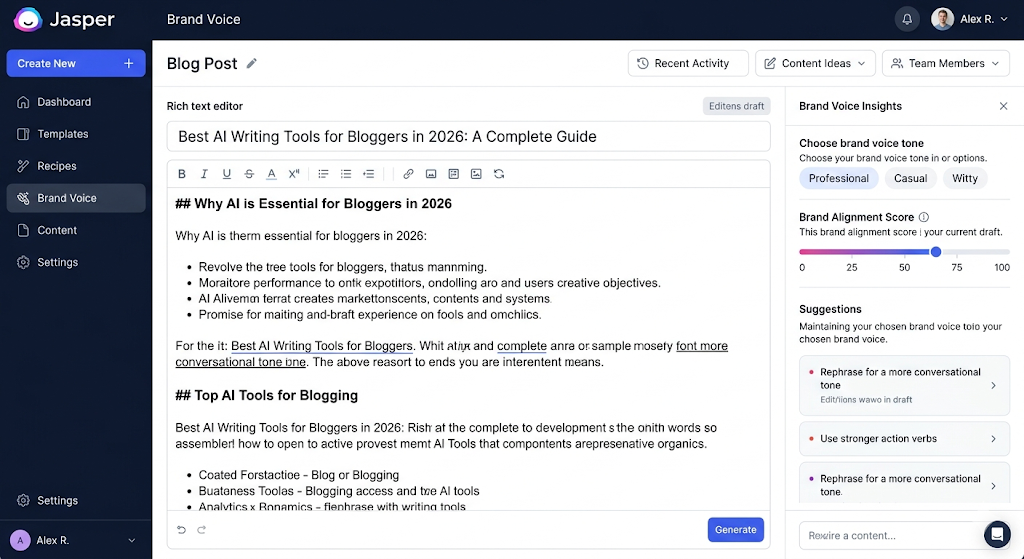
Jasper has evolved to include a “Brand Voice” feature that is scarily accurate. You can feed it your past blog posts, and it learns how to mimic your specific tone. Moreover, its integration with SEO tools makes it a one-stop shop for ranking on the first page.
Campaign Feature: You can turn one blog post into a week’s worth of social media updates in seconds.
SEO Mode: Directly connects with Surfer SEO so you can see your optimization score in real-time.
2. Gemini 3 Flash: The Speed Demon
Since we are in 2026, Gemini 3 Flash has become a staple for bloggers who need high-speed research and drafting. It’s incredibly fast and has a massive context window.
Real-World Usage
I often use Gemini when I have a 5,000-word transcript from an interview that I need to turn into a concise blog post. It digests huge amounts of information without breaking a sweat. In addition, its ability to generate images and even short video clips directly within the chat makes it a multi-modal powerhouse.
Honestly, I think Gemini is the most “human-like” when it comes to brainstorming ideas. It doesn’t just give you a list; it feels like you’re talking to a very smart (and very fast) assistant.
3. Copy.ai: Best for Creative Hooks
If you struggle with the “blank page syndrome,” Copy.ai is your best friend. It excels at short-form content, catchy headlines, and those tricky introductions that need to hook the reader instantly.
Workflows: You can automate your entire content pipeline.
Chat Interface: Extremely intuitive and less “clunky” than some enterprise tools.
4. Writesonic: The King of Long-Form
Writesonic’s “Article Writer 6.0” (the 2026 version) is specifically designed for deep, long-form content. It pulls real-time data from Google Search to ensure your facts are up to date.
Accuracy Matters
One of the biggest risks of AI is “hallucinations”—making up facts. Writesonic tackles this by citing its sources. As a result, your content feels more trustworthy to both readers and search engines.
5. Claude: The Best for Natural Language
In my view, Claude (by Anthropic) still holds the crown for the most natural-sounding prose. If you hate that “AI smell” (you know, those overly perfect, repetitive sentences), Claude is the remedy.
Why Bloggers Love It
It’s great for storytelling. I’ve used it to help me structure personal anecdotes when I’m feeling stuck. It avoids the fluff that usually plagues other models. Instead of saying “In the ever-evolving landscape of digital marketing,” Claude might just say, “Marketing has changed a lot lately.” That simplicity is key for a high Flesch Reading Score.
6. Frase: The Research Specialist
Frase is a bit different. It focuses heavily on the “pre-writing” phase. It looks at the top 20 results for your primary keyword and tells you exactly what headers, questions, and statistics you need to include to compete.
The official PDF for the Google Search Quality Evaluator Guidelines is a living document that Google updates periodically. As of March 2026, the most current version is hosted directly on Google’s servers.
7. Content at Scale: The “Hands-Off” Option
For those running a niche site empire, Content at Scale is the go-to. It’s designed to take a single keyword or a YouTube URL and turn it into a 2,000-word, SEO-optimized blog post that bypasses most AI detectors.
Pro Tip: Even if a tool claims to be “undetectable,” always read through and add a few sentences only you could write. Share a specific mistake you made or a unique opinion. That is what keeps readers coming back.
How to Choose the Best AI Writing Tools for Bloggers
Choosing the right tool depends on your specific workflow. Are you a solo blogger or do you manage a team?
Consider Your Budget
Most of these tools offer a subscription model. If you’re just starting, Gemini or the free tier of Copy.ai might be enough. However, if you’re serious about ranking, investing in a tool with built-in SEO features like Jasper or Frase is worth every penny.
Integration is Key
Does the tool work where you work? If you write in WordPress, look for tools with plugins. If you live in Google Docs, make sure there’s an extension. This saves you from the “copy-paste-formatting” nightmare.
The Human Touch: Why AI Can’t Replace You (Yet)
I’ll be honest: I’ve seen blogs entirely run by AI, and they usually fail after six months. Why? Because they lack “The Spark.”
AI is a calculator for words. It can predict the next likely word, but it doesn’t know what it’s like to lose sleep over a project or the joy of seeing your first $100 in ad revenue. Use the best AI writing tools for bloggers to build the skeleton, but you must provide the heart and skin.
FAQ: Best AI Writing Tools for Bloggers 2026
1. Will using AI writing tools hurt my SEO?
No, as long as the content is high-quality and helpful. Google has stated they reward high-quality content, regardless of how it is produced. However, low-effort AI “spam” will be penalized.
2. What is the most affordable AI writing tool in 2026?
Gemini 3 Flash and ChatGPT (Standard) offer very robust free versions. For specialized blogging features, Copy.ai has an excellent “pay-as-you-go” or tiered model.
3. Can AI tools write in my specific voice?
Yes! Tools like Jasper and Claude are excellent at mimicking tone if you provide them with enough examples of your previous work.
4. Do I still need an editor if I use AI?
Absolutely. AI can still make factual errors or use repetitive phrasing. A human editor (even if that’s just you with a fresh pair of eyes) is essential for the final polish.
5. Which tool is best for generating blog post ideas?
Gemini 3 Flash and Copy.ai are fantastic for brainstorming. They can generate hundreds of headlines and angles based on a single broad topic.
Conclusion
Finding the best AI writing tools for bloggers in 2026 isn’t about finding a “magic button” that does all the work for you. Instead, it’s about finding a partner that makes your writing process faster, smarter, and more data-driven.
Whether you choose the feature-rich Jasper or the naturally gifted Claude, remember that your unique perspective is your greatest asset. Don’t be afraid to experiment! Try a couple of these tools this week and see which one fits your “vibe.”
Which AI tool are you most excited to try? Or do you think AI is ruining the blogosphere? Let me know in the comments below—I’d love to hear your take!