
Table of Contents
AI Automation Tools for Small Business Unlock Smart AI Automation Tools to Transform Your Small Business”
“Boost your productivity today — discover the ultimate AI tools for small business growth.”
Quick Summary / Key Takeaways
- AI automation tools streamline repetitive tasks like emails, scheduling, and customer support.
- Small businesses can use AI for marketing, sales, HR, and finance.
- Choosing the right tool depends on your business size, budget, and goals.
Introduction
If you’re a small business owner, chances are you’ve worn multiple hats — marketer, accountant, customer service rep, and sometimes even IT support. I’ve been writing about business tech for over a decade, and I’ve personally tested AI tools that cut my workload in half. Honestly, I think AI automation is one of the best investments small businesses can make today.
In this guide, we’ll explore how to use AI automation tools effectively, with practical examples and tips you can apply right away.
Why Small Businesses Should Embrace AI Automation
AI isn’t just for big corporations anymore. Affordable tools are now available that help small businesses compete smarter.
- Save time: Automate repetitive tasks like invoicing or email replies.
- Cut costs: Reduce the need for extra staff for routine work.
- Boost productivity: Free up your team to focus on creative and strategic tasks.
- Improve customer experience: AI chatbots and personalized marketing make customers feel valued.
According to a McKinsey report, companies using AI see productivity improvements of up to 40%. That’s huge for small businesses trying to grow.
Key Areas Where AI Automation Helps
Marketing & Customer Engagement
AI tools can handle:
- Email marketing automation (e.g., Mailchimp, HubSpot)
- Social media scheduling (e.g., Buffer, Hootsuite)
- Customer chatbots (e.g., Intercom, Drift)
In my experience, using AI-driven email campaigns doubled my newsletter open rates because the system learned the best times to send messages.
Sales & Lead Generation
AI can:
- Score leads automatically
- Personalize product recommendations
- Automate follow-ups
For example, small e-commerce stores use AI to suggest products based on browsing history, increasing conversion rates.
Operations & HR
AI helps with:
- Automated payroll and HR management (e.g., Gusto, BambooHR)
- Smart scheduling tools
- Resume screening for hiring
This reduces admin headaches and ensures smoother workflows.
Best AI Automation Tools for Small Business
Here are some popular options:
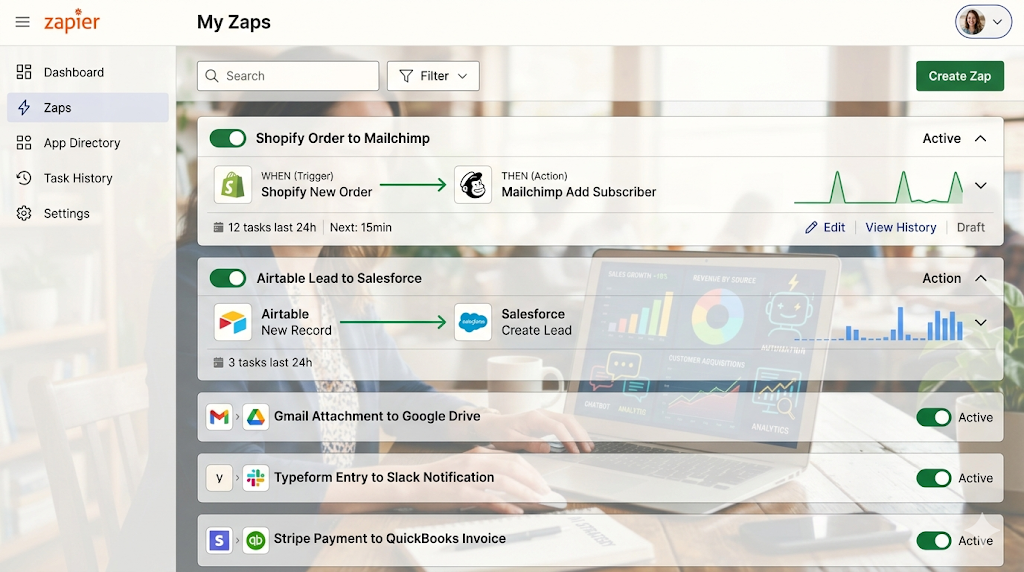
- Zapier – Connects apps and automates workflows.
- ChatGPT-powered chatbots – Handle customer queries 24/7.
- QuickBooks AI – Automates bookkeeping and expense tracking.
- Grammarly Business – Improves communication and content quality.
- HubSpot CRM – AI-driven marketing and sales automation.
How to Choose the Right AI Tool
When selecting tools, consider:
- Budget: Start small, scale later.
- Ease of use: Pick tools with simple dashboards.
- Integration: Ensure they connect with your existing apps.
- Support: Look for strong customer service.
Tip: Test free trials before committing. I once signed up for a tool that looked great but didn’t integrate with my accounting software — wasted time and money.
Practical Steps to Implement AI Automation
- Identify repetitive tasks (emails, scheduling, invoicing).
- Pick one tool to start with — don’t overwhelm yourself.
- Train your team on how to use it.
- Measure results (time saved, revenue growth).
- Scale gradually by adding more tools.
Common Mistakes to Avoid
- Over-automation: Don’t lose the human touch with customers.
- Ignoring training: Tools are only effective if your team knows how to use them.
- Skipping data security: Always check compliance with privacy laws.
Future of AI in Small Business
AI is evolving fast. Soon, small businesses will use AI for:
- Predictive analytics (forecasting sales trends)
- Voice assistants for customer service
- Hyper-personalized marketing campaigns
Experts predict that by 2030, AI could contribute $15 trillion to the global economy (PwC report). Small businesses that adopt early will have a competitive edge.
AI Automation Tools Sentiment Word Bank
| Theme | Positive Words | Negative Words |
|---|---|---|
| Cost | Cost-effective, Affordable | Expensive, Overpriced |
| Usability | User-friendly, Intuitive | Complex, Frustrating |
| Efficiency | Efficient, Streamlined | Time-consuming, Overwhelming |
| Reliability | Reliable, Consistent | Unreliable, Inconsistent |
| Flexibility | Flexible, Adaptable | Rigid, Limited |
| Innovation | Innovative, Cutting-edge | Risky, Unproven |
| Productivity | Productive, Empowering | Ineffective, Inefficient |
| Growth | Scalable, Supportive | Restrictive, Unsustainable |
| Security | Secure, Trustworthy | Risky, Vulnerable |
FAQ Section
Q1: What are AI automation tools for small business?
They’re software solutions that use artificial intelligence to automate repetitive tasks like marketing, sales, HR, and finance.
Q2: Are AI tools expensive for small businesses?
Not necessarily. Many tools offer affordable plans starting at $10–$50 per month.
Q3: Can AI replace employees?
AI doesn’t replace people; it supports them by handling repetitive tasks so employees can focus on creative work.
Q4: How do I know if AI is right for my business?
If you spend hours on repetitive tasks, AI can help. Start small and measure results.
Q5: Is AI safe for handling customer data?
Most reputable tools follow strict data security standards, but always check compliance with GDPR or local laws.
Conclusion
AI automation tools for small business are no longer optional — they’re essential for staying competitive. By automating repetitive tasks, you’ll save time, cut costs, and focus on growth. In my view, the sooner you adopt AI, the faster you’ll see results.
So, what’s your next step? Try one tool this week, measure the impact, and share your experience.
👉 Call to Action: If you found this guide helpful, leave a comment below, share it with fellow entrepreneurs, and subscribe for more practical business tips.
As of early 2026, McKinsey & Company remains the world’s leading management consulting firm, currently navigating a global landscape defined by what they call “The State of Organizations 2026”—a period characterized by “tectonic forces” like agentic AI, geopolitical fragmentation, and a permanent state of organizational transformation.