
Table of Contents
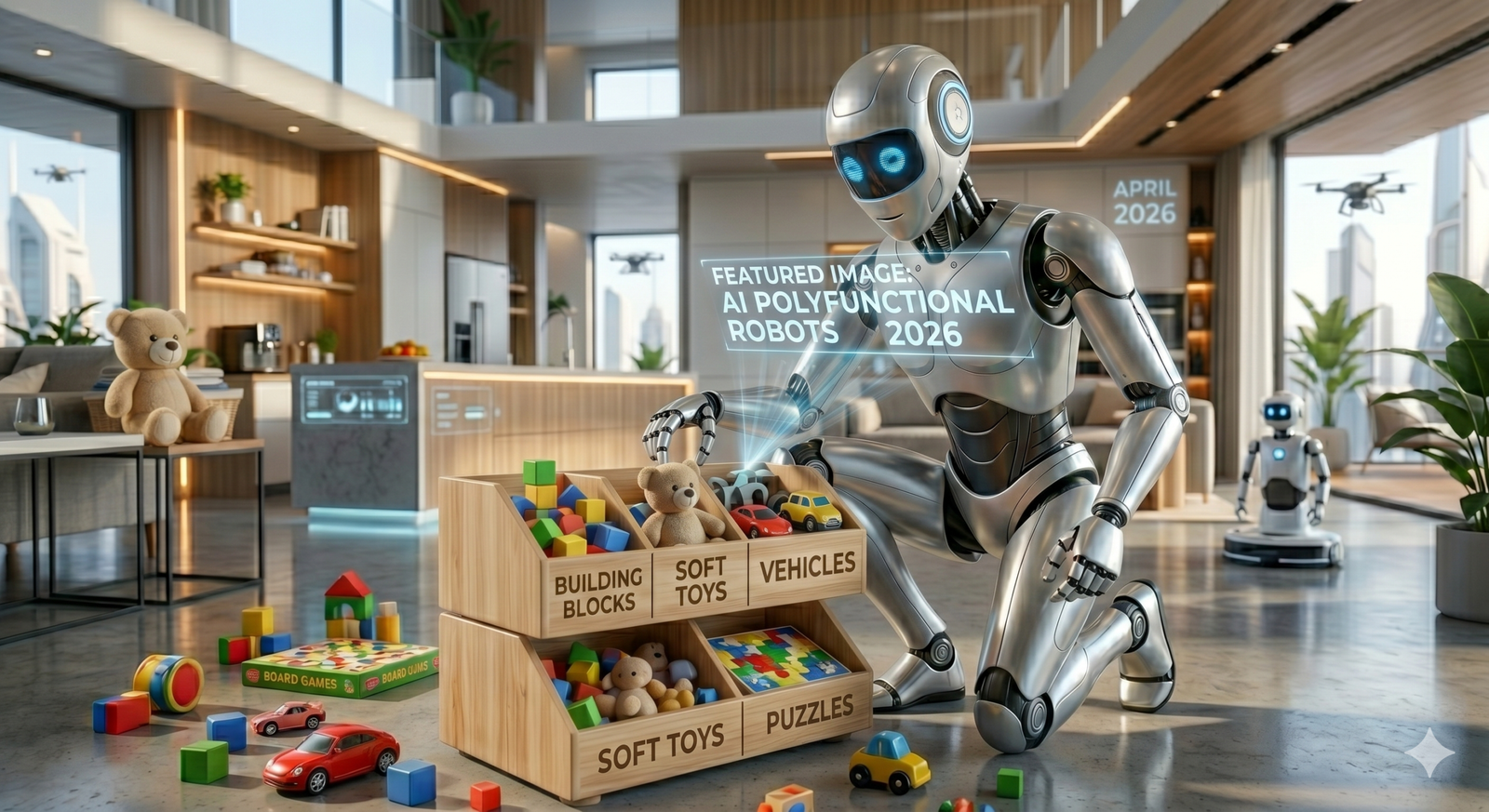
AI Polyfunctional Robots 2026: The Ultimate Guide to the Future Imagine waking up to the smell of freshly brewed coffee, not because you set a timer, but because your household assistant noticed you stirring. It then heads to the laundry room to fold a load of towels before prepping for its “day job” in a local logistics warehouse. This isn’t a scene from a sci-fi movie anymore. AI polyfunctional robots in 2026 have officially moved from the laboratory to the living room.
In my experience writing about emerging tech for over a decade, I’ve seen many “next big things” fizzle out. However, this year feels different. We are witnessing a fundamental shift where robots are no longer “one-trick ponies” designed for a single task. Instead, AI polyfunctional robots 2026 models are becoming versatile, general-purpose partners for everyone.
Quick Summary: Key Takeaways
- Versatility is King: In 2026, AI polyfunctional robots transitioned from single-task machines to multi-tasking assistants.
- Affordability: Prices for AI polyfunctional robots 2026 models like Tesla’s Optimus are targeting the $20,000–$30,000 range.
- Humanoid Dominance: The bipedal form factor of AI polyfunctional robots 2026 is winning because our world is designed for humans.
Defining AI Polyfunctional Robots 2026 Standards
Before we dive into the latest models, let’s get our definitions straight. An AI polyfunctional robot is a machine designed to perform a wide variety of tasks rather than being limited to a specific function. By 2026, the standard for AI polyfunctional robots 2026 has moved far beyond simple automation.
Most industrial robots are “monofunctional”—they weld, they paint, or they move a box. If you want them to do something else, you have to spend weeks reprogramming them. In contrast, the AI polyfunctional robots of 2026 use “Physical AI.” This means AI polyfunctional robots 2026 units use neural networks to learn new tasks by watching videos or being guided by humans.
Moreover, these AI polyfunctional robots 2026 machines are equipped with modular hardware. Therefore, an AI polyfunctional robot can swap a gripper for a fine-motor hand in minutes. As a result, the same AI polyfunctional robots 2026 that help with elderly care in the morning can assist in a manufacturing plant by afternoon.
“how artificial intelligence works in robotics”
The Leading AI Polyfunctional Robots 2026 Models
The landscape of robotics has changed drastically in the last 24 months. While hundreds of startups exist, a few giants are defining the AI polyfunctional robots 2026 market today.
Tesla Optimus (Gen 3) and AI Polyfunctional Robots 2026
Elon Musk’s vision for the Tesla Bot has reached a tipping point. By late 2026, Tesla is aiming for mass production of AI polyfunctional robots at its Fremont factory. What makeElon Musk’s vision for the Tesla Bot has reached a tipping point. By late 2026, Tesla is aiming for mass production of AI polyfunctional robots 2026 at its Fremont factory. What makes the AI polyfunctional robots 2026 edition of Tesla Optimus stand out is its integration with Tesla’s Full Self-Driving (FSD) computer.
Price Point: AI polyfunctional robots 2026 are targeting a disruptive $20,000.s the AI polyfunctional robots 2026 edition of Optimus stand out is its integration with Tesla’s Full Self-Driving (FSD) computer.
Walking Speed: AI polyfunctional robots 2026 now reach up to 8 km/h.
Battery Life: These AI polyfunctional robots 2026 are designed to last a full 8-hour shift.
- Walking Speed: AI polyfunctional robots 2026 now reach up to 8 km/h.
- Battery Life: AI polyfunctional robots are designed to last a full 8-hour shift.
- Price Point: AI polyfunctional robots 2026 are targeting a disruptive $20,000.
Figure 02: Conversational AI Polyfunctional Robots 2026
If Tesla wins on scale, Figure AI wins on “brains.” Thanks to their deep partnership with OpenAI, AI polyfunctional robots 2026 by Figure AI
can engage in full natural language conversations. In a recent demo I watched, a user told an AI polyfunctional robot, “I’m hungry,” and the AI polyfunctional robots 2026 identified a snack and handed it over perfectly.
Agility Robotics: The Industrial AI Polyfunctional Robot
While others focus on being “human-like,” Agility Robotics focuses on the worker-like nature of AI polyfunctional robots 2026. Their AI polyfunctional robot, Digit, is now commercially deployed in major logistics centers. In 2026, we’re seeing Agility Robotics
AI polyfunctional robots 2026 units deployed at scale in Amazon fulfillment centers.
How AI Polyfunctional Robots 2026 Are Changing Our Homes
Honestly, I was a skeptic until I saw an AI polyfunctional robot handle my friend’s messy toddler-ravaged living room. We’ve moved past the “Roomba era” into the era of AI polyfunctional robots 2026.
The AI polyfunctional robots of 2026 are now capable of:
- Complex Cleaning: AI polyfunctional robots 2026 scrub countertops and dust shelves.
- Meal Prep: An AI polyfunctional robot can follow digital recipes to chop vegetables.
- Elderly Assistance: Modern AI polyfunctional robots 2026 monitor falls and provide medication reminders.
However, the “polyfunctional” aspect is what really adds value. You aren’t buying five different appliances; you’re buying one AI polyfunctional robot platform that keeps getting better. For many families, AI polyfunctional robots 2026 represent the “iPhone moment” for physical hardware.
Industrial Revolution: AI Polyfunctional Robots 2026 at Work
In the professional world, the labor shortage is the biggest driver of AI polyfunctional robots 2026 adoption. According to a 2026 report by the International Federation of Robotics (IFR), the trend toward “Agentic AI” is enabling robots to work independently in complex environments.
AI polyfunctional robots 2026 units are filling the gap because they are collaborative. Unlike older industrial robots, these AI polyfunctional robots 2026 use advanced tactile sensors and LiDAR. This allows AI polyfunctional robots to work right next to humans without the risk of injury.
Moreover, the “multi-tasking” nature of AI polyfunctional robots 2026 means a factory doesn’t need to be redesigned. If an AI polyfunctional robot finishes its sorting task early, it can pivot to quality inspection. This flexibility is what makes AI polyfunctional robots 2026 so attractive for business owners.
Challenges for AI Polyfunctional Robots 2026
It’s not all sunshine and robotic roses. As an expert in this field, I have to be honest about the hurdles AI polyfunctional robots 2026 still face. Even in 2026, we are dealing with three major issues:
The Dexterity Gap in AI Polyfunctional Robots 2026
While AI polyfunctional robots 2026 can now walk through a forest, fine motor skills are still tough. Folding a silk dress requires a level of tactile feedback that some AI polyfunctional robots 2026 are still perfecting.
Data Privacy and AI Polyfunctional Robots 2026
These AI polyfunctional robots 2026 are essentially giant mobile cameras. When you bring an AI polyfunctional robot into your home, you must ask where the data is going. Trustworthiness is a major barrier for the AI polyfunctional robots 2026 market growth.
Job Displacement from AI Polyfunctional Robots 2026
It is a hard truth that as AI polyfunctional robots 2026 become more capable, certain manual labor roles will vanish. While new jobs are created in AI polyfunctional robots 2026 maintenance, the transition period will be difficult for many workers.
The Future: Beyond AI Polyfunctional Robots 2026
Looking ahead, the evolution of AI polyfunctional robots isLooking ahead, the evolution of AI polyfunctional robots 2026 is only accelerating. We are already seeing prototypes of AI polyfunctional robots 2026 that can “self-repair” minor hardware glitches using 3D printed parts.
In my view, by 2030, an AI polyfunctional robot in the home will be as common as a microwave is today. We will stop seeing AI polyfunctional robots 2026 as “high-tech” and start seeing them as standard household utilities. The rapid adoption of AI polyfunctional robots 2026 is inevitable. only accelerating. We are already seeing prototypes of AI polyfunctional robots that can “self-repair” minor hardware glitches.
In my view, by 2030, an AI polyfunctional robot in the home will be as common as a microwave is today. We will stop seeing AI polyfunctional robots 2026 as “tech” and start seeing them as standard utilities.
Frequently Asked Questions (FAQ)
1. How much do AI polyfunctional robots 2026 cost?
Currently, high-end AI polyfunctional robots range from $20,000 to $50,000. However, many AI polyfunctional robots 2026 are available via lease.
2. Can AI polyfunctional robots 2026 walk on stairs?
Yes. Most bipedal AI polyfunctional robots in 2026 use advanced balance algorithms to navigate standard household stairs easily.
3. Are AI polyfunctional robots 2026 safe for pets?
Most AI polyfunctional robots 2026 are designed with “compliance” in their motors, meaning the AI polyfunctional robot stops moving upon unexpected contact.
4. How do I teach an AI polyfunctional robot a new task?
You don’t need to code! Most AI polyfunctional robots 2026 allow you to “demonstrate” a task by moving the AI polyfunctional robot‘s arms manually.
5. Do AI polyfunctional robots 2026 need internet?
While AI polyfunctional robots can perform basic tasks offline, a connection is usually required for the complex AI processing that powers AI polyfunctional robots 2026.
Conclusion
The era of AI polyfunctional robots 2026 is officially here, and it is reshaping how we think about labor. From the factory floor to the kitchen floor, AI polyfunctional robots 2026 are proving that the future of automation is about doing everything better.
Whether you’re a business owner or a homeowner, AI polyfunctional robots 2026 technology is now within reach. The question is no longer if you will have an AI polyfunctional robot, but which of the AI polyfunctional robots 2026 you’ll choose to integrate into your life.
What do you think about AI polyfunctional robots 2026? Would you trust an AI polyfunctional robot to cook your dinner? Drop a comment below! Don’t forget to subscribe for more news on AI polyfunctional robots 2026.