

Table of Contents
Have you ever had a “million-dollar idea” for an app while sipping your morning coffee? We’ve all been there, but the gap between a great idea and a functional tool in the App Store can feel like a canyon.
In my ten years of navigating the tech world, I’ve seen mobile app development evolve from a “nice-to-have” luxury into the very heartbeat of modern business. Whether you are a startup founder or a curious creator, building an app is a journey of turning logic into magic. Honestly, I think the best apps aren’t the ones with the most features; they’re the ones that solve a single problem perfectly.
Quick Summary: Key Takeaways
- User-First Design: If your app isn’t intuitive, users will delete it within seconds.
- Platform Choice: Decide between Native (iOS/Android) or Cross-Platform (Flutter/React Native) based on your budget and speed.
- Post-Launch is Key: Development doesn’t end at launch; it’s a continuous cycle of updates and feedback.
Why Mobile App Development Matters More Than Ever
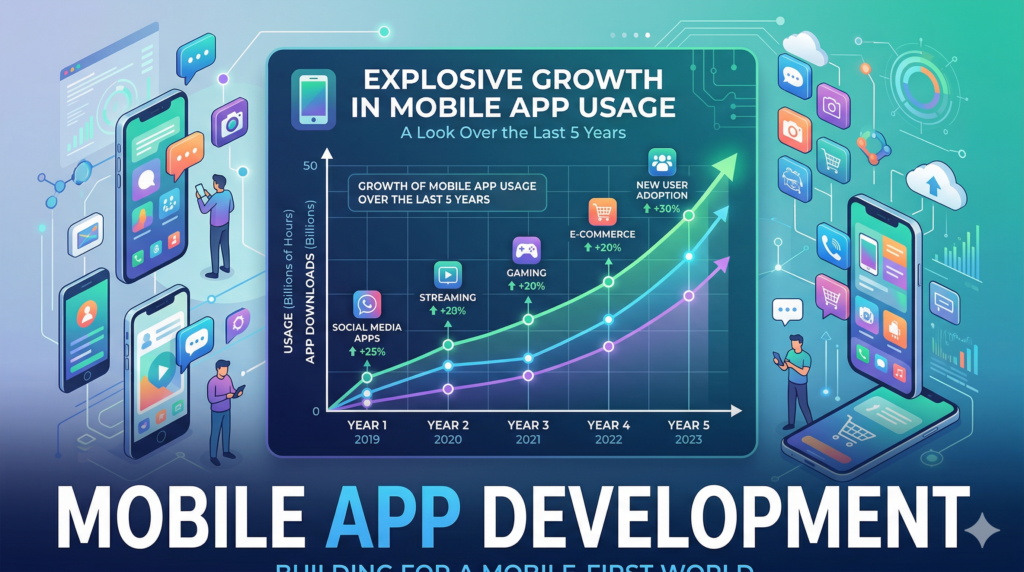
Today, people spend over five hours a day on their mobile devices. That is a massive window of opportunity. However, it also means the competition is fierce. According to recent data from Statista, there are millions of apps available, yet only a fraction see consistent daily use.
When we talk about mobile app development, we aren’t just talking about coding. We are talking about creating a digital ecosystem. In my experience writing about tech trends, I’ve noticed that the most successful projects prioritize “stickiness”—that quality that keeps a user coming back.
Moreover, with the rise of 5G and AI integration, apps are becoming faster and smarter. If you aren’t thinking about how your app fits into a user’s lifestyle, you’re already behind the curve.
The Core Stages of the Development Lifecycle
Building an app is like building a house. You wouldn’t just start nailing boards together without a blueprint, right?
1. Strategy and Discovery
This is where you define the “Why.” Who is your audience? What pain point are you fixing? I once worked with a client who wanted an app that did “everything.” It failed miserably. We stripped it down to one core function, and it took off. Narrow your focus.
2. UI/UX Design
User Interface (UI) is how it looks; User Experience (UX) is how it feels. Your app should be so easy to use that a toddler (or your tech-challenged uncle) could navigate it.
- Wireframing: Digital sketches of your app screens.
- Prototyping: A clickable model to test the flow.
3. The Development Phase
This is where the heavy lifting happens. Developers write the code, set up databases, and integrate APIs.
Choosing Your Tech Stack: Native vs. Cross-Platform
One of the biggest hurdles in mobile app development is picking the right “engine.” You basically have two main paths.
Native Development
This involves writing separate code for iOS (using Swift) and Android (using Kotlin).
- Pros: Incredible performance and full access to phone features (like the camera or GPS).
- Cons: It’s expensive and takes double the time because you’re building two separate apps.
Cross-Platform Development
Using frameworks like Flutter or React Native, you write one codebase that works on both platforms.
- Pros: Faster time-to-market and lower costs.
- Cons: Sometimes you sacrifice a tiny bit of “snappiness” in the animations.
In my view, unless you are building a high-end graphic game or a complex photo editor, cross-platform is usually the smartest move for most businesses today.
What Does Mobile App Development Actually Cost?
I’ll be honest with you: there is no “set price.” It’s like asking, “How much does a car cost?” A used sedan and a Ferrari are both cars, but the price tags are worlds apart.
| App Type | Estimated Cost (USD) | Timeline |
| Simple (Basic UI, 5-7 screens) | $15,000 – $30,000 | 2-3 Months |
| Medium (API integration, User login) | $35,000 – $80,000 | 4-6 Months |
| Complex (Real-time data, AI, Payments) | $100,000+ | 9+ Months |
Note: These are industry averages based on Western development rates. Hiring teams in different regions can shift these numbers significantly.
Common Pitfalls to Avoid (From Someone Who’s Seen Them All)
I’ve seen plenty of brilliant ideas die because of simple mistakes.
- Feature Creep: Adding too many “cool” features before the basics work. Stick to your MVP (Minimum Viable Product).
- Ignoring Feedback: If your beta testers say the “Sign Up” button is hard to find, believe them.
- Cheap Coding: You get what you pay for. Spaghettis code (messy, unorganized code) will haunt you when you try to update the app .
2026 App UI Design Best Practices :
- Predictive & Agentic UX: Designing for “intent before action.” Interfaces in 2026 are shifting from reactive (responding to a tap) to predictive (surfacing the most likely next step using AI).
- Accessibility-First Design: It’s no longer an “extra.” Use high-contrast color pairings, minimum 16sp body text, and inclusive touch targets (at least 48×48 dp) to accommodate all users.
- Glassmorphism & Tonal Elevation: Modern Android and iOS designs are moving away from harsh shadows toward “tonal elevation”—using subtle color shifts and layered transparency to create depth.
- Gesture-First Navigation: As screens get larger and buttons disappear, mastering edge-to-edge gestures (like the “swipe-up” to close or “long-press” for shortcuts) is critical.
Trends Shaping the Future of Apps
To stay relevant, your mobile app development strategy needs to look forward. We aren’t just tapping screens anymore.
Artificial Intelligence (AI) and Machine Learning
From chatbots that actually understand you to personalized shopping feeds, AI is the new standard. It’s no longer a sci-fi dream; it’s a requirement for modern apps.
The Rise of Foldables
As phones like the Samsung Galaxy Z Fold become more common, developers have to rethink “responsive design.” Your app needs to look good on a tiny screen and a mini-tablet simultaneously.
How to Choose a Development Partner
Unless you’re a coding wizard, you’ll need a team. Here’s how I suggest you vet them:
- Check their Portfolio: Have they built something similar to your idea?
- Communication Style: If they don’t explain things in plain English, move on.
- Post-Launch Support: Will they be there when the app crashes at 2 AM?
According to Gartner’s 2026 Strategic Roadmap…” to ground your content in their latest research, specifically focusing on how Agentic AI and AI-Native Development are redefining the mobile app landscape.
Gartner’s official announcement of the Top Strategic Technology Trends for 2026, as it provides the authoritative foundation for the “AI-first” and “agentic” shifts in mobile development.
Link: Gartner Identifies the Top Strategic Technology Trends for 2026
FAQs About Mobile App Development
1. How long does it take to build an app?
On average, a quality app takes 4 to 9 months. Simple apps can be done faster, but rushing often leads to bugs and poor user reviews.
2. Do I need an iPhone and an Android version?
Usually, yes. In the US, iOS is huge, but globally, Android dominates. Cross-platform tools make it easy to hit both without doubling your budget.
3. How do apps make money?
There are several ways: In-app purchases, subscriptions, advertising, or charging a one-time download fee. Subscriptions are currently the most popular for steady revenue.
4. What is an MVP?
An MVP (Minimum Viable Product) is the simplest version of your app that still solves the main problem. It’s the best way to test the market without spending your life savings.
5. How much does it cost to maintain an app?
Expect to pay about 15-20% of your initial development cost every year for updates, hosting, and security patches.
Final Thoughts on Starting Your Journey
Embarking on a mobile app development project is an exhilarating, slightly terrifying, and ultimately rewarding experience. It’s a mix of logic, art, and business. Don’t be afraid to start small. Some of the biggest apps in the world—like Instagram or Uber—started with just one or two simple features.
In my experience, the most successful developers are the ones who listen more than they talk. Listen to your users, watch how they interact with your screens, and be willing to change your mind. Therefore, take that first step, draft your wireframe, and start building!
What’s your biggest challenge with app development right now? Drop a comment below or share this guide with a fellow entrepreneur!