
Have you ever looked up at the night sky and wondered what’s actually happening up there? A few years ago, the answer was mostly government satellites and traditional telecommunication dishes. But today, the cosmos looks like a bustling, high-tech business park.
The global space economy is growing rapidly, and keeping track of the pioneers can be overwhelming. In my experience writing about deep tech and aerospace, we have never seen an era of innovation quite like this one. We are no longer just launching rockets; we are building an entire off-world infrastructure. If you want to know who is driving this cosmic revolution, you need to look closely at the breakthrough space tech startups 2026 to watch.
We are transitioning from theoretical concepts to fully operational, space-based businesses. Let’s dive into the most promising space tech startups 2026 to watch and explore how they are rewriting the rules of the cosmos.
Quick Summary: Key Takeaways
- AI is going orbital: Leading space tech startups 2026 to watch are bypassing Earth’s energy grid by launching functional GPU data centers directly into space.
- Manufacturing is leaving Earth: Zero-gravity environments are being used to manufacture superior materials and pharmaceuticals that are impossible to create on the ground.
- Access is becoming localized: Diverse international players from India, Europe, and Africa are breaking the monopoly of traditional aerospace giants.
Why Space Tech Startups 2026 to Watch Matter Right Now
Before we jump into the specific companies, we must understand why the current ecosystem is so unique. In previous years, space technology was dominated by massive, slow-moving government contracts. Today, agile, venture-backed companies are taking massive risks and moving at lightning speed.
When analyzing the top space tech startups 2026 to watch, we see a clear trend: space is no longer just a destination to visit. Instead, it has become a platform for computing, manufacturing, and deep-tech development. This shift is why investors are poured billions into orbital ventures over the last twelve months.
1. Pixxel: Bringing Sovereign AI and Orbital Data Centers to Life
To me, one of the most exciting space tech startups 2026 to watch is Bengaluru-based Pixxel. I’ve been tracking their journey since they first launched their hyperspectral imaging satellites, but their latest move is an absolute game-changer for both the space industry and artificial intelligence.
Just recently, Pixxel announced a massive partnership with LLM developer Sarvam AI to build and launch India’s very first orbital data center satellite, named The Pathfinder.
Why Pathfinder is a Massive Leap Forward
Traditionally, Earth observation satellites capture massive amounts of data and beam those raw terabytes back down to ground stations. This process creates frustrating lag and massive bandwidth bottlenecks. Pathfinder completely flips the script.
- On-Board GPUs: The 200-kg satellite houses data-center-class GPUs directly in orbit.
- Space-Based AI Training: It will run and train LLM models in space, processing hyperspectral data instantly.
- Unlimited Solar Power: By operating in orbit, these servers tap into constant solar energy, bypassing the heavy power constraints that terrestrial data centers face on Earth.
Instead of sending raw images down, Pixxel’s satellite will analyze the data on the fly and send back finished, actionable intelligence. Therefore, response times drop from days to seconds. This is a brilliant example of why Pixxel leads our list of space tech startups 2026 to watch.
2. Varda Space Industries: Leading the Zero-Gravity Manufacturing Revolution
Imagine making medicine, fiber-optic cables, or semiconductors without the annoying interference of gravity. That is exactly what California-based Varda Space Industries is doing, making them one of the must-follow space tech startups 2026 to watch. They are shifting the production paradigm by proving that some things are simply made better in microgravity.
When you try to formulate complex protein crystals or high-performance materials on Earth, gravity causes convection and sedimentation. This can introduce tiny imperfections. In the zero-gravity environment of low-Earth orbit (LEO), materials crystallize perfectly.
Varda has already successfully launched, operated, and returned its space manufacturing capsules to Earth. They are proving that automated, off-world factories are not a science-fiction dream—they are a highly profitable, 2026 business reality.
3. GalaxEye: Penetrating Clouds with OptoSAR Technology
Have you ever tried to take a photo on a cloudy day and ended up with a gray, useless image? Traditional optical satellites have the exact same problem. If there is cloud cover, heavy rain, or if it’s nighttime, they cannot see the Earth’s surface.
Enter GalaxEye, another incredibly exciting player among the space tech startups 2026 to watch. Founded by IIT Madras alumni, they have developed a proprietary technology called OptoSAR.
What is OptoSAR? It is a hybrid sensor system that combines optical imaging with Synthetic Aperture Radar (SAR).
SAR can pierce through clouds, storms, and darkness, while optical sensors provide high-resolution, intuitive imagery. By fusing these two data streams together, GalaxEye provides uninterrupted, all-weather Earth observation. This technology is incredibly vital for maritime tracking, disaster management, and national security, cementing their position among the elite space tech startups 2026 to watch.
4. ArkEdge Space: The Micro-Satellite Powerhouse from Japan
When we look at the global landscape, Japan’s ArkEdge Space is rapidly rising as a dominant force in the micro-satellite sector. For anyone compiling a list of key space tech startups 2026 to watch, this company is an absolute necessity.
ArkEdge Space has successfully launched and checked out multiple in-house developed satellites, bringing their active constellation to over a dozen spacecraft. By partnering with established telecom giants and utilizing automated mission control systems, ArkEdge is showing the world how to scale space operations efficiently.
Moreover, they are actively working with international partners in regions like South America and Central Asia, democratizing satellite communications for developing nations.
5. Impulse Space: Fast-Tracking Orbital Transportation
Getting a satellite into space on a rideshare rocket like a SpaceX Falcon 9 is only half the battle. Once the rocket lets the satellite go, it is often not in the exact orbit it needs to be in.
This is where Impulse Space steps in. Founded by industry veteran Tom Mueller (one of the founding members of SpaceX), Impulse Space designs and builds high-energy orbital maneuvering vehicles. This practical utility is why they are consistently ranked among the top space tech startups 2026 to watch.
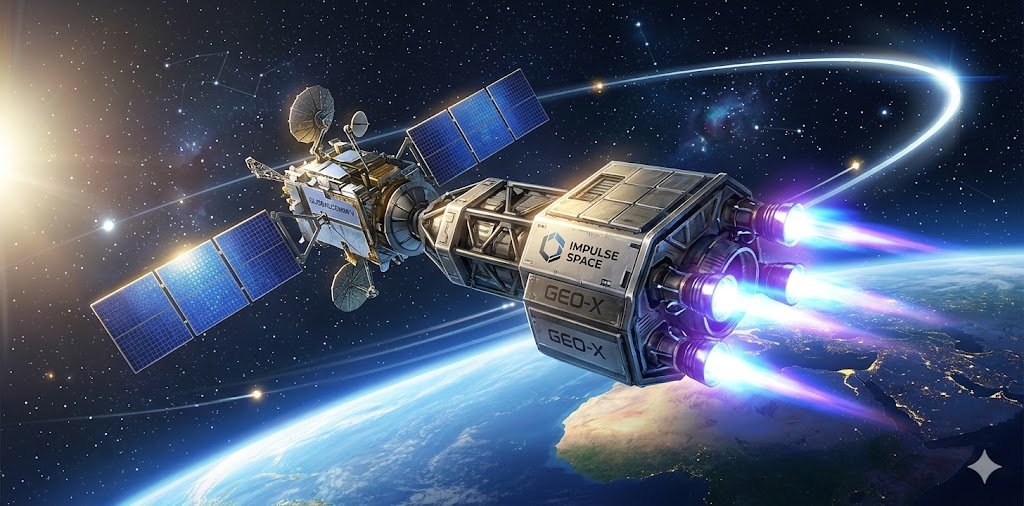
Think of them as the “last-mile delivery trucks” of outer space. Their vehicles, like the Mira and the heavy-duty Helios, take satellites from standard drop-off points and transport them to precise, high-energy orbits safely and cost-effectively. As constellations grow larger, their rapid transportation services are becoming absolutely essential.
6. Stellar Nuclear: Powering Deep Space Missions
If we want to build sustainable bases on the Moon or send humans to Mars, solar power simply won’t cut it. The lunar night lasts for 14 Earth days, and deep space is incredibly cold and dark. We need a reliable, continuous power source.
Czech Republic-based startup Stellar Nuclear is tackling this head-on, earning their spot among the revolutionary space tech startups 2026 to watch by developing innovative nuclear energy systems designed specifically for space.
Key Innovations from Stellar Nuclear:
- Radioisotope Power Systems (RPS): Compact generators that convert heat from decaying isotopes into reliable electricity.
- Nuclear Propulsion Units: Engines that could drastically cut down travel times for deep space missions.
- Space Microreactors: Small-scale nuclear reactors designed to power future lunar outposts and research stations.
While nuclear power in space sounds intimidating, experts from organizations like NASA and ESA agree that clean, compact nuclear fission is the safest and most realistic way to support long-duration space exploration.
7. Vortyx Space: Reusable Rockets for Emerging Markets
We cannot talk about the top space tech startups 2026 to watch without mentioning the launch vehicle market. While heavy players dominate the Western hemisphere, Nigerian startup Vortyx Space is making waves by developing reusable launch vehicles designed for underserved markets.
Vortyx Space is focusing on designing and operating orbital-class rockets with fully reusable stages. By lowering the cost of entry for satellite launches, they are paving the way for African nations and local tech hubs to launch their own space programs without relying on foreign launch providers. Their sustainable, cost-effective approach is a breath of fresh air, making them one of the most socially impactful space tech startups 2026 to watch this year.
Comparing the Top Space Tech Startups to Watch in 2026
| Company | Country | Core Focus Area | Major Innovation / Milestone |
| Pixxel | India | Orbital AI & Hyperspectral | Launched Pathfinder, an orbital GPU data center |
| Varda Space | USA | Space Manufacturing | Successful return of microgravity manufacturing capsules |
| GalaxEye | India | Earth Observation | OptoSAR hybrid sensor (optical + radar) |
| ArkEdge Space | Japan | Satellite Constellations | Mass-produced micro-satellites and global partnerships |
| Impulse Space | USA | Last-Mile Transportation | High-energy orbital transfer vehicles (Mira & Helios) |
| Stellar Nuclear | Czech Republic | Nuclear Space Power | Nuclear microreactors and radioisotope power systems |
| Vortyx Space | Nigeria | Reusable Launch Vehicles | Reusable stages targeting emerging regional markets |
The Challenges Facing the Space Tech Industry
As a writer deeply embedded in this sector, I believe it’s crucial to look at these innovations with a healthy dose of realism. While the potential is astronomical, even the best space tech startups 2026 to watch face brutal challenges that ground-based software companies never have to worry about.
- Severe Environmental Hazards: Space is a hostile place. Hardware must survive intense radiation, extreme thermal cycles, and micrometeoroid impacts.
- The Servicing Dilemma: If a GPU fails inside Pixxel’s orbital data center, you can’t just send an IT specialist up to replace it. Hardware must be incredibly resilient.
- Complex Global Regulations: Operating satellites, launching rockets, and transmitting data globally requires navigating a massive web of international laws and orbital debris guidelines.
Fortunately, the sheer amount of venture capital funding pouring into the sector shows that investors are more than willing to take these high-stakes risks for out-of-this-world rewards.
Frequently Asked Questions (FAQs)
What is a space tech startup?
A space tech startup is a privately owned, early-stage company that designs, builds, or operates technologies related to outer space. This includes launch vehicles, satellite hardware, space-based software, microgravity manufacturing, and deep-space power systems.
Why are companies building data centers in space?
Terrestrial data centers consume massive amounts of electricity and water for cooling. Moving data centers to orbit allows companies to power GPUs with unlimited, clean solar energy while utilizing the natural cold vacuum of space for thermal management.
How does space manufacturing work?
In the microgravity environment of space, materials do not suffer from gravity-induced convection or settling. This allows scientists to manufacture high-purity protein crystals for pharmaceuticals, flawless semiconductors, and ultra-efficient fiber-optic cables that are impossible to produce on Earth.
Is the space tech market growing in 2026?
Yes, the space tech market is experiencing unprecedented growth. According to reports by McKinsey, the global space economy is projected to reach over $1 trillion in the coming decade, driven heavily by commercial satellite services, defense contracts, and private space exploration.
How do space startups handle space debris?
Responsible space startups design their satellites with active propulsion systems to de-orbit themselves at the end of their lifespans. Additionally, international space agencies strictly enforce guidelines to ensure new satellites do not contribute to the growing space debris problem.
Final Thoughts: The Horizon of a New Space Age
Ultimately, the sky is no longer the limit. The impressive progress made by these space tech startups 2026 to watch proves that the future of technology is actively being forged in orbit. From Pixxel’s space-based AI processors to Varda’s zero-gravity factories, we are witnessing a fundamental shift in how humanity utilizes the cosmos.
The next decade won’t just be about visiting space—it will be about living, working, and computing there. If you want to stay ahead of the curve, keep your eyes on these incredible space tech startups 2026 to watch as they continue to push the boundaries of human engineering.
What do you think? Which of these space startups do you find most exciting? Would you trust an AI model that was trained entirely in orbit? Let me know your thoughts in the comments below, and don’t forget to share this article with your fellow tech enthusiasts!