
Table of Contents
Understanding the Agentic AI Workflow: A Strategic Guide
Agentic AI Workflow: How It Works
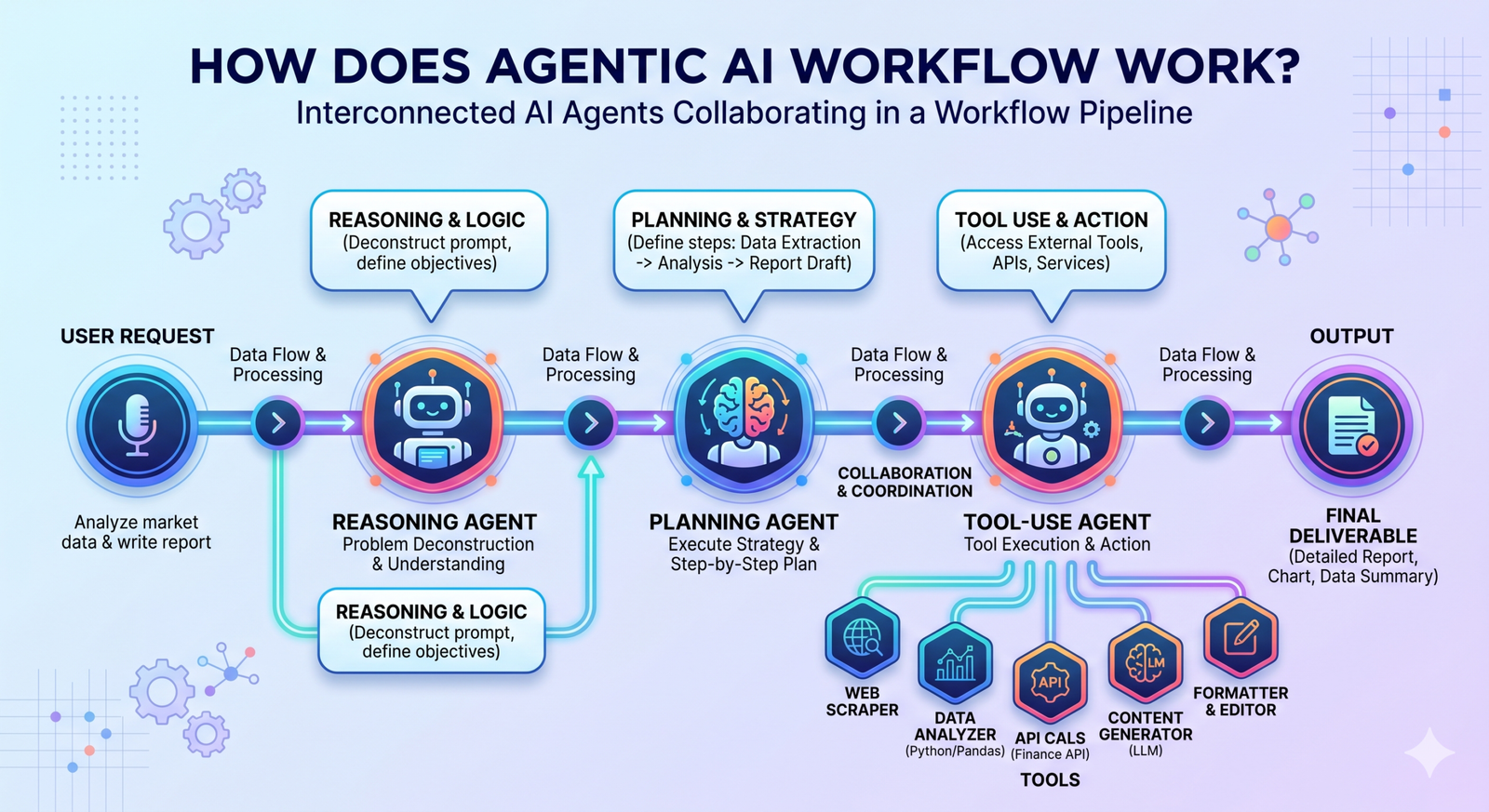
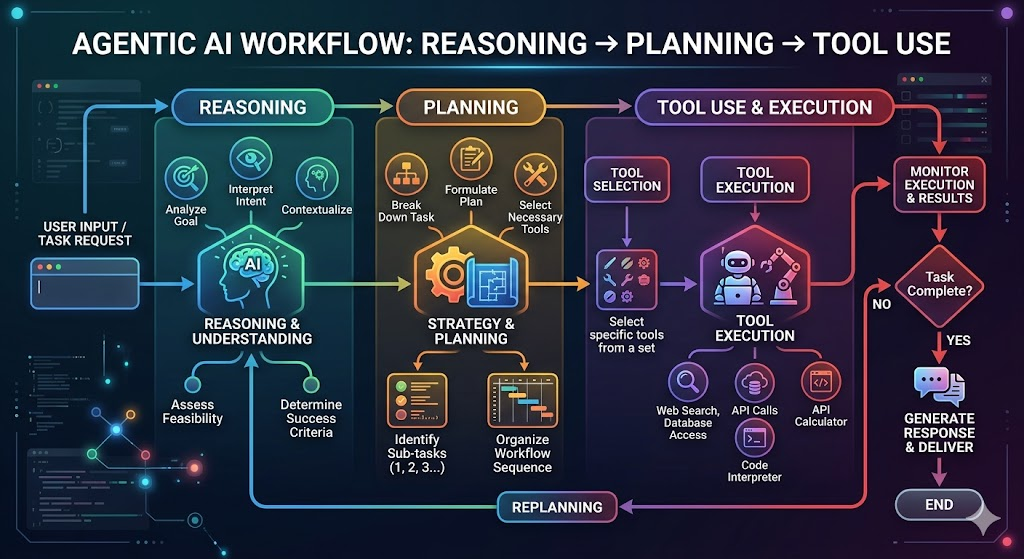
The shift from standard chatbots to agentic AI represents a move toward true autonomous orchestration. An effective agentic AI workflow isn’t just about answering questions; it’s about a cyclical process of reasoning, planning, and tool use.
1. Multi-Step Reasoning and Cognitive Analysis
At the heart of any agentic system is the reasoning layer. This is where the model uses Chain-of-Thought (CoT) processing to interpret user intent and assess context.
- Intent Recognition: Identifying the core goal of a prompt.
- Contextual Awareness: Pulling data from long-term memory or RAG (Retrieval-Augmented Generation) to inform the logic.
2. Dynamic Planning and Task Decomposition
Once the reasoning is established, the agentic AI workflow moves into the planning phase. Here, the system performs task decomposition, breaking a complex objective into a series of manageable sub-tasks.
- Self-Correction: The agent reviews its own roadmap to ensure logical consistency.
- Autonomous Pathing: If one path is blocked, the agentic AI initiates a replanning loop to find an alternative route.
3. Execution via Tool Use and API Integration
The final stage of the agentic workflow is the action layer. This is where the AI transitions from “thinking” to “doing” through tool use and function calling.
- API Orchestration: Connecting with external software, databases, or search engines.
- State Management: Tracking the results of each action and feeding them back into the reasoning loop to verify completion.
Why Agentic AI Workflows Matter for Modern SEO
For tech bloggers and SEO specialists, mastering agentic SEO is becoming essential. These workflows allow for automated SERP analysis, real-time content refreshing, and predictive keyword research, all driven by autonomous agents rather than static scripts.
Key Insight: The primary differentiator of an agentic AI workflow is the feedback loop. By observing the results of its own tool execution, the agent can refine its planning and deliver more accurate, high-authority results.
Agentic AI Workflow: How It Works
Artificial intelligence is no longer just about automation. Today, agentic AI workflows are transforming how businesses and individuals manage complex tasks. These workflows empower autonomous agents to reason, plan, and act with minimal human input.
In my experience writing about AI systems, I’ve seen agentic workflows bridge the gap between rigid automation and adaptive intelligence. They’re not just following rules — they’re thinking, adjusting, and collaborating.
🔑 Quick Summary
- Agentic AI workflow = autonomous agents reasoning, planning, and acting dynamically.
- More flexible than traditional automation.
- Real-world uses: fraud detection, customer support, healthcare, finance.
Introduction: Why Agentic AI Workflow Matters
Traditional automation is like a train on fixed tracks. It’s efficient but predictable. An agentic AI workflow, however, is more like a GPS-guided car — it adapts to traffic, reroutes when needed, and makes decisions in real time.
This adaptability is why industries are embracing agentic workflows. They combine large language models (LLMs), multi-agent systems, and workflow orchestration to create intelligent processes that evolve as conditions change.
Understanding Agentic AI Workflow
An agentic AI workflow is built on three core components:
- Reasoning – Agents analyze data and decide the next best step.
- Planning – They create dynamic action plans instead of rigid scripts.
- Tool Use – Agents call APIs, databases, or external tools to execute tasks.
Agentic AI Workflow vs Traditional Automation
- Traditional Automation: Predefined rules, predictable outcomes.
- Agentic AI Workflow: Adaptive, flexible, capable of handling uncertainty.
Example:
- A rule-based fraud detection system blocks transactions above a threshold.
- An agentic AI workflow detects subtle behavioral changes, linked accounts, or unusual device fingerprints.
Workflow Orchestration in Agentic AI Workflow
Multi-Agent Collaboration in Agentic AI Workflow
Agents communicate with each other to divide tasks. For example, one agent retrieves data while another interprets results.
Dynamic Decision-Making in Agentic AI Workflow
Instead of static branching, agents adapt workflows based on real-time input. This makes them ideal for unpredictable environments.
Real-World Agentic AI Workflow Examples
- Fraud Detection – Identifying complex patterns beyond simple rules.
- Customer Support – AI agents handle queries, escalate when needed.
- Healthcare – Assisting doctors with adaptive diagnostic workflows.
- Finance – Automating compliance checks with reasoning-based workflows.
Benefits of Agentic AI Workflow in Business
- Flexibility: Adapt to unexpected conditions.
- Efficiency: Reduce human intervention.
- Scalability: Handle complex, multi-agent tasks.
- Accuracy: Improve decision-making with reasoning.
Challenges & Limitations of Agentic AI Workflow
- Governance: Ensuring agents act ethically.
- Complexity: Designing adaptive workflows is harder than rule-based systems.
- Trust: Users must understand limitations and avoid over-reliance.
FAQs About Agentic AI Workflow
Q1: What is an agentic AI workflow?
It’s a process where autonomous AI agents reason, plan, and act with minimal human input.
Q2: How is it different from RPA (Robotic Process Automation)?
RPA follows static rules, while agentic workflows adapt dynamically.
Q3: Can agentic AI workflow replace humans?
Not entirely. It reduces repetitive tasks but still requires human oversight for ethical and complex decisions.
Q4: What industries benefit most?
Finance, healthcare, customer service, and cybersecurity.
Q5: Is agentic AI workflow safe?
It’s powerful but needs governance frameworks to ensure ethical use.
Conclusion: The Future of Agentic AI Workflow
Agentic AI workflows are reshaping automation. They’re flexible, adaptive, and capable of handling complexity that traditional systems can’t. Honestly, I think they’ll become the backbone of intelligent enterprise systems in the next decade.
If you’re exploring AI adoption, start by understanding how agentic AI workflow works and where it fits into your processes.
👉 Call-to-Action: What do you think about agentic AI workflows? Drop a comment below, share this post, or subscribe for more deep dives into AI and tech trends.