Table of Contents
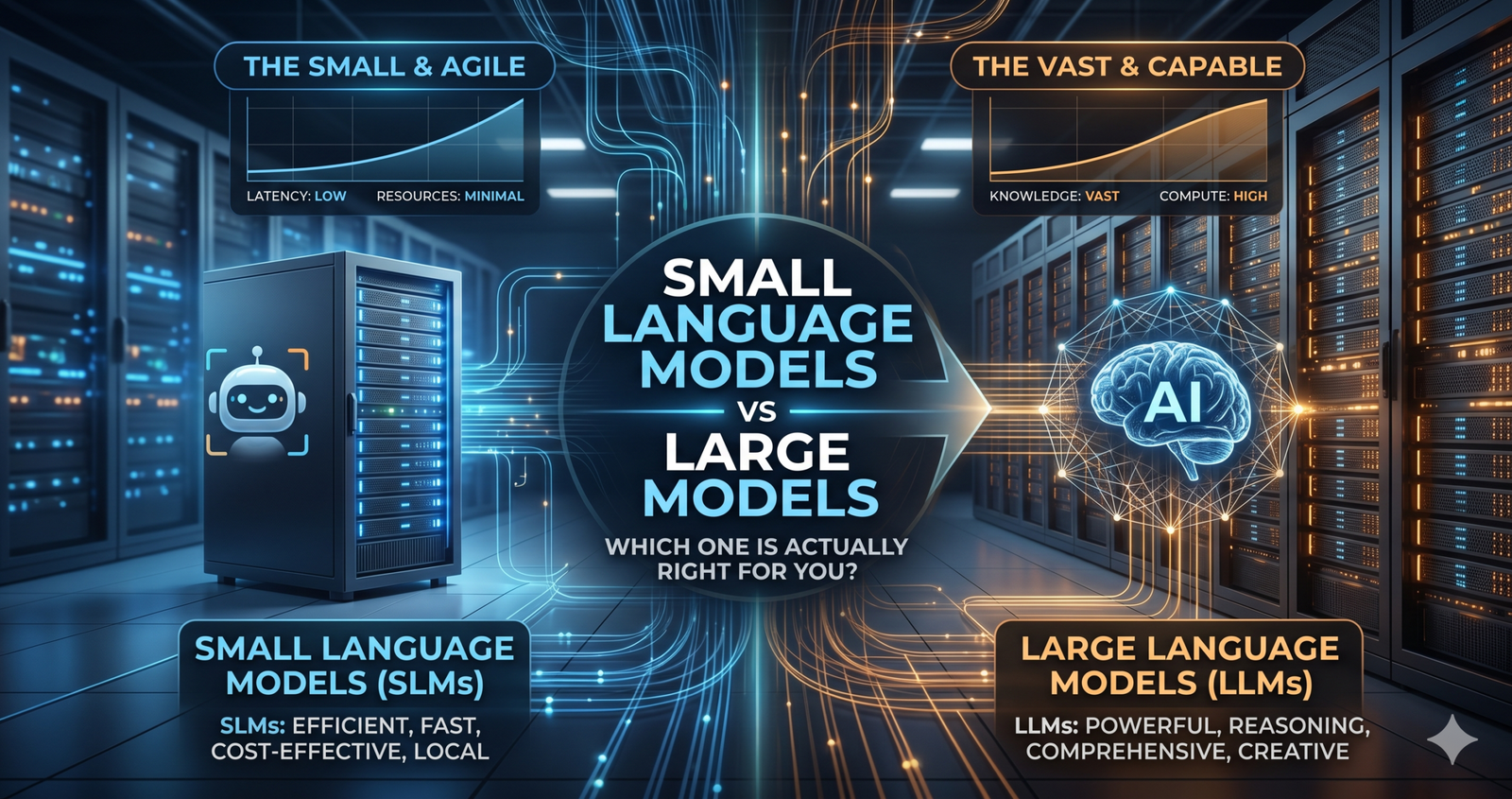
Small Language Models vs Large Models: Which One Is Actually Right for You? Here’s what nobody in the AI industry wants to admit…
Quick Summary
- Small language models (SLMs) are faster, cheaper, and run on local hardware — great for focused tasks.
- Large language models (LLMs) offer broader reasoning, creativity, and versatility, but cost more to run.
- The best choice depends on your use case, budget, and privacy needs — there’s no universal winner.
If you’ve been following the AI space lately, you’ve probably noticed something interesting: not everyone is chasing bigger models anymore. In fact, a growing number of developers, businesses, and researchers are turning to small language models — and the results are surprisingly impressive.
So what’s the real difference between small language models vs large models? And more importantly, which one should you actually use? Let’s break it down clearly, without the hype.
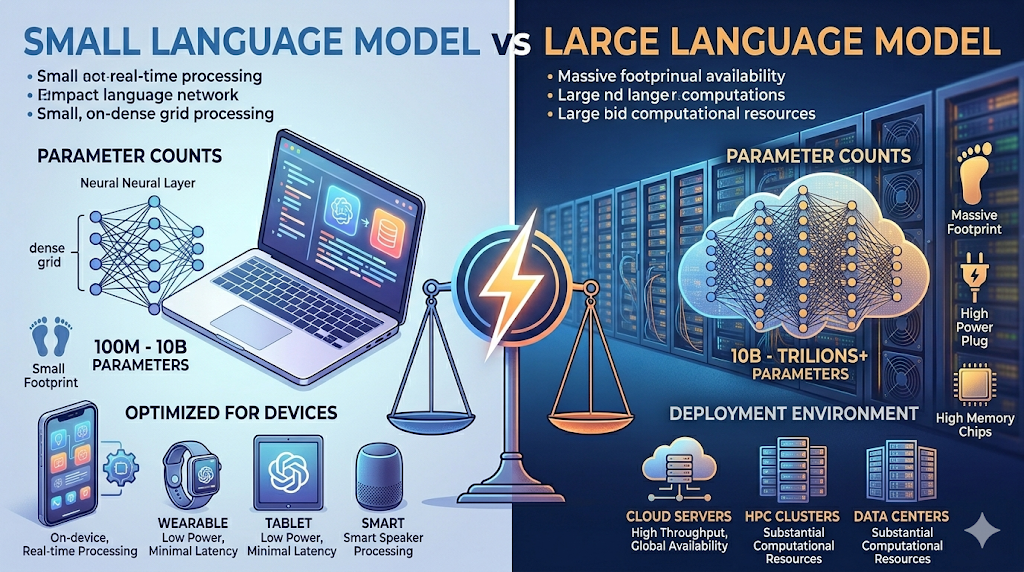
What Are Small Language Models, Exactly?
A small language model (SLM) is an AI language model with a relatively low number of parameters — typically ranging from a few million to around 7 billion. Think of parameters as the “brain cells” of an AI: the more there are, the more the model can learn and remember.
Models like Microsoft’s Phi-3, Mistral 7B, and Gemma from Google fall into this category. They’re designed to be lean, fast, and efficient — capable of running on a laptop, a smartphone, or even edge hardware without needing a beefy cloud server.
In my experience writing about AI tools, SLMs often surprise people. They’re not “watered-down” versions of big models — they’re purpose-built for specific, well-defined tasks, and they can be remarkably good at them.
What Makes Large Language Models Different?
On the other end of the spectrum, large language models (LLMs) like GPT-4, Claude, or Gemini Ultra pack hundreds of billions — sometimes over a trillion — parameters. These models are trained on enormous datasets and can handle an incredibly wide range of tasks: writing, coding, reasoning, summarizing, translating, and more.
The trade-off? They require significant computing power, cost more to run via APIs, and almost always live in the cloud. You’re not running GPT-4 on your home PC anytime soon.
However, their versatility is genuinely unmatched. If you need a model that can shift from drafting a legal document to debugging Python code to writing a poem — all in the same conversation — LLMs are your go-to.

Small Language Models vs Large Models: A Head-to-Head Comparison
Let’s put them side by side on the factors that matter most.
Small Language Models
- Runs locally (on-device or edge)
- Low inference cost
- Fast response times
- Strong data privacy
- Easier to fine-tune
- Lower energy consumption
- Limited to narrow tasks
Large Language Models
- Requires cloud infrastructure
- Higher API/compute cost
- Slightly higher latency
- Data passes through servers
- Complex to fine-tune
- High energy consumption
- Handles diverse, complex tasks
Performance on Specialized Tasks
Here’s something that often surprises people: on narrow, well-defined tasks, a fine-tuned SLM can match or even outperform a general-purpose LLM. Microsoft’s research on Phi-3 showed it performing comparably to much larger models on specific benchmarks. When a model is tightly focused on one job — say, medical coding or legal clause extraction — it doesn’t need billions of extra parameters for unrelated knowledge.
Cost and Scalability
Running an LLM via API can get expensive fast, especially at scale. If you’re processing thousands of documents per day, those per-token costs add up quickly. SLMs, on the other hand, can run on your own hardware. Once deployed, the marginal cost per query drops dramatically. For startups and mid-size businesses, this cost difference can be the deciding factor.
When Should You Use a Small Language Model?
SLMs shine in specific situations. Here are the clearest signals that an SLM is the better fit:
- You need on-device AI — smartphones, IoT devices, or offline-first applications
- Privacy is critical — healthcare, legal, or financial data that can’t leave your environment
- You have a single, repeatable task — customer intent classification, document summarization, code completion for a specific language
- Latency matters — real-time applications where milliseconds count
- Budget is tight — you want capable AI without recurring API costs
Honestly, I think SLMs are criminally underrated in most enterprise conversations. Companies spend big on LLM APIs when a well-tuned 7B model running on a local server would do the job perfectly — often faster and cheaper.
When Do Large Language Models Win?
There are tasks where LLMs are simply the better tool. Consider using an LLM when:
- You need multi-step reasoning or complex chain-of-thought logic
- Your tasks are unpredictable or highly varied — customer support across any topic, general-purpose chatbots
- You need creative generation — long-form content, ideation, novel writing
- You want zero-shot performance without fine-tuning — just plug and play
- Your queries involve cross-domain knowledge — mixing science, law, and history in one answer
Therefore, if your product is a general AI assistant meant to handle anything users throw at it, an LLM is still the safest and most capable choice.
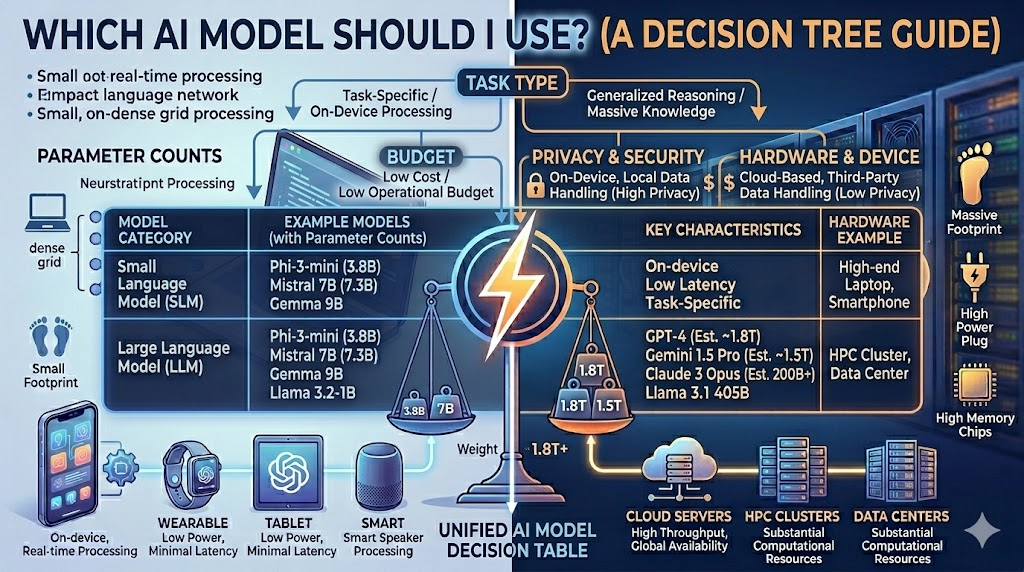
“Which AI model should I use?” with branches for task type, budget, privacy, and device
The Rise of SLMs: What’s Driving the Shift?
The trend toward small language models isn’t accidental. Several forces are converging at once.
First, hardware is catching up. Modern laptops with Apple Silicon or NVIDIA GPUs can now run 7B-parameter models smoothly. What once required a data center now fits in a backpack.
Second, fine-tuning has become accessible. Techniques like LoRA (Low-Rank Adaptation) and QLoRA let developers customize small models on modest hardware with relatively small datasets. The barrier to building a specialized AI tool has dropped significantly.
Third, and perhaps most importantly, not every task needs a genius. Using a trillion-parameter model to classify customer emails into five categories is like hiring a rocket scientist to sort your mail. It works — but it’s overkill. Moreover, it’s expensive overkill.
According to research from Stanford’s HAI group and multiple industry reports, efficiency-focused AI is one of the fastest-growing areas of investment as organizations seek to deploy AI more sustainably and cost-effectively.
Cite the Stanford HAI Annual AI Index Report (hai.stanford.edu) for AI deployment and efficiency statistics.For more detailed technical benchmarks and geographic investment data, the full reports and raw data are available at hai.stanford.edu/ai-index
.
Real-World Use Cases: Who’s Using What?
It helps to see these choices play out in practice.
SLM in action: A healthcare startup uses a fine-tuned 3B-parameter model to extract structured data from clinical notes — entirely on-premise, with zero patient data leaving their servers. It’s fast, compliant, and cost-effective.
LLM in action: A SaaS platform uses GPT-4 to power an open-ended AI assistant that helps users with everything from writing marketing copy to analyzing their business metrics and suggesting next steps.
Neither choice is wrong — they’re solving fundamentally different problems. As a result, the smartest teams often use both: an LLM for open-ended interactions and an SLM for high-volume, backend processing tasks.
Frequently Asked Questions
What is considered a “small” language model?
Generally, models with fewer than 10 billion parameters are considered small. Popular examples include Phi-3 (3.8B), Mistral 7B, and Gemma 2B. Some definitions extend up to 13B for “medium-small” models, but below 7B is the most common threshold.
Can a small language model replace ChatGPT for business use?
For specific, well-defined tasks — yes, absolutely. A fine-tuned SLM can match or beat a general-purpose LLM on narrow jobs like document classification, intent detection, or domain-specific Q&A. However, for open-ended, multi-domain conversations, LLMs still have the edge.
Are small language models more private than large ones?
In most cases, yes. SLMs can run entirely on local hardware, meaning your data never leaves your device or server. This makes them a strong choice for industries with strict data regulations, like healthcare, finance, and legal services.
What is the best small language model available right now?
As of 2024, Microsoft’s Phi-3 Mini, Mistral 7B Instruct, and Meta’s Llama 3 8B are widely regarded as top performers in the SLM category. The “best” depends heavily on your task — it’s worth benchmarking on your specific use case before committing.
Is it expensive to run a small language model?
Not at all — that’s one of their biggest advantages. Many SLMs run on consumer-grade GPUs or even modern CPUs. Once deployed on your own infrastructure, the ongoing cost per query is near zero, especially compared to pay-per-token API pricing from LLM providers.
Conclusion: Small Language Models vs Large Models — It’s Not a Battle, It’s a Toolkit
The debate around small language models vs large models often gets framed as a competition, but the reality is more nuanced. These two types of models aren’t fighting for the same throne — they’re built for different purposes, and the smartest AI strategies use both.
If you need broad, flexible intelligence and cost isn’t a primary concern, an LLM is your best bet. However, if you’re building something focused, privacy-sensitive, or cost-conscious, a small language model is worth serious consideration — and it might just outperform the big guns on your specific task.
In my view, the real shift happening in AI right now isn’t about “bigger is better” — it’s about right-sized intelligence for the right job. And that’s genuinely exciting.
Found this comparison helpful? Drop a comment below — I’d love to hear which type of model you’re working with and what your experience has been. And if you know someone navigating this same decision, share this post with them!