Table of Contents
AI is moving fast—almost too fast to keep up. One day there’s a new model, the next day it’s already outdated. If you’re trying to stay ahead, this open source LLM models list 2026 will save you hours of research.
Whether you’re a developer, blogger, or AI enthusiast, open-source LLMs give you freedom. You can tweak them, deploy locally, and avoid heavy API costs.
🔹 Quick Summary (Key Takeaways)
- Open-source LLMs are cheaper and customizable compared to closed models
- Models like LLaMA, Mistral, and Falcon dominate in 2026
- Choosing the right model depends on performance, hardware, and use case
Introduction
In my experience writing about AI and testing tools hands-on, open-source LLMs have become incredibly powerful. A few years ago, they lagged behind proprietary models. Now? Some are surprisingly competitive.
So, if you’re searching for the open source LLM models list 2026, you’re likely asking: Which models are worth using today?
Let’s break it down in a simple, no-jargon way.
What Are Open Source LLMs?
Open-source LLMs (Large Language Models) are AI models whose weights, architecture, or code are publicly available.
That means you can:
- Run them locally
- Modify them
- Fine-tune for your own tasks
- Avoid vendor lock-in
However, not all “open” models are fully open. Some come with restrictions. So always check licensing.
Best Open Source LLM Models List 2026
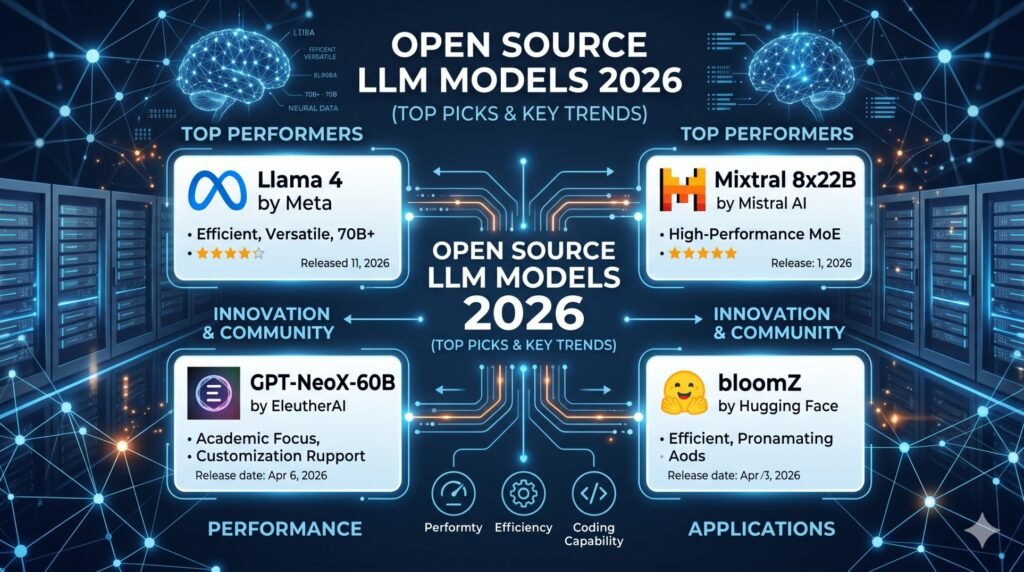
Here’s a carefully curated open source LLM models list 2026 based on performance, popularity, and real-world usability.
1. LLaMA 3 (Meta)
Best for: General-purpose AI tasks
- Strong reasoning and coding ability
- Available in multiple sizes (8B, 70B, etc.)
- Huge community support
You can check full details on
LLaMA model official documentation.
Honestly, LLaMA models are everywhere. If you’re starting out, this is often the safest choice.
2. Mistral & Mixtral
Best for: High performance with efficiency
- Smaller models but very powerful
- Mixture-of-Experts (MoE) architecture
- Faster inference
You can explore updates on
Mistral AI official website.
I’ve personally tested Mistral on a mid-range GPU—it’s surprisingly fast.
3. Falcon (Technology Innovation Institute)
Best for: Research and enterprise use
- Open weights available
- Competitive benchmarks
- Strong multilingual support
Many improvements in such models are discussed in
latest AI research papers.
According to industry benchmarks, Falcon models perform well in structured tasks.
4. Gemma (Google)
Best for: Lightweight AI applications
- Designed for efficiency
- Works well on limited hardware
- Backed by Google research
However, licensing is slightly restrictive, so check before commercial use.
5. Phi-3 (Microsoft)
Best for: Small models with high capability
- Tiny size, big performance
- Ideal for edge devices
- Great for mobile AI apps
This one surprised me the most. Small models are finally catching up.
6. OpenChat / OpenHermes
Best for: Chatbot-style interactions
- Fine-tuned for conversations
- More human-like responses
- Easy to deploy
If you’re building a chatbot, these are solid picks.
How to Choose the Right LLM
Not every model fits every use case. So, how do you decide?
🔸 1. Based on Hardware
- Low-end PC → Go for Phi-3 or Gemma
- Mid GPU → Mistral works well
- High-end GPU → LLaMA 70B or Mixtral
🔸 2. Based on Use Case
- Content writing → LLaMA / OpenChat
- Coding → Mistral / LLaMA
- Chatbots → OpenHermes
- Research → Falcon
🔸 3. Based on Licensing
Always check:
- Commercial use allowed?
- Redistribution rules?
- Fine-tuning permissions?
Skipping this step can cause legal issues later.
Advantages of Open Source LLMs
Let’s be honest—why are people switching?
✅ Key Benefits
- No API cost (save money long-term)
- Full control over data
- Custom fine-tuning
- Offline usage possible
Moreover, privacy improves significantly when models run locally.
Limitations You Should Know
Nothing is perfect.
⚠️ Drawbacks
- Requires hardware (GPU/CPU power)
- Setup can be technical
- Performance may vary
- Frequent updates needed
In my view, beginners might struggle at first. But once you get the hang of it, it’s worth it.
Real-World Use Cases
Here’s how people actually use models from the open source LLM models list 2026:
- Blogging and SEO content generation
- AI chatbots for websites
- Coding assistants
- Customer support automation
- Local AI tools (privacy-focused apps)
FAQ Section
1. What is the best open source LLM in 2026?
LLaMA 3 and Mistral are among the best, depending on your needs.
2. Are open source LLMs free to use?
Most are free, but some have licensing restrictions for commercial use.
3. Can I run LLMs on my laptop?
Yes, smaller models like Phi-3 or Gemma can run on standard laptops.
4. Which LLM is best for coding?
Mistral and LLaMA models perform well for coding tasks.
5. Are open source LLMs safe?
They are generally safe, but you must handle data privacy and security yourself.
Conclusion
The open source LLM models list 2026 shows one clear trend—AI is becoming more accessible than ever.
You don’t need massive budgets anymore. With the right model, you can build powerful AI tools from your own laptop.
Honestly, I think open-source LLMs will dominate the next few years. They give control back to developers—and that’s a big deal.
If you haven’t explored them yet, start with
open source LLM models on Hugging Face and test a few yourself.
👉 Now it’s your turn:
Which model are you planning to try first? Drop a comment, share this post, or bookmark it for later!