
Table of Contents
MLOps Best Practices Beginners Should Master Today-So, you’ve built a machine learning model. It works great in your Jupyter Notebook. You feel proud. But then you try to show it to your boss, and nothing happens. The code breaks. The data changes. Suddenly, your brilliant algorithm is useless.
This scenario happens all the time. It’s called the “notebook trap.” Moving from a local script to a live system is hard. That’s where MLOps best practices beginners need to focus their energy. MLOps (Machine Learning Operations) bridges the gap between data science and IT operations. It ensures your models actually work in the real world.
In my experience writing about tech for over a decade, I’ve seen countless projects fail because teams ignored operations. They focused only on accuracy. But accuracy means nothing if the model never reaches the user. In this guide, we’ll walk through the essential steps to fix that. We’ll cover version control, automation, and monitoring. By the end, you’ll know how to build systems that last.
Key Takeaways
- Version control is non-negotiable: Track code, data, and models separately.
- Automation saves lives: Manual deployments lead to human error.
- Monitor constantly: Models decay over time due to data drift.
MLOps Best Practices Beginners Should Master Today-Understanding the MLOps Lifecycle
Before we dive into the rules, we need to understand the playing field. MLOps isn’t just one tool. It’s a culture. It combines machine learning, DevOps, and data engineering. Think of it like building a house. Data scientists are the architects. They design the look. But engineers are the builders. They ensure the plumbing and electricity work.
If you ignore the plumbing, the house floods. Similarly, if you ignore MLOps, your model floods with errors. The lifecycle usually starts with data collection. Then comes training, validation, and deployment. Finally, you monitor performance. Most beginners stop at deployment. However, the real work starts there.
According to a report by Gartner, only about 53% of AI projects make it from prototype to production. That statistic is staggering. It shows that building the model is the easy part. Keeping it running is the challenge. Therefore, understanding this lifecycle is your first step toward success.
Top MLOps Best Practices Beginners Should Follow
MLOps Best Practices Beginners Should Master Today-When you start, everything feels overwhelming. There are so many tools. Where do you begin? I recommend sticking to the fundamentals. These MLOps best practices beginners adopt will save you hundreds of hours of debugging later. You don’t need the fanciest stack immediately. You need reliability.
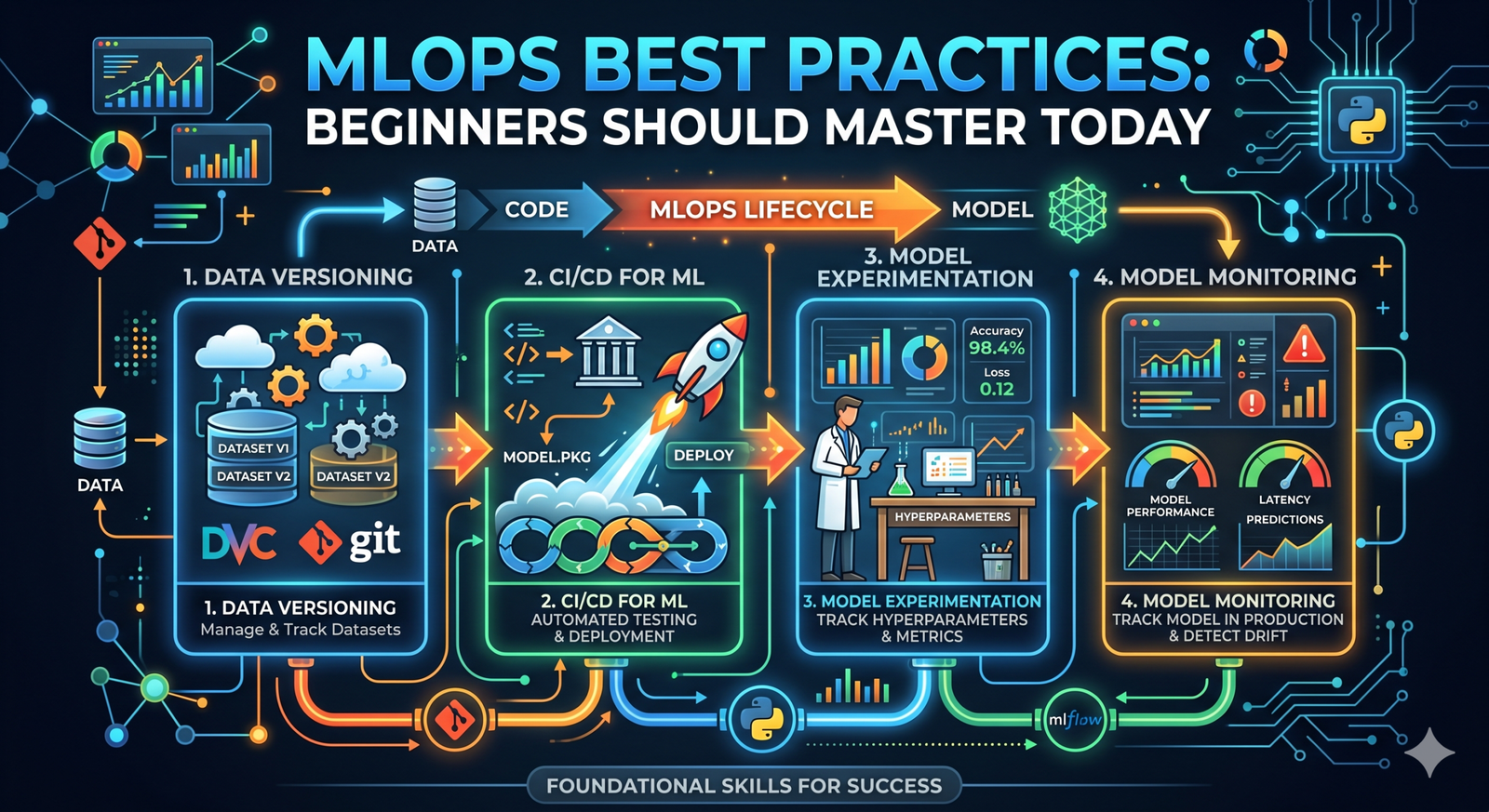
Version Control Everything
Most developers know Git for code. But in ML, code is only one piece of the puzzle. You also have data and model artifacts. If you change the training data slightly, your model results change. Therefore, you must version your data too.
I remember a project where a model suddenly started performing poorly. We spent weeks checking the code. It turned out someone updated the dataset without telling anyone. We had no way to roll back. Don’t let this happen to you. Use tools like DVC (Data Version Control) alongside Git. This way, you can reproduce any experiment exactly.
Automate Your Pipelines
Manual processes are fragile. You might remember to run the script today. But will you remember next month? Probably not. Automation removes human error. You should set up CI/CD (Continuous Integration/Continuous Deployment) pipelines.
When you push code to your repository, the pipeline should automatically test it. It should train the model and run validation checks. If the accuracy drops below a threshold, the deployment stops. This safety net protects your production environment. In addition, it frees you up to focus on improving the algorithm instead of worrying about deployment steps.
Choosing the Right Tools for Your Stack
MLOps Best Practices Beginners Should Master Today-The tooling landscape changes fast. New platforms launch every week. However, the core needs remain the same. You need tracking, orchestration, and serving. Don’t get caught up in hype. Choose tools that fit your team’s size and skills.
For experiment tracking, MLflow is a fantastic open-source option. It lets you log parameters and metrics easily. For orchestration, Kubeflow is powerful but complex. If you are just starting, maybe try Airflow or even simple Python scripts with cron jobs. Honestly, I think beginners often over-engineer this. Start simple. You can always migrate to complex tools later as your needs grow.
Start Small and Scale
There is no need to build a massive Kubernetes cluster on day one. Begin with a single server or a managed cloud service. AWS SageMaker or Google Vertex AI can handle the heavy lifting. These platforms offer built-in MLOps features. They allow you to focus on logic rather than infrastructure. As your traffic grows, you can refactor. This approach reduces initial costs and complexity.
Monitoring Model Performance
MLOps Best Practices Beginners Should Master Today-Once your model is live, you might think you’re done. You aren’t. The world changes. Data changes. This phenomenon is called data drift. Imagine you built a model to predict winter coat sales. It learns from last year’s data. But this year, the weather is unusually warm. Your model will fail because the input data looks different than what it learned.
Therefore, monitoring is critical. You need to track two things: system performance and model performance. System performance checks if the server is up. Model performance checks if the predictions are still accurate. Set up alerts for anomalies. If accuracy drops by 5%, you should know immediately.
Handling Data Drift
When drift happens, you need a retraining strategy. Do you retrain weekly? Monthly? Or only when performance dips? This depends on your use case. A fraud detection model needs frequent updates. A credit scoring model might stay stable longer. Define this policy early. Moreover, keep a shadow mode. Run the new model alongside the old one without affecting users. Compare their outputs before switching fully.
Collaboration Between Teams
MLOps Best Practices Beginners Should Master Today-MLOps is not a solo sport. It requires communication. Data scientists speak one language. Engineers speak another. Business stakeholders speak a third. Miscommunication causes delays. I’ve seen projects stall because the engineer didn’t know the model required a GPU.
To fix this, create shared documentation. Define clear interfaces between components. Use common terminology. Regular stand-up meetings help align everyone. In my view, the technical stuff is easy. The people stuff is hard. Foster a culture where asking questions is encouraged. When teams collaborate, bugs get found faster.

Common Pitfalls to Avoid
MLOps Best Practices Beginners Should Master Today-Even with good intentions, mistakes happen. Being aware of them helps you dodge them. Here are a few traps I see often.
- Ignoring Security: Models can be attacked. Adversarial examples can trick them. Secure your endpoints.
- Hardcoding Paths: Never write
/home/user/datain your code. Use environment variables. - Neglecting Logging: If something breaks, you need logs to find out why. Log inputs and outputs.
Another big issue is testing. Unit tests check code. But you also need data tests. Check for null values or unexpected ranges. If your input data looks weird, stop the pipeline. Don’t let bad data poison your model. Furthermore, document your assumptions. Future you will thank present you.
Building a Culture of Continuous Learning
MLOps Best Practices Beginners Should Master Today-The field evolves rapidly. What works today might be obsolete tomorrow. Therefore, keep learning. Read blogs. Attend webinars. Experiment with new tools in sandbox environments. Encourage your team to do the same.
Knowledge sharing is vital. Hold internal tech talks. Let team members present what they learned. This builds authority within the group. It also ensures everyone stays on the same page. Trust me, a team that learns together grows together. It makes the hard days easier when you have support.
FAQ Section
1. What is the most important MLOps practice for beginners?
Version control is the foundation. Without it, you cannot reproduce results or collaborate effectively. Start by versioning your code and data immediately.
2. Do I need Kubernetes to start with MLOps?
No. Kubernetes is powerful but complex. You can start with simpler tools like Docker or managed cloud services. Scale up only when necessary.
3. How often should I retrain my machine learning model?
It depends on data stability. Some models need weekly retraining. Others last months. Monitor performance metrics to decide when retraining is needed.
4. What is the difference between DevOps and MLOps?
DevOps focuses on software code. MLOps includes code plus data and models. Models behave differently than standard software because they depend on statistical patterns.
5. Can I implement MLOps on a small budget?
Absolutely. Many open-source tools like MLflow and DVC are free. You can run them on modest hardware or free tiers of cloud providers.
Conclusion
Transitioning from experiments to production is a journey. It requires patience and discipline. But by following these MLOps best practices beginners can avoid the most common headaches. You need to version your assets, automate your workflows, and monitor your models constantly.
Remember, technology is only half the battle. Culture matters too. Build bridges between your data scientists and engineers. Keep communication open. And never stop learning. The landscape changes fast, but the fundamentals remain solid.
Ready to start your MLOps journey? Pick one practice from this list and implement it this week. Maybe set up version control for your data. Or maybe add logging to your pipeline. Small steps lead to big changes. If you found this guide helpful, share it with your team. And let me know in the comments: what’s your biggest challenge with model deployment right now?