
10 Best AI Research Tools for Students in 2026: The Ultimate Guide
Remember when “researching” meant spending six hours in the library basement, smelling old paper and praying the one book you needed wasn’t checked out? I do. In my experience writing about academic technology for over a decade, I’ve seen some massive shifts, but nothing compares to the AI revolution we’re living through right now.
Today, the challenge isn’t finding information—it’s filtering the noise. If you’re still just asking a basic chatbot to “write an essay,” you’re missing out on the real power of modern technology. The best AI research tools for students in 2026 don’t just give you answers; they provide verified, peer-reviewed evidence that makes your citations bulletproof.
In this guide, I’ll walk you through the tools I’ve personally tested that will actually help you get that high distinction without losing your mind (or your academic integrity).
Key Takeaways: Quick Summary
- Best for Evidence: Consensus and Elicit are the gold standards for finding peer-reviewed papers.
- Best for General Search: Perplexity AI beats Google for quick, cited overviews.
- Best for Visualization: ResearchRabbit and Litmaps help you see how different studies are connected.
Why You Need Specialized AI Research Tools
Let’s be honest: ChatGPT is great for brainstorming, but it has a nasty habit of “hallucinating” (making things up). According to recent studies, general AI models can still struggle with academic accuracy if they aren’t grounded in real-time databases.
In 2026, professors have higher standards. They want traceability. That’s why using the best AI research tools for students is about more than just speed; it’s about finding primary sources like PubMed, arXiv, and Semantic Scholar.
When I was finishing my Master’s degree, I wasted days manually checking citations. Now, these tools do that in seconds. Therefore, shifting your workflow to AI-native research isn’t just a shortcut—it’s a necessary upgrade for the modern student.
1. Consensus: The “Yes/No” Evidence Engine
If you’ve ever felt overwhelmed by conflicting studies, Consensus is your new best friend. It’s an AI search engine that specifically indexes over 200 million peer-reviewed papers.
The Consensus Meter
What makes this one of the best AI research tools for students is the “Consensus Meter.” You ask a question like, “Does caffeine improve long-term memory?” and the AI scans thousands of abstracts. It then gives you a visual breakdown: 60% say Yes, 20% say No, 20% are Uncertain.
Why Students Love It:
- Scientific Rigor: Every answer is backed by a real study.
- Instant Summaries: It synthesizes the “bottom line” of multiple papers so you don’t have to read every intro.
- SJR Rankings: It even shows you the quality of the journal where the paper was published.
2. Perplexity AI: The Google Killer
I’ll say it: I barely use standard search engines anymore. Perplexity AI has become my go-to for the “Discovery” phase of research. It works like a conversation but provides inline citations for every single claim it makes.
Focus Modes
In 2026, Perplexity’s “Academic” focus mode is a game-changer. It narrows its search to Semantic Scholar, ensuring you aren’t just getting info from a random blog or Reddit thread. Moreover, it links directly to the PDFs, which is a massive time-saver.
Personal Tip: Use Perplexity to understand a broad topic first. I recently used it to wrap my head around “Quantum Cryptography.” In 30 seconds, it gave me a summary and five foundational papers to start with.
3. Elicit: Your AI Research Assistant
If Consensus is for quick answers, Elicit is for the deep dive. It’s designed to automate the “Literature Review” process.
Data Extraction Tables
Elicit can find 40 relevant trials and instantly extract the sample size, methodology, and results into a sortable table. This used to take researchers weeks. Now, it’s a “one-click” job. It’s easily one of the best AI research tools for students working on a thesis or a major capstone project.
Sub-Features of Elicit:
- Chat with Paper: Upload a PDF and ask, “What were the limitations of this study?”
- Concept Mapping: It helps you find related concepts you might have missed in your initial search.
4. ResearchRabbit: The “Spotify for Papers”
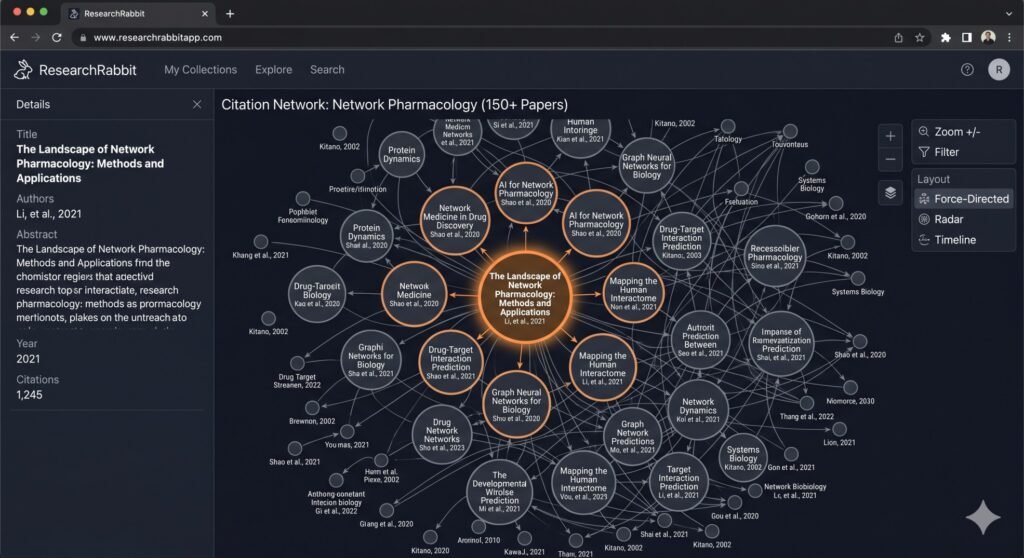
I absolutely love the interface of ResearchRabbit. It’s a visual discovery tool that maps out the “citation galaxy” of your topic.
Visualizing the Network
You start with one “seed paper,” and ResearchRabbit shows you all the papers it cited and everyone who has cited it since. It creates a web of bubbles that makes it incredibly easy to find the most influential (seminal) works in your field.
5. NotebookLM: The Ultimate Study Buddy
Google’s NotebookLM is a bit different. Instead of searching the whole web, you feed it your sources—your textbooks, lecture notes, and downloaded PDFs.
Grounded Intelligence
Because it only looks at the documents you provide, the risk of hallucination is almost zero. You can ask it to “create a study guide based on Chapter 4” or “summarize the conflicting arguments in these three papers.” It’s like having a tutor who has read your entire syllabus.
Comparing the Top AI Research Tools
Not sure which one to pick? Here’s a quick comparison to help you choose the right tool for your current task:
| Tool | Best For | Source Quality | Price |
|---|---|---|---|
| Consensus | Quick evidence-backed answers | Peer-reviewed only | Free (Pro available) |
| Perplexity | Broad overviews & fact-checking | Web + Academic | Free / $20/mo |
| Elicit | Literature reviews & data tables | Academic papers | Credit-based / Paid |
| ResearchRabbit | Mapping citation networks | Academic papers | Free |
| NotebookLM | Analyzing your own notes/PDFs | Your uploads only | Free |
Ethical Use: Staying Within Academic Guidelines
Wait! Before you go full “AI-mode,” we need to talk about academic integrity. In 2026, universities are using sophisticated tools like Turnitin Clarity that look at the process of your writing, not just the final product.
To keep your work ethical, follow these rules:
- Always Verify: AI can misinterpret a study’s conclusion. Open the PDF and make sure the data matches what the AI told you.
- Cite Everything: Use tools like Zotero or Mendeley (which now have AI integrations) to manage your references.
- Use as an Assistant, Not a Ghostwriter: Use AI to find papers, summarize complex ideas, and organize your thoughts. Do the actual writing yourself.
FAQ: Best AI Research Tools for Students
1. Is using AI for research considered cheating?
Generally, no. Most universities encourage using the best AI research tools for students for discovery, summarization, and organization. However, submitting AI-generated text as your own is cheating. Always check your specific course handbook!
2. Are these AI tools free for students?
Many have generous free tiers. ResearchRabbit is 100% free, while Consensus and Elicit offer a limited number of free searches or “credits” each month.
3. Which AI tool is best for medical or science students?
Consensus and Elicit are top-tier for STEM because they prioritize peer-reviewed, empirical data over general web content.
4. Can I use ChatGPT for citations?
I wouldn’t recommend it. ChatGPT often “invents” citations that look real but don’t exist. Use Perplexity or Consensus if you need reliable references.
5. How do I cite an AI tool in my paper?
This depends on your style guide (APA, MLA, Chicago). Usually, you cite the AI only if you used its direct output. If you just used it to find a paper, you simply cite the paper itself!
Conclusion: Level Up Your Research Game
The landscape of education has changed forever. By mastering the best AI research tools for students, you aren’t just saving time—you’re becoming a more thorough, evidence-based researcher.
Whether you’re using Consensus to settle a debate or ResearchRabbit to map out your thesis, these tools are there to amplify your brainpower, not replace it. Honestly, I think the students who embrace these tools ethically are the ones who will lead their fields in the years to come.
What do you think? Have you tried any of these tools yet, or is there another one I missed? Let me know in the comments below—I’d love to hear your experiences!