Don’t Be Intimidated: Why AI Literacy Skills Are Your New Superpower
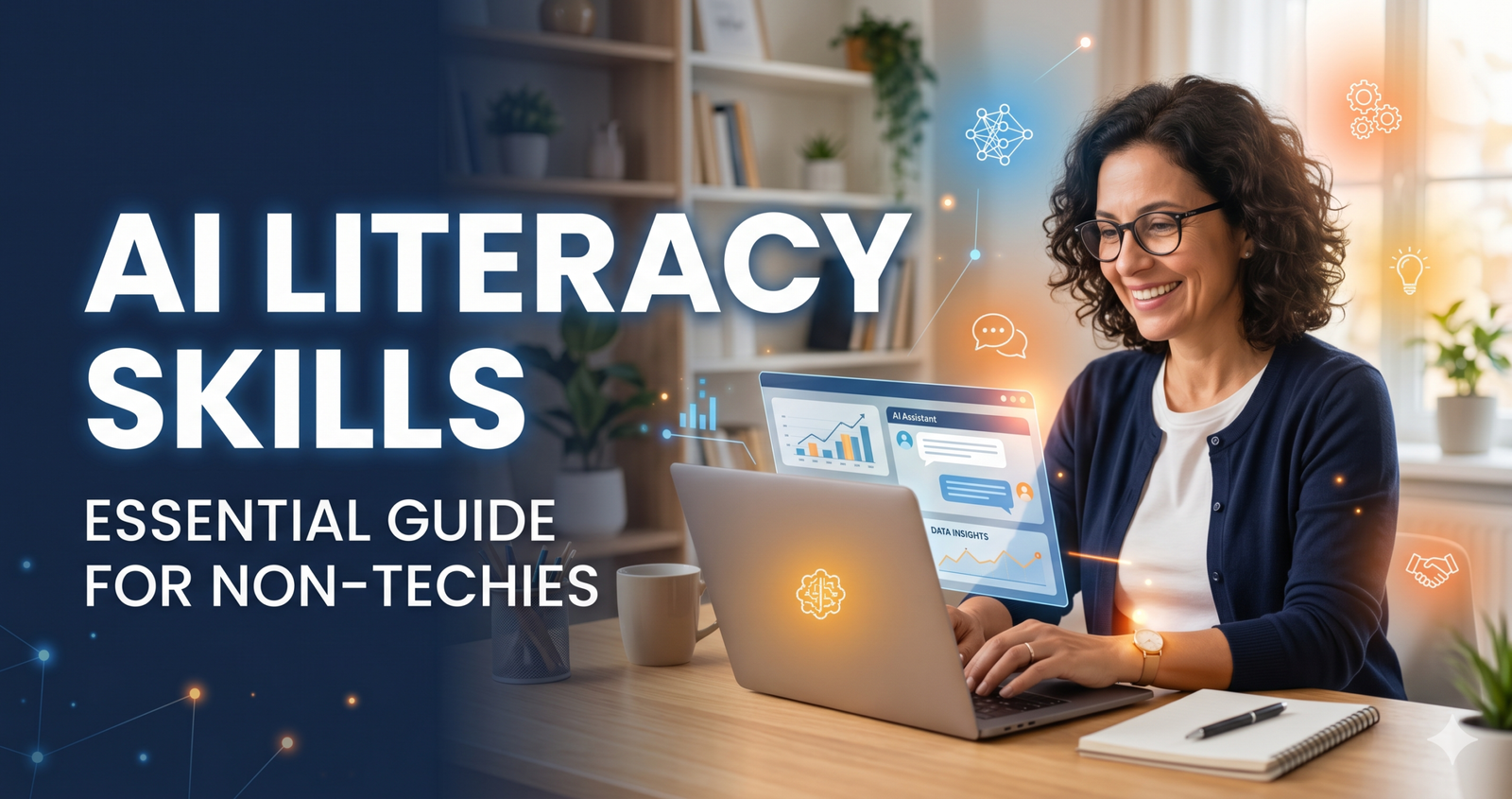
AI Literacy Skills: Essential Guide for Non-Techies-Let’s be real. When you hear “Artificial Intelligence,” you might picture sci-fi robots or complex code. You might think, “That’s for the tech experts, not for me.” I used to feel that way too. But here’s the thing: the AI revolution isn’t just for programmers. In my experience writing about and using AI tools daily, I’ve seen that AI literacy skills are becoming as fundamental as knowing how to use email or the internet. They are your ticket to working smarter, not harder.
So, what if you could confidently use AI to draft emails, analyze data, or brainstorm ideas in half the time? That’s not a far-off future. That’s today. This guide is for you—the teacher, marketer, project manager, writer, or small business owner. We’ll break down what AI literacy really means, why it’s a game-changer for your career, and the practical skills you can start building this week. No PhD required.
Key Takeaways:
- AI literacy isn’t about building AI; it’s about using it effectively and critically.
- You don’t need to code to benefit. Focus on prompt engineering, ethical evaluation, and tool selection.
- Start small. Integrate one AI tool into a routine task to build confidence and see real value.
AI Literacy Skills: Essential Guide for Non-Techies-What Exactly Are “AI Literacy Skills”? (And What They’re Not)
First, let’s clear up a huge misconception. AI literacy does not mean you need to understand algorithms, neural networks, or how to train a model. That’s AI engineering.
Instead, think of AI literacy skills as the ability to understand, interact with, evaluate, and collaborate with artificial intelligence systems effectively and responsibly. It’s about being a savvy consumer and collaborator, not a creator.
In my view, AI literacy is like learning to drive a car. You don’t need to be an automotive engineer who can rebuild the engine. You need to know the rules of the road (ethics), how to read the dashboard (interpret outputs), and how to steer to your destination (prompt the tool correctly).
The Core Components for Everyday Users
AI Literacy Skills: Essential Guide for Non-Techies-For non-technical professionals, AI literacy breaks down into three main areas:
- Foundational Understanding: Knowing what AI is (and isn’t), its basic capabilities (like generating text, images, or recommendations), and its significant limitations (it can be wrong, biased, or make things up).
- Practical Application Skills: This is the hands-on part. It’s knowing how to use specific AI tools for your work. This includes prompt engineering (the art of giving clear instructions to an AI), understanding different AI models for different tasks, and integrating AI into your existing workflows.
- Critical Evaluation & Ethics: This is your superpower. It’s the ability to spot AI-generated misinformation, check for bias in results, understand data privacy concerns, and know when not to rely on AI. It’s asking, “Is this output accurate? Fair? And did it use my data responsibly?”
AI Literacy Skills: Essential Guide for Non-Techies-Why AI Literacy Skills Are Non-Negotiable for Your Career
Still not convinced? Consider this. A 2023 report from McKinsey Global Institute suggests that generative AI could automate tasks that currently take up 60-70% of employees’ time. That doesn’t mean it will replace you, but it will drastically change how you work.
Here’s how mastering AI literacy directly benefits you:
- Massive Productivity Gains: You can offload repetitive tasks. For example, using AI to summarize long reports, draft first versions of presentations, or transcribe meeting notes can save you 5-10 hours every week. That’s time for high-value strategic work.
- Enhanced Creativity and Problem-Solving: Think of AI as a brainstorming partner that never sleeps. It can generate 20 marketing slogans in 30 seconds or suggest solutions to a logistical problem you hadn’t considered.
- Future-Proof Your Role: Professionals who can leverage AI will become centaurs—a human-AI hybrid that’s far more effective than either alone. You’ll be the person who knows how to get the best out of these powerful tools, making you invaluable to any team.
- Better Decision-Making: AI can analyze vast datasets far quicker than any human, uncovering trends and insights. Your literacy skill is knowing what questions to ask it and how to interpret the results to make smarter business decisions.
Building Your Toolkit: 5 Essential AI Literacy Skills to Master
AI Literacy Skills: Essential Guide for Non-Techies-Ready to build your skills? Here are the five most important areas for a non-technical person to focus on.
1. The Art of the Prompt: Crafting Effective Instructions
This is the #1 skill to practice. AI tools are incredibly powerful, but their output is only as good as your input. A vague prompt gets a vague answer.
- Bad Prompt: “Write about marketing.”
- Good Prompt: “Act as a social media manager for a small bakery. Write a 200-word Instagram caption for our new seasonal pumpkin spice cookie. The tone should be warm and friendly. Include 3 relevant hashtags and a call-to-action to visit our shop.”
Pro Tip: Use the CLEAR framework for prompting: Context, Length, Examples, Audience, Result. Give the AI context, specify the length, provide examples if you have them, define your audience, and state the desired result.
2. Tool Selection: Knowing Which AI for Which Job
Not all AI is created equal. You don’t use a hammer to screw in a bolt. Similarly, you wouldn’t use a code-generation AI to write a poem.
- For Writing & Ideas: Tools like Jasper, Copy.ai, or ChatGPT are fantastic for brainstorming, drafting content, and overcoming writer’s block.
- For Data & Analysis: Tools with Microsoft Copilot in Excel or Google’s Gemini in Sheets can help you analyze data, create charts, and find patterns using plain language.
- For Images & Design: Canva’s AI features, Midjourney, or Adobe Firefly can generate visuals, create variations of designs, or remove backgrounds.
- For Productivity: AI features in Zoom, Otter.ai, and Notion can summarize meetings, organize notes, and automate task lists.
3. Critical Output Evaluation: Trust, But Verify
This is where your human judgment shines. Never take AI output at face value.
- Check for “Hallucinations”: AI can confidently state false information. Always fact-check key claims, statistics, and names. If it cites a source, click the link (if available) to confirm.
- Look for Bias: AI models are trained on human data, which can include historical biases. Ask yourself: Is the output stereotyping? Is it representing a diverse perspective? You are the final editor for fairness.
- Assess the “Vibe”: Does the tone sound right? Is it original, or does it sound like generic AI-speak? Your job is to inject the personality, nuance, and brand voice that only a human can.
4. Understanding Basic Concepts (Just Enough!)
You don’t need to be an expert, but knowing a few terms helps you navigate the landscape.
- Generative AI: AI that can create new content (text, images, code).
- Large Language Model (LLM): The type of AI that powers chatbots like ChatGPT. It’s trained on a huge amount of text data.
- Fine-Tuning: The process of further training an AI on specific data to make it more accurate for a particular task (like your company’s customer service responses).
- Ethics & Privacy: Always consider what data you’re inputting. Avoid sharing sensitive personal or confidential business information with public AI tools.
5. Cultivating an “AI Mindset”
This is the overarching habit. It’s the reflex to ask: “Could an AI help with this?”
When faced with a task, pause and break it down. Part of your workflow might be ripe for AI assistance—research, summarizing, first drafts, scheduling, data sorting. By consistently asking this question, you’ll naturally discover new and powerful ways to integrate AI into your work.
AI Literacy Skills: Essential Guide for Non-Techies-Real-World Applications: How Different Non-Techies Use AI
Let’s move from theory to practice.
- The Marketing Manager: Uses AI to generate 10 different email subject lines, analyze sentiment in customer reviews, and create personalized ad copy variations for A/B testing.
- The HR Professional: Uses AI to draft job descriptions, screen resumes for key skills (with human oversight for bias), and create FAQ documents for employee handbooks.
- The Consultant: Uses AI to analyze a 100-page industry report in minutes, summarize client interview transcripts, and build the initial framework for a client presentation.
- The Teacher: Uses AI to create differentiated lesson plans for various learning levels, generate quiz questions on a specific topic, and provide students with interactive learning examples.
The pattern is the same: AI handles the scalable, data-heavy, or first-draft work, freeing up the human to focus on strategy, empathy, and final judgment.
AI Literacy Skills: Essential Guide for Non-Techies-The Ethical Responsibility: Don’t Forget the “Human in the Loop”
With great power comes great responsibility. Using AI literacy skills ethically is paramount.
- Transparency: In many cases, you should disclose when you’ve used AI to create content. Be proud of using tools efficiently, but be honest.
- Accountability: You are responsible for the final output. If you publish an AI-generated article that contains a factual error, it’s on you. If an AI image you use infringes copyright, the liability rests with the user who deployed it.
- Data Privacy: As a rule of thumb, treat public AI tools like you would a public space. Don’t input confidential client data, proprietary business strategies, or personal identifiable information (PII) unless using a secure, enterprise-grade tool.
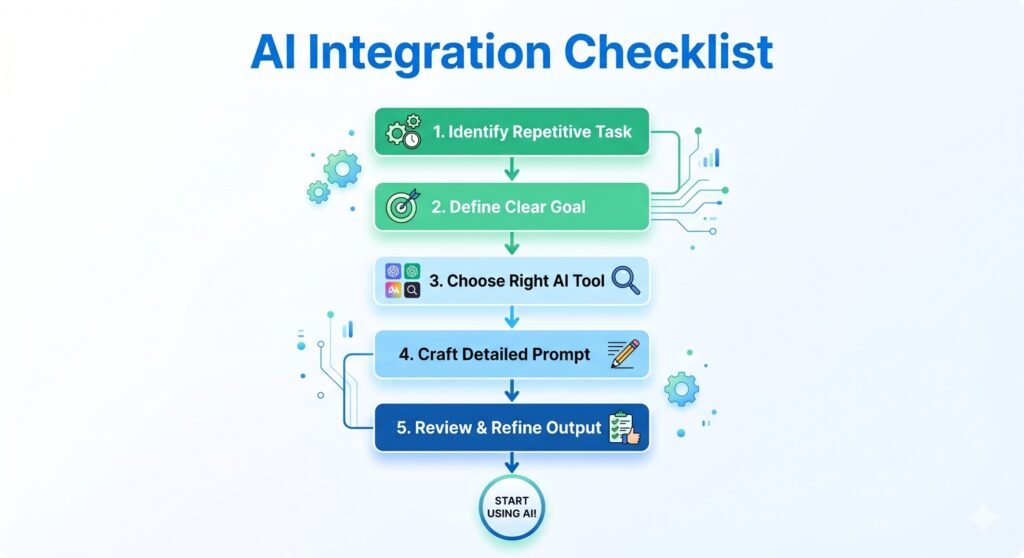
AI Literacy Skills: Essential Guide for Non-Techies-Your First Step to AI Literacy: The 30-Minute Challenge
Feeling motivated? Don’t let it fade. Here’s a simple challenge for you.
This week, pick ONE repetitive task you do and use AI to help with it.
- Choose a Task: (e.g., Writing a weekly status report email, brainstorming social media post ideas, summarizing notes from a long article).
- Pick a Tool: (e.g., ChatGPT, the AI in your email client, Canva).
- Spend 30 Minutes: Craft a detailed prompt, generate the output, and then heavily edit and refine it with your expertise.
That’s it. You’ve just taken your first step. The goal isn’t perfection; it’s familiarization.
Frequently Asked Questions (FAQs)
1. Do I need to learn Python to be AI literate?
Absolutely not. For non-technical professionals, AI literacy is about using existing tools via natural language interfaces (typing prompts). Learning a programming language like Python is related to AI development, not AI literacy.
2. Are free AI tools like ChatGPT good enough to learn with?
Yes, they’re perfect for starting out. Free tiers of ChatGPT, Gemini, and Canva’s AI features are powerful enough to learn prompt engineering and core skills. As your needs grow, you might explore paid plans with more features and better performance.
3. How can I tell if something I’m reading online is written by AI?
It’s getting harder, but look for these signs: a generic or overly neutral tone, a lack of personal anecdotes or original opinions, perfect grammar but sometimes awkward phrasing, and a tendency to list points without deep, nuanced analysis. Always cross-reference facts with authoritative sources.
4. Will using AI make me lazy or less skilled?
This is a common fear, but the opposite is true. AI handles drudgery, freeing you to practice higher-order skills like critical thinking, creative strategy, and emotional intelligence. It’s a tool that, when used well, amplifies your expertise rather than replacing it.
5. What’s the biggest risk for non-techies using AI?
The biggest risk is over-reliance without critical evaluation. Blindly trusting AI output for important decisions, publishing unvetted content, or sharing sensitive data can lead to errors, reputational damage, or privacy breaches. Your human judgment is the essential safeguard.
Conclusion: Embrace the Future, One Prompt at a Time
The world of AI isn’t a tidal wave that will wash non-technical people away. Instead, it’s a powerful current that, if you learn to navigate it, can carry you to amazing new places in your career and creativity. Mastering AI literacy skills isn’t about chasing every new tech trend; it’s about building a foundational competency for the 21st-century workplace.
You’ve now got the map. You know it’s not about coding, but about critical thinking and smart tool use. You understand the core skills: prompting, evaluating, and applying AI ethically.
So, here’s my challenge to you: Stop reading and start doing. Pick that one task for your 30-minute challenge this week. Play with an AI tool. Break it. Learn its limits. Use it to do something that used to be tedious.
The future belongs to the human-AI team. It’s time to claim your spot on that team.
What’s the first task you’re going to try with AI? Share it in the comments below! If you found this guide helpful, consider sharing it with a colleague who might also benefit.