

Table of Contents
EU AI Act Compliance Guide 2026: Key Deadlines & Requirements If you’ve been treating the AI EU Act compliance guide 2026 as a “future problem,” I have some news that might make your morning coffee go down a bit faster: the clock is officially ticking. By August 2, 2026, the majority of the European Union’s landmark Artificial Intelligence Act will be fully enforceable.
In my experience writing about digital regulations, I’ve seen companies scramble at the last minute for GDPR and the DMA. Trust me, you don’t want to do that here. The AI Act isn’t just a set of “polite suggestions.” It’s a rigorous legal framework that carries fines higher than almost any other regulation we’ve seen.
Whether you’re a developer in Berlin or a SaaS founder in San Francisco selling to European clients, this guide will walk you through exactly what you need to do to stay on the right side of the law this year.
Key Takeaways:
- August 2, 2026: The hard deadline for most AI systems, especially those labeled “High-Risk.”
- Risk Tiers: Your obligations depend entirely on whether your AI is “Minimal,” “Limited,” “High,” or “Unacceptable.”
- Fines: Non-compliance can cost up to €35 million or 7% of global turnover—whichever is higher.
Why 2026 is the “Make or Break” Year for AI Compliance
While the AI Act technically entered into force back in 2024, it has been rolling out in phases. We already saw “Unacceptable” AI practices—like social scoring and certain biometric systems—banned in early 2025. Then, in August 2025, General-Purpose AI (GPAI) providers had to step up their game.
However, August 2, 2026 is the big one. This is when the rules for “High-Risk” AI systems (Annex III) become mandatory. If your AI helps decide who gets a job, who gets a loan, or how critical infrastructure is managed, you are now in the crosshairs of EU regulators.
In my view, 2026 is the year the “Wild West” of AI development officially ends in Europe. We are moving from “move fast and break things” to “move carefully and document everything.” It’s a shift in culture as much as it is a shift in code.
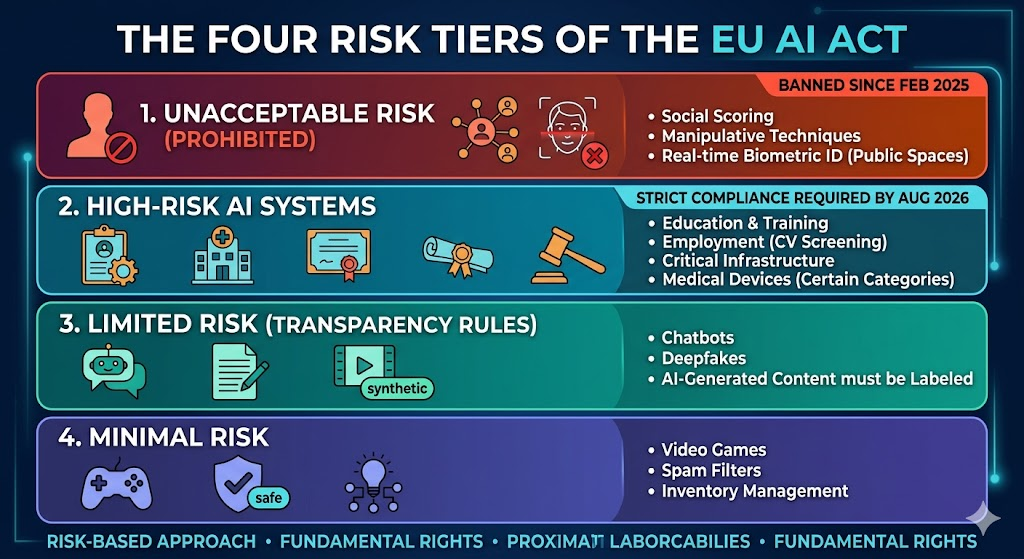
Understanding the 4 Risk Tiers in 2026
The AI EU Act compliance guide 2026 hinges on a risk-based approach. You can’t comply if you don’t know where you sit on the ladder.
1. Unacceptable Risk (Prohibited)
These systems have been banned since February 2025. If you are still using AI for “dark pattern” manipulation or untargeted scraping of facial images for databases, you aren’t just out of compliance—you’re breaking the law today.
2. High-Risk AI Systems
This is where most of the heavy lifting happens in 2026. High-risk systems include AI used in:
- Education and vocational training.
- Employment and worker management (CV screening, etc.).
- Access to essential private and public services.
- Law enforcement and border control.
3. Limited Risk (Transparency Rules)
If you run a chatbot or use AI to generate “Deepfake” content, your main job is transparency. You must ensure users know they are interacting with an AI.
4. Minimal Risk
This covers things like AI-enabled video games or spam filters. For these, the Act mostly stays out of your way, though the EU encourages voluntary codes of conduct.
Step-by-Step Checklist for High-Risk AI Compliance
If you’ve determined your system is “High-Risk,” you have a mountain of paperwork—and technical adjustments—ahead of you. Honestly, I think the “Technical Documentation” requirement is the one that will catch most teams off-guard. It’s not just a README file; it’s a deep dive into your architecture.
Establish a Risk Management System (RMS)
You need a continuous process that identifies and analyzes risks to health, safety, and fundamental rights. This isn’t a “one and done” audit. You must test your system against potential misuse and document how you’ve mitigated those risks.
Data Governance and Quality
According to authoritative sources like the European Commission, datasets used for training high-risk models must be “relevant, representative, and to the best extent possible, free of errors.”
Moreover, you need to prove you’ve checked for biases. I once spoke with a developer who thought “we didn’t include race in the data” was enough. Under the 2026 rules, that’s not enough. You have to actively test for proxy variables that could lead to discriminatory outcomes.
The “Human-in-the-Loop” Requirement
High-risk systems must be designed so they can be effectively overseen by humans. This means building interfaces that allow a human to understand the “why” behind an AI’s decision and, if necessary, override it or hit the “kill switch.”
General-Purpose AI (GPAI) and Systemic Risk
We can’t talk about an AI EU Act compliance guide 2026 without mentioning the giants: Large Language Models (LLMs). If you are a provider of a GPAI model, you have specific transparency duties.
- Technical Documentation: You must keep detailed records for the AI Office.
- Copyright Compliance: You need a policy to respect EU copyright law.
- Training Summaries: You must publish a summary of the content used to train the model.
If your model is massive—specifically if it was trained with more than $10^{25}$ floating-point operations (FLOPs)—it’s classified as having “systemic risk.” These models face even stricter rules, including mandatory adversarial testing and incident reporting.
Penalties: The Cost of Getting it Wrong
Let’s talk numbers, because they are terrifying. The EU isn’t playing around. If you violate the bans on prohibited AI, the fine can reach €35,000,000 or 7% of your total worldwide annual turnover.
For most other non-compliance issues (like failing to meet high-risk requirements), the fine is up to €15,000,000 or 3%. Even providing “incorrect or misleading information” to regulators can cost you €7.5 million.
Therefore, the cost of compliance, while high, is significantly lower than the cost of a single major violation. Think of it as an insurance policy for your company’s future.
How to Prepare Your Team for August 2026
I’ve personally used several “AI Governance” tools over the last year, and the best thing you can do right now is inventory. You can’t regulate what you don’t track.
- Create an AI Inventory: List every AI tool your company uses, whether built in-house or bought from a vendor.
- Assign Ownership: Who is your “AI Compliance Officer”? If you don’t have one, someone in Legal or Engineering needs to own this.
- Audit Your Vendors: If you use a third-party AI for hiring, ask them for their “Declaration of Conformity.” If they can’t provide it, you might be the one liable for their mistakes.
- Update Your Privacy Policy: Make sure your transparency disclosures are clear and meet the new standards.
FAQ: Common Questions About AI EU Act Compliance 2026
1. Does the EU AI Act apply to companies outside the EU?
Yes. If your AI system is placed on the market in the EU or its output is used within the EU, the law applies to you, regardless of where your headquarters are located.
2. What is the deadline for high-risk AI systems in 2026?
The primary deadline is August 2, 2026. However, if your AI is embedded into a product already covered by EU safety laws (like medical devices), you may have until August 2027.
3. Are SMEs and startups exempt?
No, but there are some “protections.” The EU has promised to set up “Regulatory Sandboxes” to help smaller companies test their AI. Fines for SMEs are also capped at lower levels, but they aren’t zero.
4. What happens if I use an AI model like GPT-4?
As a deployer (user), your responsibilities are lighter than the provider (OpenAI). However, if you use it for a high-risk purpose—like screening tenants—you still have significant compliance duties.
5. Is there a “grace period” after August 2026?
Not really. The grace period is happening now. By the time August 2, 2026, rolls around, the authorities expect you to have your “CE marking” and documentation ready to go.
Final Thoughts: Don’t Wait Until July
Wrapping your head around the AI EU Act compliance guide 2026 is no small feat. It’s complex, it’s bureaucratic, and it’s a bit scary. But it’s also an opportunity. Companies that can prove their AI is safe, transparent, and ethical will win the trust of the European market.
In addition to avoiding fines, compliance can actually be a competitive advantage. I’ve seen customers choose one software over another simply because the first could provide a clear audit trail of their AI decisions.
Don’t wait until the summer of 2026 to start your audit. Start today. Your legal team (and your bank account) will thank you.
What’s your biggest concern regarding the AI Act? Let me know in the comments below, or share this guide with your dev team to get the conversation started!