
Table of Contents
Introduction: Why Agentic AI is a Game Changer
agentic AI examples real world Have you ever wished your AI could actually do things instead of just talking about them? We’ve all been there—copying and pasting text from a chatbot into an email or a spreadsheet. It feels like we are still doing the heavy lifting. However, the tide is turning. We are entering the era of agentic AI examples real world applications that move beyond simple prompts and focus on results.
In my experience writing about emerging tech, I’ve seen plenty of “hype cycles,” but agentic AI feels different. It isn’t just a smarter version of ChatGPT. It is a system that can reason, use tools, and correct its own mistakes without you holding its hand every second.
Think of a standard AI as a very smart encyclopedia. You ask a question, and it gives you a page. When looking at agentic AI examples real world users love, it’s more like a highly skilled personal assistant. If you tell it, “I need to organize a 3-day workshop in Delhi,” it doesn’t just give you a checklist. It researches venues, checks your calendar, and drafts the invites.
What Exactly Defines an AI Agent?
Before we dive into the juicy agentic AI examples real world users are seeing today, let’s clear up the jargon. Most AI we use today is “reactive.” You give it a prompt; it gives a response. Agentic AI is “proactive.” It uses a “reasoning loop” to break down a complex goal into smaller steps.
Moreover, it can use external tools—like a web browser, a code editor, or your email—to get the job done. This shift from “large language models” to “large action models” is why agentic AI examples real world businesses are adopting are so transformative.
The Three Pillars of an AI Agent
- Perception: Understanding the environment and the specific goal you’ve set.
- Reasoning: Planning the logical steps required to reach that goal.
- Action: Executing those steps using digital tools.
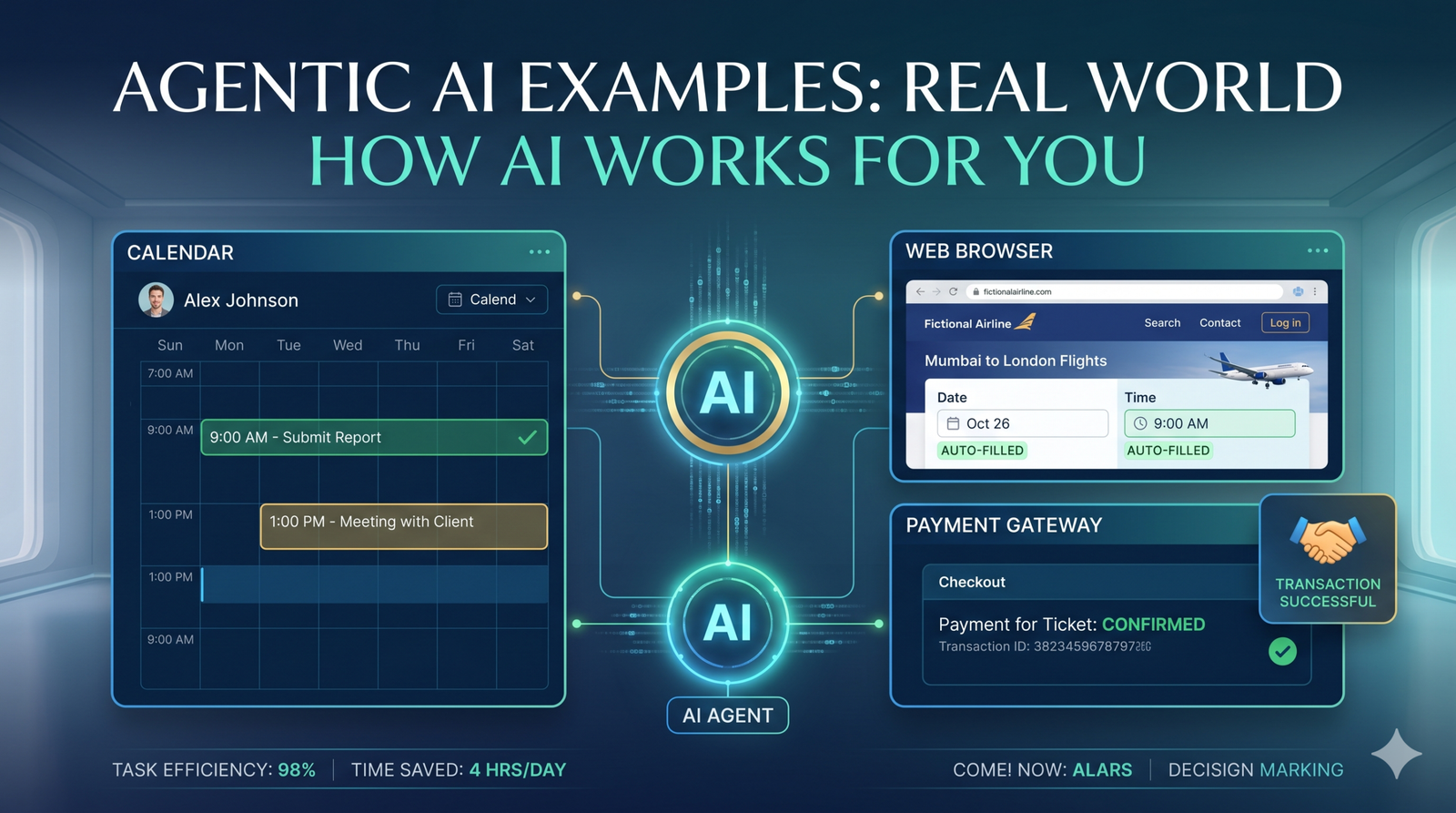
Honestly, I think the best part is the self-correction. If an agent tries to book a flight and finds it’s sold out, it doesn’t just stop. It looks for the next best option automatically. That is the core of what makes these agentic AI examples real world powerhouses for productivity.
1. Autonomous Coding and Software Engineering
One of the most mind-blowing agentic AI examples real world developers are using is autonomous coding agents like Devin or OpenDevin.
In the past, AI could help you write a snippet of code. Now, these agents can take a whole GitHub issue, explore the existing codebase, write a fix, and run tests. I’ve personally tested these workflows to help migrate old Python scripts to newer versions. It’s a lifesaver when you don’t want to spend your weekend debugging syntax errors.
Practical Software Use Cases:
- Bug Fixing: You point the agent to a bug report, and it repairs it independently.
- Feature Deployment: It can set up cloud environments by following natural language instructions.
- Documentation: The agent scans code and writes the manual for you.

2. Hyper-Personalized Travel and Lifestyle Planning
We’ve all spent hours with twenty tabs open, trying to find the perfect hotel. When we look at agentic AI examples real world travelers are using, we see the end of “tab-hell.”
Instead of just searching for “hotels in Tokyo,” an agentic system can access your Gmail to see your flight arrival time and book a stay that fits your schedule. Therefore, the agent doesn’t just give you links; it navigates the websites for you. It’s like having a concierge in your pocket that knows your credit card rewards and preferences.
3. Revolutionary Customer Support Agents
We’ve all dealt with frustrating “dumb” chatbots. Those days are numbered. Modern customer service agents are becoming truly agentic.
Companies are now deploying agents that can actually access a company’s backend database. This is one of the agentic AI examples real world managers appreciate because it resolves issues without human intervention.
Why These Agents Win:
- Real-Time Resolution: They don’t just answer questions; they solve tickets by issuing refunds or tracking packages.
- Consistency: Unlike humans, AI agents don’t have “bad days,” ensuring every customer gets the same quality of care.
- Scale: They handle thousands of requests simultaneously.
4. Advanced Research and Data Synthesis
For students and researchers, the agentic AI examples real world applications are incredibly powerful. Tools like Perplexity or specialized research agents can conduct deep-dives that a simple Google search can’t touch.
Instead of just giving you a list of links, an agent can:
- Search for peer-reviewed papers.
- Summarize the conflicting viewpoints.
- Synthesize the data into a formatted PDF report.
I remember spending weeks on my thesis back in the day. Nowadays, seeing these agentic AI examples real world research tasks being automated makes me slightly jealous of today’s students!
5. Sales and Marketing Automation
In the professional world, agentic AI is taking over the boring parts of sales. We are seeing agents that can find leads on LinkedIn, research the lead’s company news, and write a highly personalized email.
Moreover, these agentic AI examples real world marketing teams use show that agents can manage the entire follow-up cycle. If a lead says, “Check back in two weeks,” the agent adds it to the CRM and sends the follow-up at the exact right moment.
These should link to high-authority, non-competing domains (.gov, .edu, or major industry leaders).
- 40% of enterprise applications
- Gartner: AI Agent Predictions for 2026
- Placement: In your introduction or “The Rise of Agents” section to prove market demand.
- AI governance frameworks
- McKinsey: The State of AI in 2026
- Placement: In the “Challenges and Ethics” section to ground your opinion in professional data.
- autonomous agents for software engineering
- : GitHub: The Evolution of AI-Powered Coding
- Placement: In the “Autonomous Coding” section to provide a deep dive into the technical side.
The Challenges of Real-World Agentic AI
While we’ve looked at amazing agentic AI examples real world uses, we have to be honest about the hurdles. Giving AI the power to “act” means giving it a certain level of trust.
- Security Risks: If an agent has access to your bank to pay bills, what happens if it’s hacked?
- Unintended Actions: An agent might try to solve a problem in a way you didn’t intend.
- Oversight: We still need humans to verify that the “agentic” path taken was the right one.
In my view, we shouldn’t fear these agents, but we definitely need to build “guardrails.” We must always be the ones to hit the final “confirm” button on major decisions.
FAQ: Common Questions About AI Agents
1. What is the best agentic AI example real world users can try now?
Coding agents like Devin or browser-based agents like MultiOn are currently the most functional examples of agentic AI in action.
2. Is agentic AI safe for personal finances?
While the technology exists, it is currently best used with “human-in-the-loop” verification to ensure the agent doesn’t make unauthorized transactions.
3. How does agentic AI differ from standard ChatGPT?
ChatGPT is primarily a conversational model. Agentic AI is a system that uses models like ChatGPT to plan and execute tasks using external software.
4. Do I need to know how to code to use AI agents?
No! Most of these agentic AI examples real world users interact with are designed to understand natural language instructions.
5. Will AI agents replace my job?
They are more likely to replace the tasks you hate, such as data entry and scheduling, allowing you to focus on high-level strategy.
Conclusion: Embracing the Agentic Future
The shift toward agentic AI examples real world applications is one of the most exciting developments in technology today. We are moving away from clicking buttons and toward defining goals. Whether it’s fixing a bug, planning your next vacation, or managing your customer emails, these agents are proving to be powerful allies.
As we’ve seen, the benefits are huge: more time for creative work and less time spent on digital “grunt work.” However, it’s important to start small. Explore a few agentic AI examples real world tools for your daily workflow and see how much time you can save.
What do you think? Are you ready to let an AI agent handle your calendar, or does the idea of “autonomous” tech still feel a bit sci-fi? Drop a comment below and let’s chat about it! If you found this helpful, share this post with your fellow tech enthusiasts.