
Table of Contents
AI is no longer just a buzzword—it’s your research assistant, data analyst, and productivity partner all rolled into one. If you’re still manually digging through endless PDFs and reports, you’re wasting time.According to McKinsey’s AI adoption report, businesses are rapidly integrating AI into research and knowledge work, making AI tools essential in 2026.
In this deep research AI tools list 2026, I’ll walk you through the most powerful tools that can completely transform how you research, analyze, and create content. This deep research AI tools list 2026 is designed for students, professionals, and creators who want faster and smarter results.
In my experience writing about AI tools and testing dozens of them, a few truly stand out. Some impressed me. Others? Not so much. Let’s focus on what actually works.
🔹 Quick Summary (Key Takeaways)
- AI research tools can cut your research time by 50–80%
- The best tools combine data analysis, summarization, and citation features
- Choosing the right tool depends on your use case (academic, business, content)
Introduction: Why Deep Research AI Tools Matter in 2026
Let’s be real—research today is overwhelming.
Here’s the deep research AI tools list 2026 based on performance, usability, and real-world testing. I’ve personally explored many of these tools, and this curated deep research AI tools list 2026 focuses only on those that deliver consistent value.
According to industry reports from sources like McKinsey AI research, AI adoption in knowledge work has increased dramatically in the last 3 years.
Therefore, using AI for research isn’t optional anymore—it’s a competitive advantage.
What Are Deep Research AI Tools?
Deep research AI tools are advanced software that use machine learning and natural language processing (NLP) to:
- Analyze large datasets
- Summarize academic papers
- Extract insights from documents
- Generate reports with references
Unlike basic chatbots, these tools are designed for serious, high-level research work.
Best Deep Research AI Tools List 2026
Here’s the curated list based on performance, usability, and real-world results.Using tools from this deep research AI tools list 2026 can dramatically improve your workflow. In fact, many professionals now rely on this deep research AI tools list 2026 to stay competitive in fast-paced industries.
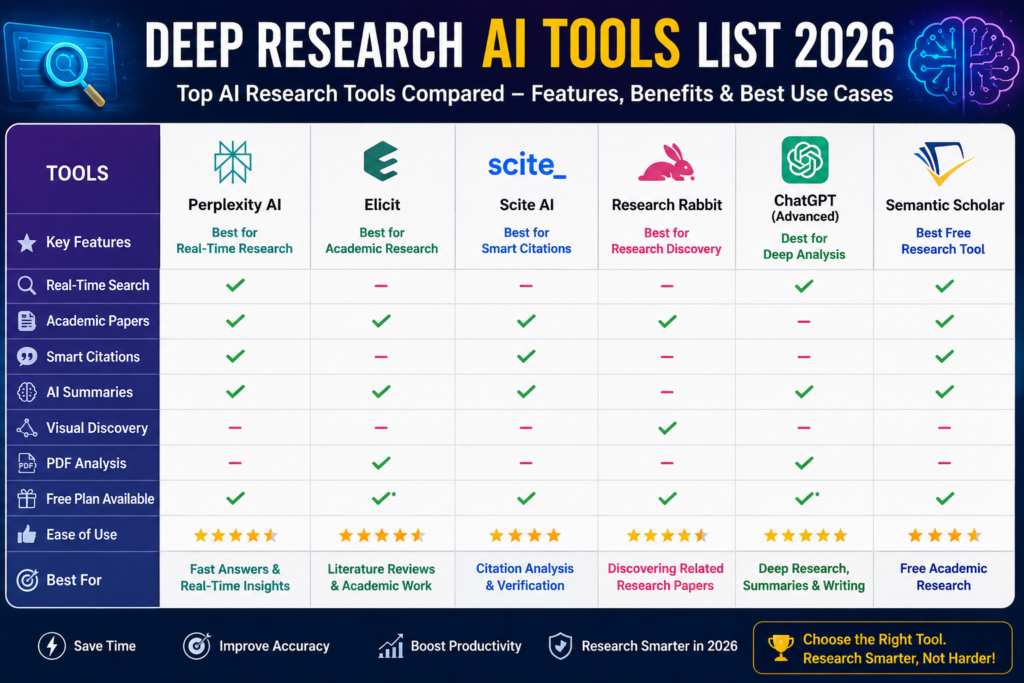
1. Perplexity AI (Best for Real-Time Research)
Perplexity AI feels like Google—but smarter.Before selecting from the deep research AI tools list 2026, it’s important to understand your goals. Not every tool in the deep research AI tools list 2026 will suit your needs.
- Provides real-time answers with citations
- Great for quick research and fact-checking
- Clean interface and fast results
👉 Honestly, I use this almost daily when I need quick, reliable insights.
2. Elicit (Best for Academic Research)
If you’re dealing with research papers, Elicit is a game changer.
- Summarizes academic papers instantly
- Extracts key findings and methodologies
- Helps with literature reviews
Perfect for students, researchers, and analysts.
3. Scite AI (Best for Smart Citations)
Scite doesn’t just show citations—it tells you how a paper is cited.
- Identifies supporting vs contradicting citations
- Improves research credibility
- Useful for thesis and academic writing
4. Research Rabbit (Best for Discovery)
Think of it as Spotify—but for research papers.
- Visual graph of related studies
- Helps discover hidden connections
- Tracks research trends
It’s surprisingly fun to use (yes, research can be fun 😄).
5. ChatGPT (Advanced Research Mode)
AI models like ChatGPT now support deeper research workflows.
- Summarizes complex topics
- Helps brainstorm ideas
- Generates structured content
However, always verify facts—it’s powerful, but not perfect.
6. Semantic Scholar (Best Free Tool)
Backed by AI, this tool is great for academic searches.
- Millions of research papers
- AI-powered summaries
- Citation tracking
How to Choose the Right AI Research Tool
Not every tool fits every need. Here’s how to decide:
Based on Your Goal
- Academic work → Elicit, Scite
- Content research → Perplexity, ChatGPT
- Trend discovery → Research Rabbit
Based on Features
Look for tools that offer:
- Citation support
- PDF analysis
- Data visualization
- Export options
Based on Budget
- Free tools: Semantic Scholar, Research Rabbit
- Paid tools: Advanced AI platforms with premium features
Benefits of Using Deep Research AI Tools
Using tools from this deep research AI tools list 2026 can dramatically improve your workflow.Recent findings from World Economic Forum’s Future of Jobs Report show that AI-driven tools are reshaping how professionals work and research globally.
Key Benefits:
- ⏱ Saves hours of manual work
- 📊 Improves accuracy and insights
- 📚 Enhances research quality
- 🚀 Boosts productivity
In addition, AI reduces human bias by analyzing data objectively.
Limitations You Should Know
Let’s keep it honest—AI isn’t magic.
Common Limitations:
- May generate incorrect or outdated info
- Requires human verification
- Some tools have paywalls
In my view, the best approach is AI + human judgment.
Future of AI Research Tools
AI tools are evolving fast.As highlighted in the Stanford AI Index Report, AI systems are improving rapidly in reasoning, automation, and large-scale data analysis.
By 2026 and beyond, we can expect:
- More personalized research assistants
- Better real-time data analysis
- Integration with productivity tools
Experts believe AI will soon act like a full research partner, not just a tool.
FAQ Section
1. What is the best AI tool for deep research in 2026?
Perplexity AI and Elicit are among the best, depending on your use case.
2. Are AI research tools reliable?
They are helpful but not 100% accurate. Always verify information.
3. Can AI replace human researchers?
No. AI assists research but cannot replace human critical thinking.
4. Are there free AI research tools?
Yes, tools like Semantic Scholar and Research Rabbit offer free access.
5. How do AI tools improve research speed?
They automate data collection, summarization, and analysis, saving hours.
Conclusion: Should You Use These AI Tools?
Absolutely.
This deep research AI tools list 2026 shows that AI can dramatically improve how you work, learn, and create.
However, don’t rely blindly on AI. Use it as a smart assistant—not a replacement for your thinking.
Honestly, once you start using the right tools, going back to manual research feels painfully slow.
👉 Now it’s your turn:
Which AI tool are you excited to try? Drop a comment, share this guide, or bookmark it for later!