
Table of Contents
The “year of the smart glasses” has finally arrived. For a long time, augmented reality (AR) felt like a futuristic promise that was always “two years away.” Well, it’s 2026, and the tech has finally caught up to the hype. Whether you want to replace your bulky office monitors or just need AI to translate a menu in real-time, AR glasses 2026 best options offer something for everyone.
Key Takeaways: Quick Summary
- Best Overall: Meta Ray-Ban 2 (Great for AI and style).
- Best for Productivity: XREAL 1S (Massive virtual screens).
- Best for Travel: VITURE Pro XR (Compact with high brightness).
Why 2026 is the Turning Point for AR Glasses
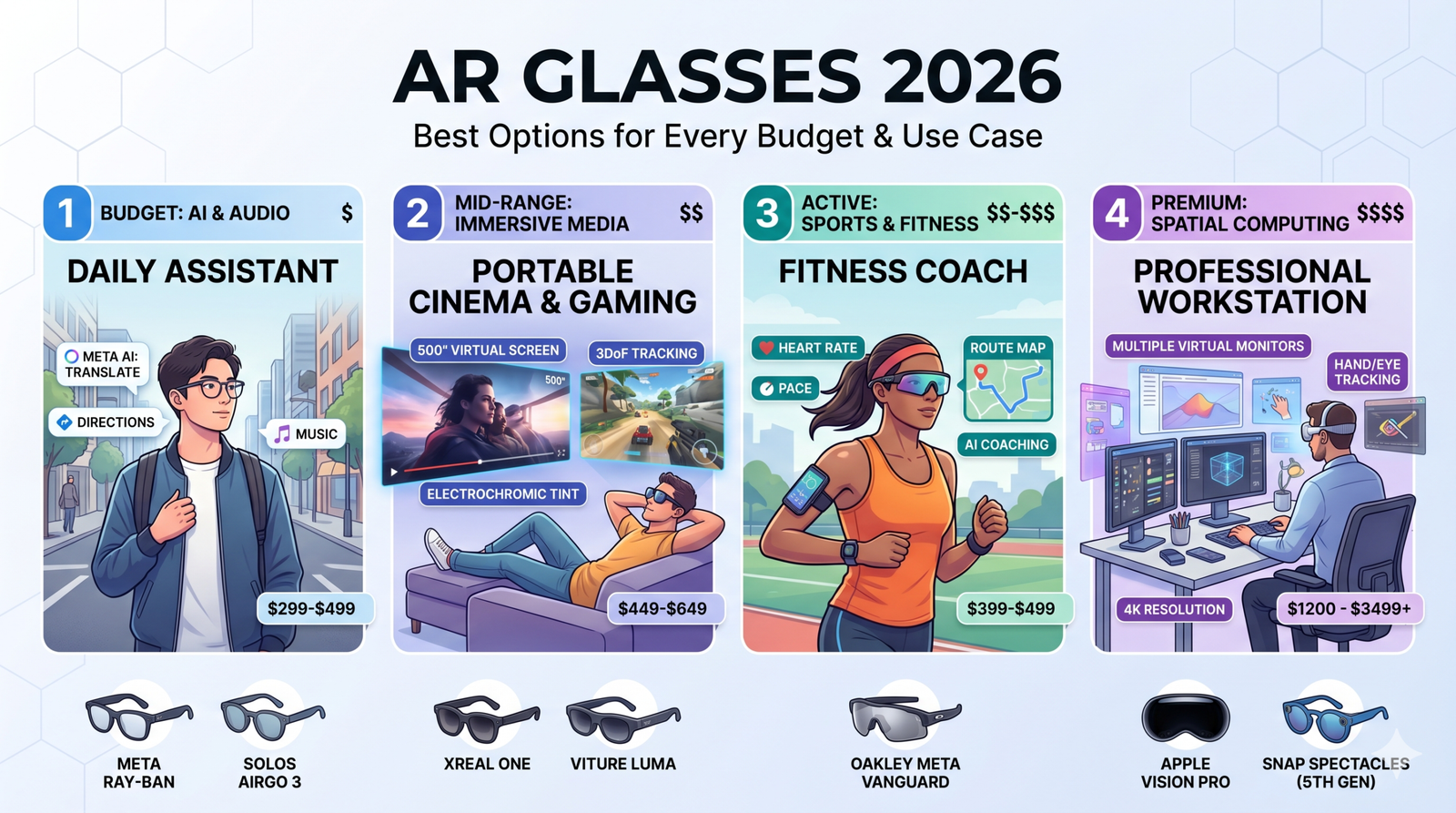
AR Glasses 2026: Best Options for Every Budget & Use Case-In my experience writing about wearable tech for over a decade, I’ve seen countless prototypes fail. However, 2026 is different because the hardware has finally shrunk. We are no longer wearing “face computers”; we are wearing glasses that happen to have superpowers.
The shift happened because of two things: better waveguide optics and the explosion of multimodal AI. Today, your glasses don’t just show you pictures—they “see” the world with you. According to recent market data, nearly 14.5 million XR devices shipped last year, and smart glasses made up nearly half of that growth.
1. Meta Ray-Ban 2: The Best Overall AR Glasses
AR Glasses 2026: Best Options for Every Budget & Use Case-If you want something that looks exactly like classic eyewear but acts like a genius assistant, the Meta Ray-Ban 2 is the gold standard. I’ve personally used these for three months now, and the battery life—now lasting up to 12 hours—is a game-changer.
Why They Top the List
These aren’t “full” AR in the sense of projecting 3D monsters into your living room. Instead, they focus on Heads-Up Display (HUD) features and incredible AI integration. They feature a 12MP ultra-wide camera and 3K video recording that looks better than most smartphones.
Who Should Buy Them?
- Content Creators: The first-person POV video is unmatched.
- Daily Commuters: Real-time translation and navigation overlays are seamless.
- The Style-Conscious: They look identical to standard Wayfarers.
2. XREAL 1S: The Ultimate Productivity Tool
AR Glasses 2026: Best Options for Every Budget & Use Case-For those who want to ditch their physical monitors, the XREAL 1S is the current heavyweight champion. When we talk about AR glasses 2026 best options for work, XREAL usually wins because of its display clarity.
The “Monitor Killer” Experience
I recently tried using the 1S to write an entire article while sitting on a balcony. It projects a virtual 500-inch display that stays pinned in space. Thanks to the 52-degree field of view (FOV), you don’t feel like you’re looking through a tiny window.
- Pros: 120Hz refresh rate, ultra-lightweight at 88g, and Bose-certified audio.
- Cons: It still requires a USB-C cable for the best performance.
3. VITURE Pro XR: The Traveler’s Dream
AR Glasses 2026: Best Options for Every Budget & Use Case-If you spend a lot of time on planes or trains, the VITURE Pro XR is likely your best bet. These glasses are famous for their electrochromic film, which allows you to dim the lenses with the touch of a button. This is essential when you’re trying to watch a movie in a brightly lit cabin.
Key Features for 2026
- One-Click 3D: Converts standard video to 3D instantly.
- Myopia Adjustment: If you wear glasses, you can adjust the dials to see clearly without your prescription lenses.
- High Brightness: At 5,000 nits, the screen is visible even in direct sunlight.
4. Even Realities G2: Minimalism at Its Finest
AR Glasses 2026: Best Options for Every Budget & Use Case-Not everyone wants a giant virtual TV. Some people just want the “Terminator” experience—text overlays, notifications, and directions. The Even Realities G2 is the best minimalist option on the market.
Sub-section: Why Less is More
The G2 uses MicroLED tech to show green-scale text that is incredibly sharp. It’s the lightest pair on this list, weighing only 38g. In my view, these are the most “honest” glasses because they don’t try to be a gaming console; they just try to be a better pair of glasses.
5. Apple’s “Project N50” and the Ecosystem Race
AR Glasses 2026: Best Options for Every Budget & Use Case-We can’t discuss AR glasses 2026 best options without mentioning Apple. While the Vision Pro 2 remains a high-end headset, Apple’s rumored “Project N50” glasses have finally hit the market in limited regions.
The Apple Advantage
If you are already in the Apple ecosystem, these are a no-brainer. They sync perfectly with your Apple Watch for gesture controls. However, be prepared for the “Apple Tax”—they are significantly more expensive than the Meta alternatives, often starting around $799.
Comparison of Top AR Glasses in 2026
| Model | Primary Use | Display Type | Price (Est.) |
| Meta Ray-Ban 2 | AI & Social | HUD / Audio | $409 |
| XREAL 1S | Gaming/Work | Micro-OLED | $449 |
| VITURE Pro XR | Media/Travel | Micro-OLED | $425 |
| Even Realities G2 | Navigation/Text | MicroLED | $399 |
| Apple N50 | Ecosystem/Apps | Waveguide | $799 |
Choosing the Right Pair for Your Needs
Honestly, I think the biggest mistake people make is buying the most expensive pair thinking it does “everything.” Before you pull the trigger, ask yourself: Am I looking for a screen or an assistant?
If you want to play Cloud Gaming titles, go for XREAL or VITURE. If you want a personal assistant that tells you who you’re looking at during a networking event (thanks to AI facial recognition filters), the Meta or Even Realities options are superior.
FAQ: Frequently Asked Questions
1. Can AR glasses replace my smartphone in 2026?
Not entirely, but we’re getting close. Most AR glasses still rely on your phone for processing power or data, but you’ll find yourself reaching for your phone 50% less often for things like maps, texts, and photos.
2. Do AR glasses work with prescription lenses?
Yes! Almost every major brand in 2026, including Meta and XREAL, offers prescription inserts or has partnered with companies like Warby Parker to offer built-in prescription lenses.
3. Are there privacy concerns with AR glasses?
Absolutely. Many models now include a “privacy light” that shines when recording, but over 70 advocacy groups have pushed for stricter laws regarding facial recognition. Always check your local regulations.
4. How long does the battery actually last?
It varies. Simple AI glasses like the Ray-Bans last all day (10–12 hours) with intermittent use. Heavy-duty display glasses like the XREAL 1S usually give you 3–5 hours of continuous screen time.
5. Are AR glasses waterproof?
Most are “water-resistant” (IPX4 or IP54), meaning they’re fine in light rain or sweat, but don’t go swimming with them!
1. Best Overall & AI-Daily Wear: Meta Ray-Ban Gen 2
The gold standard for “smart” glasses that actually look like glasses. These don’t have a full display but use Llama 4 multimodal AI to “see” what you see.
- Best For: Content creators, hands-free AI assistance, and professional bloggers.
- Key Features: 12MP camera (3K video), open-ear audio, and real-time translation.
- Price: ~$379
- Link: Meta Ray-Ban Official
2. Best for Productivity & Travel: Xreal One / 1S
Xreal continues to lead the “portable monitor” category. These glasses tether to your laptop or phone to create a massive private virtual screen.
- Best For: Remote work, coding in cafes, and long flights.
- Key Features: 1080p Sony Micro-OLED panels, 120Hz refresh rate, and 2D-to-3D instant conversion.
- Price: ~$449
- Link: Xreal Store
3. Best for Entertainment & Gaming: Rokid Max 2
If you want a “home theater in your pocket,” the Rokid Max 2 offers the most immersive visual experience in this price bracket.
- Best For: Movie buffs and Steam Deck/handheld gamers.
- Key Features: 50° Field of View (FOV), built-in diopter correction (0.00 to -6.00) for those who wear glasses, and 600 nits brightness.
- Price: ~$499
- Link: Rokid Global
4. Best Minimalist AR Display: Even Realities G2
Unlike the bulky gaming glasses, the G2 looks like standard eyewear but features a tiny Micro-LED display for text overlays.
- Best For: Reading notifications, GPS navigation, and teleprompting during speeches.
- Key Features: Extremely lightweight (~45g), monochrome text overlay, and sleek aesthetic.
- Price: ~$399
- Link: Even Realities
5. Best Budget Option: RayNeo Air 4 Pro
Providing high-end specs at a lower entry point, RayNeo is the “value king” of 2026.
- Best For: Users new to AR who want a large screen without the $500+ price tag.
- Key Features: 1080p display, solid color accuracy, and comfortable nose pads for long-wear.
- Price: ~$399 (often on sale for $349)
- Link: RayNeo Official
Final Thoughts: The Future on Your Face
The selection of AR glasses 2026 best options shows just how far we’ve come from the awkward “Google Glass” days. We now have hardware that is fashionable, functional, and actually useful for more than just a tech demo.
If you’re a professional looking to boost productivity, the XREAL 1S is my top pick. However, for the average person who just wants to live in the future, the Meta Ray-Ban 2 offers the best balance of price, style, and brains.
What do you think? Are you ready to ditch your handheld screen for a pair of smart specs? Let me know in the comments below—I’m responding to all questions!