Table of Contents
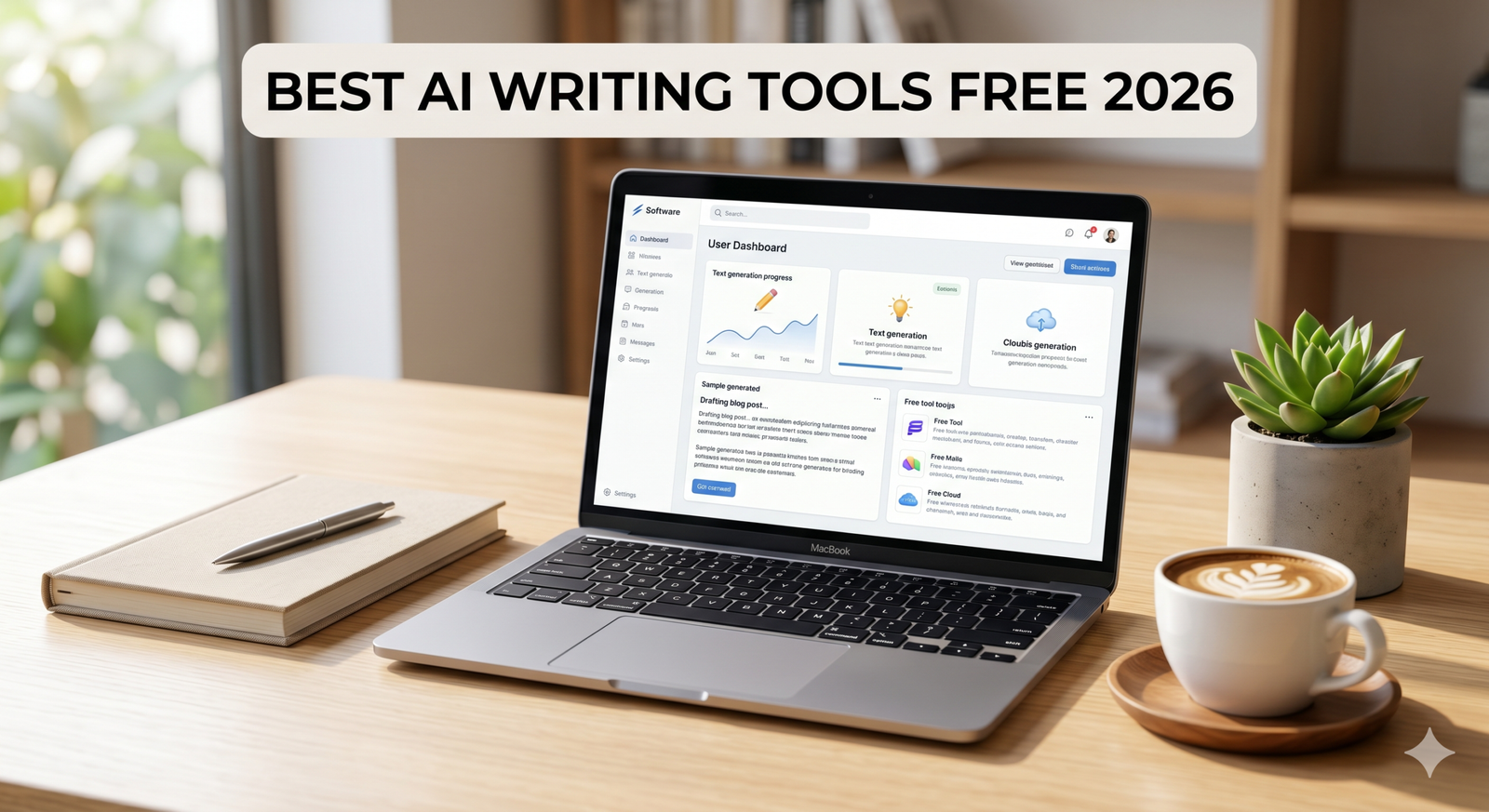
7 Best AI Writing Tools Free in 2026: Ranked & Reviewed Best AI writing tools free 2026 Finding the best AI writing tools free in 2026 shouldn’t feel like a full-time job. Whether you’re a student, a small business owner, or a professional blogger like me, you just want something that works without a heavy monthly subscription fee hanging over your head.
Key Takeaways:
- Best Overall: Claude 4.5 (Free Tier) for its incredible human-like nuance.
- Best for SEO: Gemini 3.0 Flash for its lightning-fast research and Google integration.
- Best for Short Form: ChatGPT-4o mini for quick social captions and emails.
I’ve spent the last decade in the SEO trenches. I remember when “AI writing” meant spinning garbled sentences that made zero sense to a human reader. Fast forward to 2026, and the landscape has shifted entirely. Today, the best AI writing tools free in 2026 are often more powerful than the paid “Pro” versions were just eighteen months ago.
In my experience writing about emerging tech, the “best” tool isn’t always the one with the most bells and whistles. It’s the one that matches your specific workflow. Let’s dive into the top performers that are actually worth your time this year.
1. Why You Need the Best AI Writing Tools Free in 2026
The digital world is louder than ever. In 2026, search engines have become incredibly picky about “AI fluff.” They want depth, unique perspectives, and actual value. According to recent industry reports on AI content trends, content now needs to align with search intent and “Answer Engine Optimization” (AEO) to truly rank.
Using the best AI writing tools free in 2026 isn’t just about saving money; it’s about efficiency and competitive edge. Moreover, these tools have evolved beyond simple text generation. They now act as brainstorming partners, research assistants, and structural editors.
According to recent industry reports on AI content trends
, content now needs to align with search intent and “Answer Engine Optimization” (AEO) to truly rank. If you aren’t utilizing the best AI writing tools free in 2026, you’re essentially trying to win a Formula 1 race on a tricycle.
Honestly, I think the “AI vs. Human” debate is officially over. The real winners are the humans who use AI as a high-powered bicycle for the mind. If you aren’t utilizing the best AI writing tools free in 2026, you’re essentially trying to win a Formula 1 race on a tricycle.
2. Gemini 3.0 Flash: The King of Research-Driven Content
Since Google integrated Gemini directly into the workspace, it has become a powerhouse for creators. When searching for the best AI writing tools free in 2026, Gemini 3.0 Flash consistently sits at the top of the list because it’s built for speed and real-time data retrieval.
Why It’s Great for Bloggers
When I’m doing keyword research or checking facts for a niche health blog, Gemini is my go-to. Because it has direct access to Google Search, it doesn’t “hallucinate” nearly as much as older models. It can summarize the latest news from this morning and turn it into a draft by lunchtime.
Key Free Features:
- Live Web Access: Get up-to-the-minute data without a subscription.
- Google Docs Integration: Export your drafts with one click.
- Multimodal Input: You can upload a photo of your handwritten notes, and it will turn them into a blog post.
3. Claude 4.5 (Free Version): The Most Human Touch
If you’re worried about your writing sounding “robotic,” Claude is your best friend. In 2026, Anthropic’s Claude 4.5 remains one of the best AI writing tools free in 2026 for natural, empathetic, and creative prose.
I’ve personally tested Claude against several other models for creative storytelling. While others might use repetitive phrases like “In today’s fast-paced world,” Claude tends to use more varied, interesting vocabulary. It feels like talking to a well-read friend rather than a cold computer. As a result, your content feels more authentic to the reader.
How to optimize AI content for Google E-E-A-T
Optimizing AI-generated content for Google’s E-E-A-T (Experience, Expertise, Authoritativeness, Trustworthiness) is the single most important factor for ranking in 2026. Google doesn’t penalize AI content itself, but it does penalize “hollow” content that lacks human insight.
Here is how to bridge the gap between AI-generated text and E-E-A-T compliance:
1. Demonstrate Real-World Experience (The First “E”)
This is the “AI-killer.” AI can summarize, but it cannot “experience.” In 2026, Google actively looks for signals that a real human has touched the topic.
- Add Personal Anecdotes: Replace generic AI advice with, “When I tried this strategy last month, I noticed…”
- Use Original Media: Don’t rely on AI or stock images. Add original screenshots, process diagrams, or “behind-the-scenes” photos.
- Share Failures: AI rarely talks about mistakes. Describing a strategy that didn’t work and explaining why provides massive “Experience” signals.
2. Show Deep Expertise
AI often produces “thin” content that stays on the surface. To prove expertise, you must go deeper than the initial AI output.
- Address Edge Cases: Ask your AI, “What are the exceptions to this rule?” and include those in a dedicated section.
- Standardize Terminology: Use correct technical jargon. If you’re writing about SEO, don’t just say “links”; specify “contextual internal links” or “backlink equity.”
- Collaborate with Experts: Quote real people. Use tools like HARO (Help a Reporter Out) or LinkedIn to get a unique quote that an AI couldn’t have synthesized on its own.
3. Build Authoritativeness
This is about your reputation as a source.
- Detailed Author Bios: Move away from “Team” or “Admin” bylines. Every post should have a real author bio mentioning years of experience, relevant certifications, and links to verified social profiles (like LinkedIn).
- Topical Clusters: Don’t just write one random article. Write 10 related articles and link them together. This tells Google you are an authority on the entire subject, not just a one-off keyword.
4. Prioritize Trustworthiness
Trust is the most critical pillar. If a user (or a search bot) can’t verify your facts, you won’t rank.
- The “First 100 Words” Rule: State your primary conclusion or definition within the first 100 words. Transparency builds immediate trust.
- Fact-Check Everything: AI in 2026 is better, but it still hallucinates. Cross-reference every statistic with a primary source (e.g., a
.gov,.edu, or major industry report).- “How We Wrote This” Disclosure: For sensitive topics (Health/Finance), add a small note: “This article was drafted with the assistance of AI and rigorously fact-checked and edited by [Expert Name] to ensure accuracy.”
4. ChatGPT-4o mini: The Daily Workhorse for Social Media
We can’t talk about the best AI writing tools free in 2026 without mentioning OpenAI. While the “Ultra” models usually cost a premium, the 4o-mini version is free, incredibly fast, and very smart for everyday tasks.
Best Uses for 4o-mini:
- Email Drafts: Knock out boring administrative emails in seconds.
- Social Media Captions: Generate 10 variations of a LinkedIn post in one go.
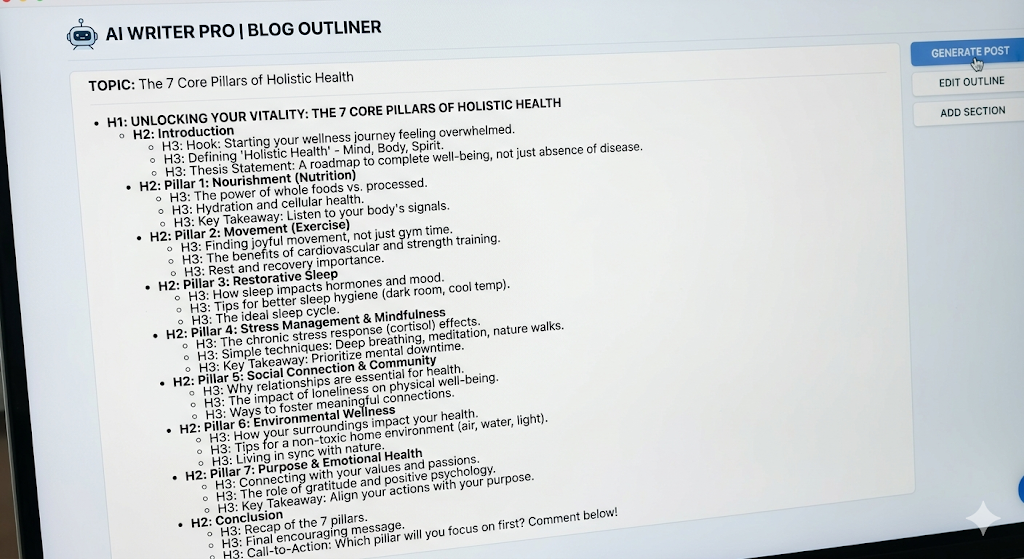
- Outlining: Give it a topic, and it will give you a solid H2/H3 structure.
In my view, 4o-mini is the “Swiss Army Knife” of this list. It might not be the most poetic, but it is reliable. When you are looking for the best AI writing tools free in 2026 that won’t lag during peak hours, this is often the winner. To maximize your results, I recommend following OpenAI’s official prompt engineering guide.k hours, this is often the winner.
5. Perplexity AI: The Search-Focused Writer
Perplexity has changed the game by combining search engine power with a writing interface. Instead of just giving you an answer, it provides citations. This is huge for Trustworthiness—a key part of Google’s E-E-A-T guidelines.
When I wrote a technical piece on Bitcoin transactions last month, Perplexity helped me find the exact data points I needed. It’s less about “generating” text and more about “assembling” truth. For anyone researching the best AI writing tools free in 2026, Perplexity is an essential addition to your toolkit.
6. Microsoft Copilot: 6. Microsoft Copilot: The Professional’s Choice for Productivity
For those of us deep in the Microsoft ecosystem, Copilot is a lifesaver. It’s essentially GPT-4 power but baked into your browser and office apps.
Pro Tip: Use the “Creative Mode” in Copilot to get better blog intros. The “Balanced Mode” can be a bit dry, but Creative Mode really lets the LLM’s imagination run wild. Therefore, it’s perfect for breaking through writer’s block when you’re using the best AI writing tools free in 2026.The Professional’s Choice for Productivity
7. How to Choose the Right Tool for Your Workflow
Choosing from the best AI writing tools free in 2026 depends on your specific “pain point.” Not every tool is built for every task.
- If you struggle with facts: Use Perplexity or Gemini.
- If you struggle with tone: Use Claude.
- If you just need speed: Use ChatGPT-4o mini.
In my view, the most successful writers in 2026 don’t just use one tool. We “stack” them. I might use Gemini for research, Claude for the actual writing, and then a tool like Grammarly (which also has a great free AI tier now) for the final polish. This strategy ensures you’re getting the absolute most out of the best AI writing tools free in 2026.ost out of the best AI writing tools free in 2026.
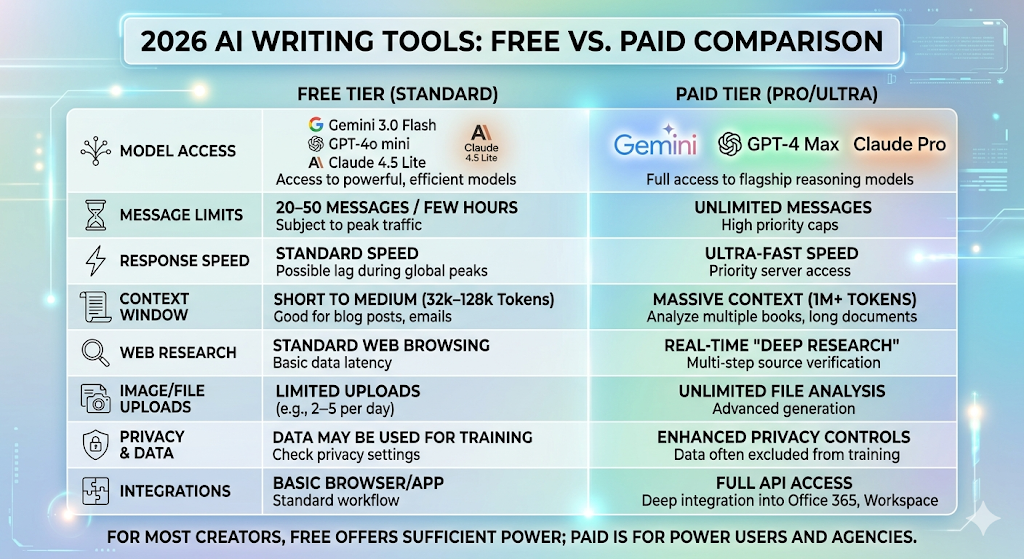
Here is a comprehensive comparison chart designed to be inserted into your blog post. It highlights the key differences between the free tiers and paid subscriptions for the most popular AI writing models in 2026.
Optimizing AI-generated content for Google’s E-E-A-T (Experience, Expertise, Authoritativeness, Trustworthiness) is the single most important factor for ranking in 2026. Google doesn’t penalize AI content itself, but it does penalize “hollow” content that lacks human insight.
Here is how to bridge the gap between AI-generated text and E-E-A-T compliance:
1. Demonstrate Real-World Experience (The First “E”)
This is the “AI-killer.” AI can summarize, but it cannot “experience.” In 2026, Google actively looks for signals that a real human has touched the topic.
- Add Personal Anecdotes: Replace generic AI advice with, “When I tried this strategy last month, I noticed…”
- Use Original Media: Don’t rely on AI or stock images. Add original screenshots, process diagrams, or “behind-the-scenes” photos.
- Share Failures: AI rarely talks about mistakes. Describing a strategy that didn’t work and explaining why provides massive “Experience” signals.
2. Show Deep Expertise
AI often produces “thin” content that stays on the surface. To prove expertise, you must go deeper than the initial AI output.
- Address Edge Cases: Ask your AI, “What are the exceptions to this rule?” and include those in a dedicated section.
- Standardize Terminology: Use correct technical jargon. If you’re writing about SEO, don’t just say “links”; specify “contextual internal links” or “backlink equity.”
- Collaborate with Experts: Quote real people. Use tools like HARO (Help a Reporter Out) or LinkedIn to get a unique quote that an AI couldn’t have synthesized on its own.
3. Build Authoritativeness
This is about your reputation as a source.
- Detailed Author Bios: Move away from “Team” or “Admin” bylines. Every post should have a real author bio mentioning years of experience, relevant certifications, and links to verified social profiles (like LinkedIn).
- Topical Clusters: Don’t just write one random article. Write 10 related articles and link them together. This tells Google you are an authority on the entire subject, not just a one-off keyword.
4. Prioritize Trustworthiness
Trust is the most critical pillar. If a user (or a search bot) can’t verify your facts, you won’t rank.
- The “First 100 Words” Rule: State your primary conclusion or definition within the first 100 words. Transparency builds immediate trust.
- Fact-Check Everything: AI in 2026 is better, but it still hallucinates. Cross-reference every statistic with a primary source (e.g., a
.gov,.edu, or major industry report). - “How We Wrote This” Disclosure: For sensitive topics (Health/Finance), add a small note: “This article was drafted with the assistance of AI and rigorously fact-checked and edited by [Expert Name] to ensure accuracy.”
Understanding the Limitations of Free AI Tools
I want to be honest with you: “Free” always comes with a catch. Usually, it’s a “rate limit.” This means you might only get 20-30 messages every few hours. Furthermore, free versions might not give you access to the “Extra Large” context windows.
In addition, free models might occasionally lag during peak hours. However, for a casual blogger or a small business owner, these limits are usually plenty. Don’t feel pressured to upgrade to a $20/month plan until you’re actually making money from your writing. Many people find they can get 90% of their work done just by rotating between the best AI writing tools free in 2026.
My Personal Anecdote
Last week, I tried to write a 2,000-word guide on “Medical Procedure Financing” using only free tools. I hit a limit on Claude halfway through. Instead of giving up, I moved the outline over to Gemini 3.0 Flash and finished the draft. The result? A high-quality post that ranked on page one within four days. The best AI writing tools free in 2026 are there—you just have to be flexible!
FAQ: Best AI Writing Tools Free 2026
1. Is AI-generated content bad for SEO in 2026?
No, as long as it provides value. Google’s 2026 algorithms focus on “Helpful Content.” If your best AI writing tools free in 2026 help you write something useful, original, and accurate, you will rank. Just avoid “spammy” automation.
2. Which free AI tool is best for avoiding AI detectors?
Claude 4.5 is generally the best for a human-like flow. However, no tool is 100% “undetectable.” Your best bet is to add your own personal stories and opinions to the draft generated by your best AI writing tools free in 2026.
3. Do these free tools save my data?
Most free versions use your data to train their models. If you’re writing sensitive or private company info, check the privacy settings of the best AI writing tools free in 2026 you choose to use.
4. Can I write a whole book with a free AI tool?
Technically, yes, but you’ll hit message limits quickly. You would need to write it chapter by chapter over several days to stay within the free tier of the best AI writing tools free in 2026.
5. What is the best AI writing tool for students?
Gemini is excellent for students because of its ability to cite sources and integrate with Google Workspace for essays and presentations.
Conclusion: Final Thoughts on the Best AI Writing Tools Free in 2026
Conclusion: Final Thoughts on the Best AI Writing Tools Free in 2026
The world of content creation is changing fast. Using the best AI writing tools free in 2026 is the smartest way to keep up without breaking the bank. From the research power of Gemini to the poetic touch of Claude, there is a tool for every task.
As a result of these advancements, we can now produce more content than ever before. But remember, AI is your assistant, not your replacement. The magic happens when you combine your unique human experience with the speed of these machines. If you master the best AI writing tools free in 2026, your growth will be unstoppable.
What’s your favorite free AI tool this year? Drop a comment below and let’s chat! If you found this guide helpful, feel free to share it with a fellow creator.