
Table of Contents
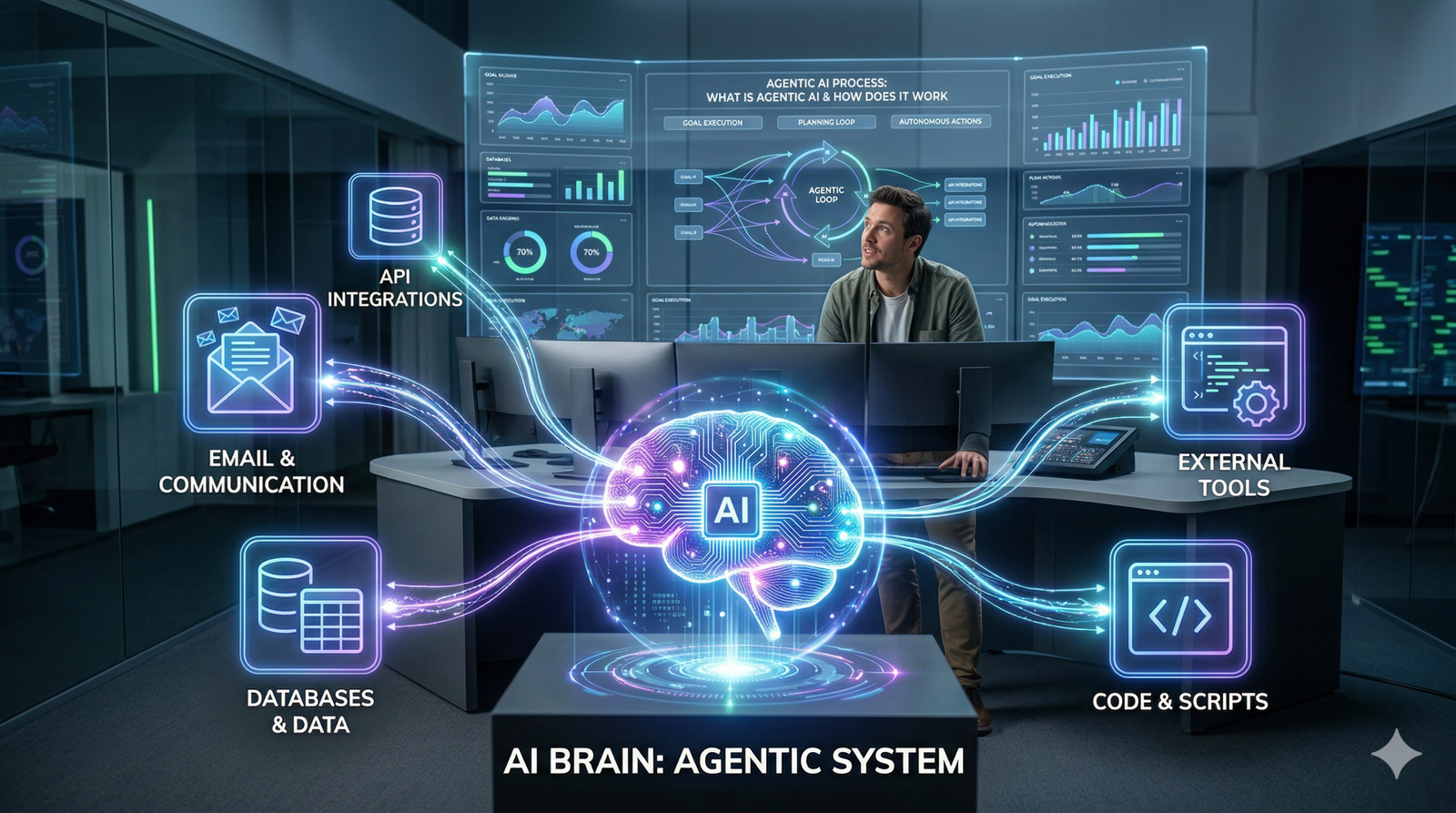
What is agentic AI and how does it work We’ve all spent the last few years playing with ChatGPT, prompting it to write emails or summarize long PDFs. But have you noticed the shift lately? We’re moving away from AI that just talks to AI that actually does.
Agentic AI is the biggest buzzword of 2026 for a reason. Unlike the “reactive” chatbots of 2023, these systems are “proactive.” In my experience writing about AI evolution, I’ve seen plenty of “next big things,” but agentic systems are the first to truly feel like a digital workforce rather than a fancy search engine.
In this guide, we’ll break down exactly what is agentic AI, how the “reasoning loop” works, and why your business (or your daily workflow) is about to change forever.
Key Takeaways
- Autonomy is Key: Agentic AI can plan and execute multi-step tasks with minimal human intervention.
- Beyond Generation: While Generative AI creates content, Agentic AI uses that content to take real-world actions.
- 2026 Impact: Enterprises are moving from “AI assistants” to “autonomous workflows” to save thousands of human hours.
What is Agentic AI? (The Simple Definition)
At its core, agentic AI is a type of artificial intelligence designed to achieve a goal autonomously. Think of it as an “agent” you hire. Yout tell a travel agent which buttons to click on a website; you tell them, “I want a five-day trip to Tokyo on a $3,000 budget,” and they handle the rest.
Traditional AI (like basic Generative AI) is reactive. You give it a prompt, and it gives you a response. However, agentic AI is proactive. Once you give it a high-level objective, it breaks that goal into smaller steps, chooses the right tools, and executes them until the job is done.
The “Agency” Factor
The word “agentic” comes from “agency”—the capacity to act. According to recent 2026 industry reports, the shift to agentic systems is expected to drive a 10% increase in enterprise growth by automating entire process segments rather than just individual tasks.
How Does Agentic AI Work? The “Reasoning Loop”
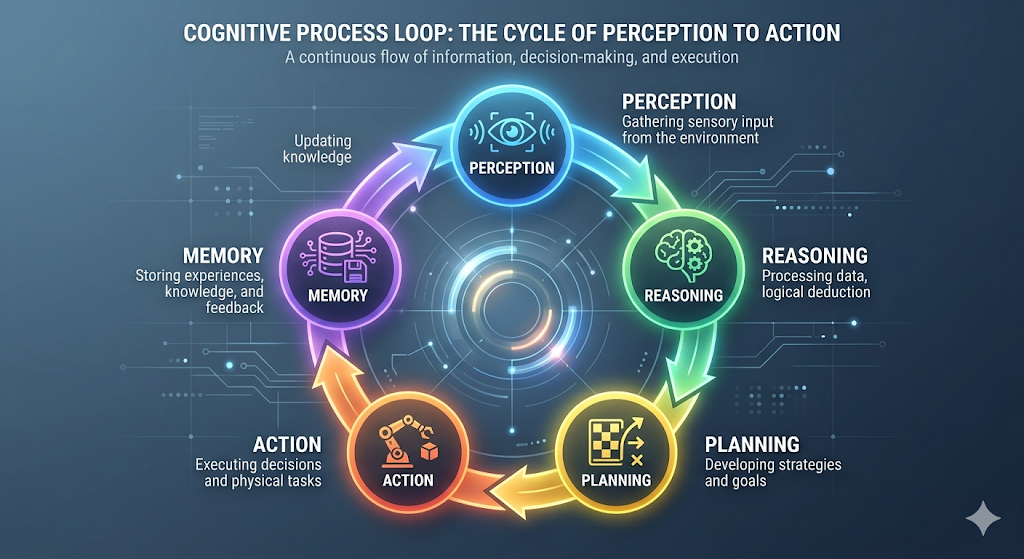
You might be wondering, “How does it actually think?” It isn’t magic, though it often feels like it. Agentic AI works by running a continuous cycle often called a reasoning loop.
1. Perception and Goal Setting
First, the agent receives a goal. For example: “Research 10 competitors and update the CRM with their latest pricing.” The agent “perceives” its environment by accessing your internal databases and the open web.
2. Planning and Decomposition
The AI doesn’t just jump in. It creates a plan. It might decide:
- Search Google for competitor lists.
- Visit each website.
- Scrape pricing data.
- Compare it to our current data.
- Log into the CRM and update fields.
3. Tool Selection (The “Action” Phase)
This is where agentic AI shines. It can use external tools. It might call an API to check a flight status, use a Python script to calculate data, or send a Slack message to your manager for approval.
4. Self-Correction and Reflection
If the agent hits a paywall on a competitor’s site, it doesn’t just stop and give you an error. It “reflects” on the failure and tries a different route—perhaps looking for a public press release or a third-party review site.
Agentic AI vs. Generative AI: What’s the Difference?
It’s easy to confuse the two because most agentic systems actually use Generative AI (like Large Language Models) as their “brain.” But they aren’t the same.
| Feature | Generative AI (GenAI) | Agentic AI |
| Primary Goal | Creating new content (text, images) | Completing a multi-step objective |
| Interaction | Reactive (needs a prompt for every step) | Proactive (works on a single high-level goal) |
| Tools | Usually limited to its own training data | Can use APIs, web browsers, and software |
| Human Role | Constant supervision and prompting | High-level oversight and “kill-switch” control |
Moreover, while GenAI is a productivity multiplier for individuals, Agentic AI is an operational multiplier for organizations. I’ve personally used agentic workflows to automate my entire guest-posting outreach, and it’s a world of difference from manually asking a chatbot to “write an email” 50 times.
Real-World Examples of Agentic AI in 2026
We are seeing these agents pop up in almost every industry. Here are a few ways they are working right now:
Autonomous Customer Concierge
Standard chatbots answer questions. An agentic customer service agent can identify a delayed order, check the warehouse status, initiate a refund, and email the customer a discount code—all without a human ever touching it.
Personal Financial Agents
In the fintech world, agents are now moving funds between accounts to prevent overdrafts or automatically investing “spare change” based on real-time market fluctuations and your personal risk profile.
Software “Auto-Devs”
In 2026, developers use agents to not just write code, but to test and deploy it. An agent can run a test suite, find a bug, write the patch, and submit a pull request for human review.
Why Agentic AI is Exploding Right Now
There are three main reasons why 2026 is the “Year of the Agent”:
- Lower Latency: New models are fast enough to “think” and “act” in real-time.
- Tool Integration: We now have standardized “Agentic Protocols” that allow AI to talk to software like Salesforce, Microsoft 365, and SAP seamlessly.
- Cost Efficiency: It is now cheaper to run an AI agent for 24 hours than it is to pay for one hour of high-level human administrative work.
Here for “future of AI in the workplace” or “AI automation strategies”.
Gartner’s 2026 Strategic Trends: Link to Gartner’s 2026 Top Strategic Technology Trends.
- Context: Use this to back up the claim that Multi-Agent Systems (MAS) are a top priority for enterprise digital roadmaps this year.
MIT Sloan Management Review: Link to MIT Sloan’s “Agentic AI, Explained”.
- Context: Use this to support the data point that 44% of organizations planned to deploy agents by 2025/2026 and to cite Professor Kate Kellogg’s research on workflow integration.
Anthropic’s Agent Autonomy Study: Link to Anthropic’s Research on Measuring AI Agent Autonomy.
- Context: This is a perfect citation for the “Risks” section, as it discusses how agents are being used in “risky domains” like finance and cybersecurity.
Open AI Engineering Blog: Link to Harness Engineering: Leveraging Codex in an Agent-First World.
The Risks: Why We Can’t Just Let Agents Run Wild
I’ll be honest: giving AI “agency” is a bit scary. If an agent has your credit card info to book a flight, what’s stopping it from booking a first-class ticket to Vegas by mistake?
Security and “Shadow AI”
Security experts at the RSAC 2026 Conference highlighted that unmanaged agent identities are a massive risk. If an agent has “admin” rights to your company’s data, a single “prompt injection” attack could lead to a data breach.
The Need for Guardrails
Most experts agree that we need “Human-in-the-Loop” (HITL) systems. This means the agent can do $90\%$ of the work, but it must pause and ask for a “thumbs up” before spending money or deleting files.
FAQ: Common Questions About Agentic AI
1. Is Agentic AI the same as AGI?
No. Artificial General Intelligence (AGI) is a theoretical AI that can do anything a human can. Agentic AI is “Specialized Autonomy”—it is very good at specific tasks within defined boundaries but doesn’t have a human-like consciousness.
2. Do I need to learn coding to use AI agents?
Not necessarily. In 2026, many “no-code” platforms allow you to build agents using natural language. You simply describe the workflow, and the platform builds the agent for you.
3. Can Agentic AI make its own decisions?
Yes, but only within the “guardrails” you set. It can choose how to reach a goal (e.g., which website to search), but it cannot change the goal itself without your permission.
4. Will agentic AI replace my job?
It is more likely to replace your tasks. Most experts suggest that “human hours reclaimed” is the new metric for success. You’ll spend less time on “busy work” and more time on high-level strategy.
5. How do I start using Agentic AI today?
Many enterprise tools (like Salesforce’s Agentforce or Microsoft’s Copilot Studio) already have agentic features. Start by identifying a repeatable, multi-step process in your day and see if an agentic tool can handle the “middle steps.”
Conclusion: Embracing the Autonomous Era
The transition to agentic AI represents a fundamental shift in how we interact with technology. We are moving from a world where we use tools to a world where we manage digital coworkers.
Understanding how agentic AI works is no longer just for developers; it’s a necessary skill for anyone who wants to stay competitive in the 2026 economy. While there are certainly risks involving security and oversight, the potential for reclaimed time and massive productivity gains is too big to ignore.
In my view, the most successful people won’t be those who can write the best prompts, but those who can design and manage the best agentic workflows.
What do you think? Are you ready to let an AI agent handle your inbox or your travel planning? Or does the idea of “autonomous” software make you nervous? Drop a comment below and let’s discuss!