
Table of Contents
Cybersecurity Threats 2026 List: How to Stay Safe in the AI Era-Think back to just a few years ago. We used to worry about clicking a suspicious link in a poorly spelled email. Today? That “link” might be a high-definition video call from your “boss” asking for a wire transfer. The digital landscape has shifted faster than most of us can keep up with.
In my decade of tracking digital trends, I’ve noticed a massive shift. We are no longer just fighting hackers; we are fighting automated, intelligent systems. This cybersecurity threats 2026 list isn’t meant to scare you, but to give you the “street smarts” needed to navigate this new world.
Key Takeaways:
- AI is the Weapon of Choice: Hackers now use generative AI to automate personalized attacks at scale.
- Identity is the New Perimeter: Protecting your biometric and visual identity is just as important as your password.
- Proactive Defense is Key: Waiting for a breach to happen is no longer an option for businesses or individuals.
1. The Rise of “Hyper-Personalized” AI Phishing
The days of “Dear Valued Customer” are officially over. By 2026, the primary entry point for most breaches is what I call Hyper-Phishing.
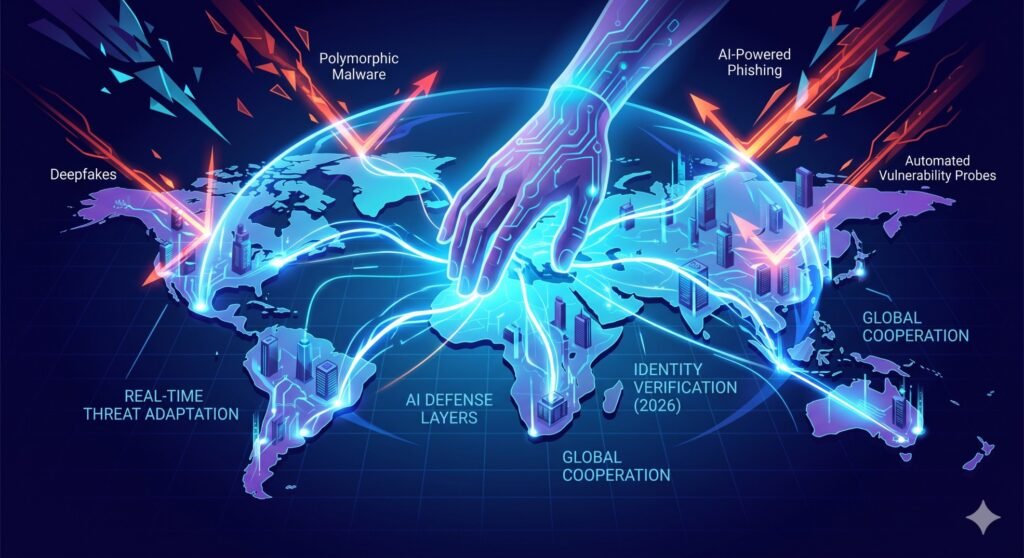
Hackers use AI to scrape your social media, LinkedIn, and public data to craft an email or text that sounds exactly like a friend or colleague. They might mention a recent conference you attended or a specific project you’re working on. Because these tools can generate millions of unique messages in seconds, the volume of attacks has skyrocketed.
In my experience, even the most tech-savvy people are getting fooled because the tone and context are nearly perfect. It’s not about bad grammar anymore; it’s about believable storytelling.
2. Deepfake Social Engineering and “Vishing” 2.0
Deepfakes have moved from funny internet memes to serious corporate liabilities. On our cybersecurity threats 2026 list, this is perhaps the most unsettling.
Voice Cloning in Real-Time
We’ve seen cases where AI clones a CEO’s voice during a live phone call. They don’t just sound like the person; they mimic their speech patterns and emotional cues.
Video Manipulation in Meetings
With the processing power available in 2026, hackers can now overlay a “digital mask” on a video call. You might think you’re talking to your CFO on Zoom, but you’re actually talking to a bot. Honestly, I think we’re reaching a point where we need “safewords” for sensitive family or business transactions.
3. Quantum-Resistant Encryption Scrambles
You might have heard the buzz about quantum computing. While full-scale quantum computers aren’t in every home yet, the “Harvest Now, Decrypt Later” strategy is a massive threat.
Threat actors are stealing encrypted data today, betting on the fact that they can crack it in a few years with quantum power. As a result, 2026 is the year many organizations are frantically switching to quantum-resistant algorithms. If your data isn’t protected by these new standards, consider it a ticking time bomb.
4. The Vulnerability of the “Smart Everything” (IoT)
Our homes are smarter than ever, but they’re also noisier. From your smart fridge to industrial sensors in factories, the Internet of Things (IoT) remains a favorite target on any cybersecurity threats 2026 list.
The problem is that many of these devices weren’t built with security as a priority. They act as “backdoors” into your main network. Moreover, we are seeing “botnet” attacks where thousands of smart home devices are hijacked to shut down major websites or even local power grids.
5. Ransomware 3.0: Data Corruption and Extortion
Ransomware used to be simple: they lock your files, you pay, they (hopefully) give them back. In 2026, the game has changed.
Data Poisoning
Instead of locking you out, hackers might subtly change bits of data in your database. Imagine a hospital where blood types are swapped, or a bank where decimal points are moved. You don’t know what’s real and what’s fake. This forces companies to pay just to ensure their data integrity is restored.
Triple Extortion
- They lock your files.
- They threaten to leak your private data.
- They contact your customers or partners to tell them their data was stolen through you.
It’s a brutal cycle that can ruin a reputation overnight.
6. Adversarial Machine Learning (AML)
This is a more technical entry on the cybersecurity threats 2026 list, but it’s vital. Adversarial ML is when hackers “trick” an AI model.
For example, they might feed a self-driving car’s visual system specific patterns that make it “see” a green light instead of a stop sign. In the business world, they might feed an AI-based fraud detection system “clean” data that teaches it to ignore actual fraudulent transactions. We are essentially seeing a “war of the algorithms.”
7. Supply Chain Attacks: The Weakest Link
You might have the best security in the world, but what about the small software company that manages your payroll? Or the vendor that provides your cloud storage?
Supply chain attacks target the software or services that companies rely on. By hitting one provider, hackers can gain access to thousands of their clients. It’s the ultimate “force multiplier” for criminals. In my view, checking your vendors’ security is now just as important as checking your own.
How to Defend Yourself in 2026
So, what can we actually do? It feels like the bad guys have all the toys, but that’s not entirely true.
- Zero Trust Architecture: Assume no one is safe, even if they are inside your network. Always verify identity.
- Multi-Factor Authentication (MFA) 2.0: Moving away from SMS codes (which are easily intercepted) to hardware keys or physical biometrics.
- Employee Awareness: Since many entries on the cybersecurity threats 2026 list rely on human error, training is your best shield.
- Regular Backups: Use the 3-2-1 rule: 3 copies of data, 2 different media types, 1 off-site (and offline).
Internal Link Suggestion: [best practices for remote work security] Internal Link Suggestion: [guide to choosing a password manager in 2026] External Link Suggestion: [CISA.gov official alerts] External Link Suggestion: [OWASP Top 10 vulnerabilities]
FAQ: Cybersecurity in 2026
What is the biggest threat on the cybersecurity threats 2026 list? While all are dangerous, AI-driven social engineering (deepfakes) is the most difficult to detect because it exploits human trust rather than just software bugs.
Are passwords still useful in 2026? Passwords are becoming a secondary layer. “Passkeys” and biometric authentication are much more secure and are becoming the standard for most major platforms.
How can I tell if a video call is a deepfake? Look for “glitches” around the edges of the face, unnatural blinking, or audio that doesn’t quite match the lip movements. When in doubt, ask a personal question only that person would know.
Is my smart home making me less safe? It can. To stay safe, keep your devices on a separate “Guest” Wi-Fi network so they can’t access your primary computer or phone if they are hacked.
Should I be worried about quantum computing yet? For the average person, not immediately. However, businesses dealing with long-term sensitive data (like health records) should be transitioning to quantum-resistant encryption now.
Conclusion
Navigating the digital world today requires a mix of skepticism and modern tools. This cybersecurity threats 2026 list shows that while the technology has changed, the goal of hackers remains the same: finding the path of least resistance.
Whether it’s an AI-generated email or a sophisticated supply chain breach, staying informed is half the battle. Don’t let the complexity paralyze you. Start with the basics—better MFA, updated software, and a healthy dose of caution before clicking “approve.”
What’s your biggest concern about AI and security this year? Let me know in the comments below, and let’s discuss how to stay one step ahead!