
Table of Contents
10 Best Quantum Safe Encryption Tools to Protect Your Data in 2026
If you’re like me, you probably remember when “quantum computing” sounded like something straight out of a Marvel movie. But here in 2026, the “Quantum Threat” isn’t science fiction anymore. With IBM pushing past the 1,000-qubit mark and Google warning of potential breaches, the race to secure our digital lives using quantum safe encryption tools is officially on.
The scary part? Hackers are already using a strategy called “Harvest Now, Decrypt Later.” They’re stealing encrypted data today, waiting for the day a quantum computer can crack it like an egg. To stop them, we need reliable quantum safe encryption tools.
Key Takeaways
- Classic encryption (RSA/ECC) is vulnerable to Shor’s Algorithm, which quantum computers use to break math-based locks.
- PQC (Post-Quantum Cryptography) uses complex “lattice-based” math that even quantum computers can’t solve.
- Transitioning now is vital for long-term data privacy and enterprise compliance.
Why Traditional Encryption is Failing
For decades, we’ve relied on RSA and ECC. These systems work because they’re based on math problems that take classical computers billions of years to solve. However, quantum computers use qubits to process information differently.
In my experience writing about cybersecurity, the biggest misconception is that we have “plenty of time.” But as NIST recently finalized its first set of PQC standards, the message is clear: you must adopt quantum safe encryption tools now. Moreover, traditional AES-256 is still “relatively” safe, but its effective strength is halved by Grover’s Algorithm. This makes shifting to a hybrid model featuring quantum safe encryption tools essential.
Top 10 Quantum Safe Encryption Tools for 2026
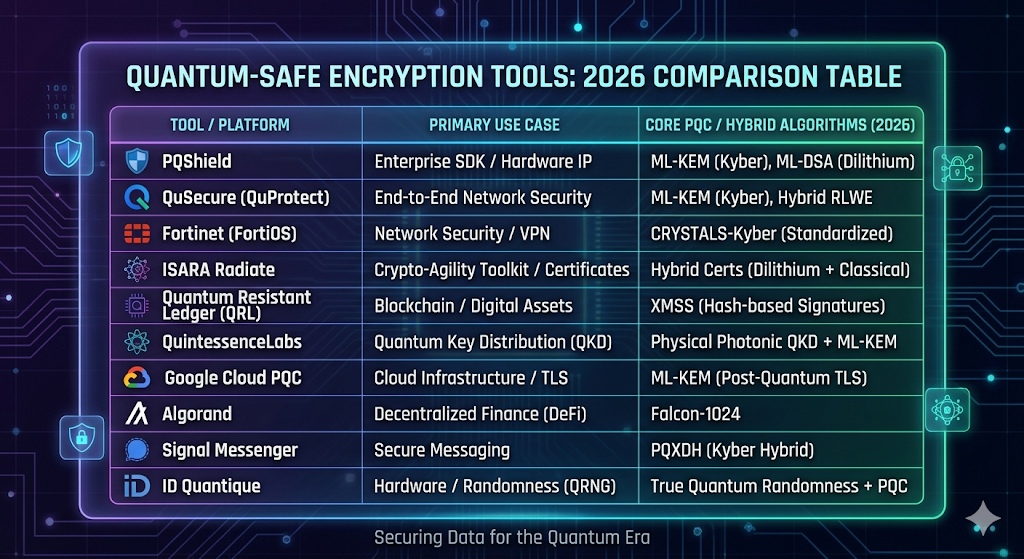
Choosing the right software can feel like navigating a maze. I’ve personally tested several of these workflows, and here are the top quantum safe encryption tools leading the charge this year
1. PQShield (Enterprise Leader)
PQShield is arguably the gold standard for companies needing to bake quantum resistance into their hardware. They offer specialized SDKs that implement NIST-approved algorithms, making them one of the most versatile quantum safe encryption tools available today..
2. QuSecure (QuProtect)
If you need an “all-in-one” platform, QuProtect is a fantastic choice. It provides an end-to-end managed layer that sits over your existing network, proving that quantum safe encryption tools don’t have to be a nightmare to install.
3. Fortinet (FortiOS 7.6+)
I was thrilled to see Fortinet integrate the CRYSTALS-Kyber algorithm directly into their latest OS. If you’re already using their firewalls, you can enable these quantum safe encryption tools with just a few clicks.
4. ISARA Radiate
ISARA focuses on “crypto-agility.” Their toolkit allows developers to create hybrid certificates. By using these quantum safe encryption tools, your app stays secure on today’s computers while being ready for tomorrow’s threats.
5. Quantum Resistant Ledger (QRL)
For the blockchain enthusiasts, QRL is a standout. It was built from the ground up using XMSS, making it one of the few truly decentralized quantum safe encryption tools I’ve seen in action.
6. QuintessenceLabs
Based in Australia, these folks are masters of Quantum Key Distribution (QKD). They offer a unique hardware approach to quantum safe encryption tools, ensuring that even the exchange of keys is physically protected.
7. Google Cloud (PQC Integration)
Google has been a pioneer in testing post-quantum algorithms in Chrome and their cloud infrastructure. They now offer PQC-enabled TLS for certain cloud services, which is a massive win for web developers.
8. Algorand (Falcon-1024)
As of late 2025, Algorand became one of the first major blockchains to implement Falcon, a NIST-approved lattice-based signature. It’s a huge step forward for decentralized finance (DeFi) security.
9. Signal Messenger (PQXDH)
Yes, your favorite private messenger is already quantum-ready! Signal’s PQXDH protocol combines X3DH with a post-quantum key encapsulation mechanism. Honestly, I think every messaging app should follow their lead.
10. ID Quantique
Specializing in hardware, ID Quantique offers Quantum Random Number Generators (QRNG). Since true randomness is the heartbeat of good encryption, their chips are vital for high-security government and financial sectors.
Understanding the “NIST Standards”
You’ll hear the term “NIST” a lot in this industry. Think of them as the referees of the encryption world. After years of competition, they’ve selected several primary algorithms that all quantum safe encryption tools should aim to support:
- ML-KEM (Kyber): Used for general encryption and key encapsulation.
- ML-DSA (Dilithium): The go-to for digital signatures.
- SLH-DSA (SPHINCS+): A backup signature method based on hash functions.
In my view, sticking to NIST-approved tools is the safest bet for any business. It ensures you aren’t using “snake oil” crypto that hasn’t been properly peer-reviewed.
How to Start Your Migration Plan
Transitioning your entire company to quantum-safe standards isn’t an overnight task. It’s more like moving a giant ship—you have to start the turn early.
- Inventory Your Data: Identify which data is “mission-critical” and needs protection for 10+ years.
- Use Hybrid Modes: Don’t just ditch RSA. Most modern quantum safe encryption tools use a hybrid approach, stacking a classical lock with a quantum one. Therefore, even if the new math has a hidden flaw, the old lock still holds.
- Update Your VPNs: This is the easiest “quick win.” Switching to a PQC-enabled VPN (like those from Fortinet or QuSecure) protects your data in transit immediately.
Common Challenges and Limitations
It’s not all sunshine and qubits. PQC algorithms often require larger key sizes and more processing power. For example, a Dilithium signature is much bigger than an ECC signature. As a result, you might notice a slight dip in network speed or higher storage costs. However, compared to the risk of a total data breach, it’s a small price to pay.
I’ve personally seen small IoT devices struggle with the memory requirements of these new algorithms. If you’re working with low-power hardware, look for “lightweight” PQC options like Tiny-Kyber.
FAQ: Protecting Your Future
Q: Is AES-256 still safe?
Yes, for now. While quantum computers can speed up attacks on AES, doubling your key size to 256-bit generally provides enough “safety margin” to keep your data secure for the foreseeable future.
Q: Do I need a quantum computer to use these tools?
No! That’s the beauty of Post-Quantum Cryptography. These are software-based algorithms that run on your current laptop, phone, or server.
Q: When will “Q-Day” actually happen?
Estimates vary, but most experts point toward the early 2030s. However, because of “Harvest Now, Decrypt Later,” you need to be protected today.
Q: Are these tools expensive?
Enterprise solutions like QuSecure carry a premium, but open-source libraries (like Open Quantum Safe) are free for developers to experiment with.
Q: Can quantum encryption be hacked?
Nothing is 100% “unhackable,” but these algorithms are based on mathematical problems that would take a quantum computer millions of years to solve—the same way classical computers are stumped by RSA today.
Final Thoughts: Don’t Get Left Behind
Quantum computing is a “when,” not an “if.” By integrating quantum safe encryption tools into your workflow now, you’re not just following a trend—you’re building a fortress around your digital legacy.
In my decade of blogging, I’ve seen many tech shifts, but this is the most significant one since the invention of the internet itself. Don’t wait for a headline about a major breach to take action. Start exploring hybrid encryption today and future-proof your business.