
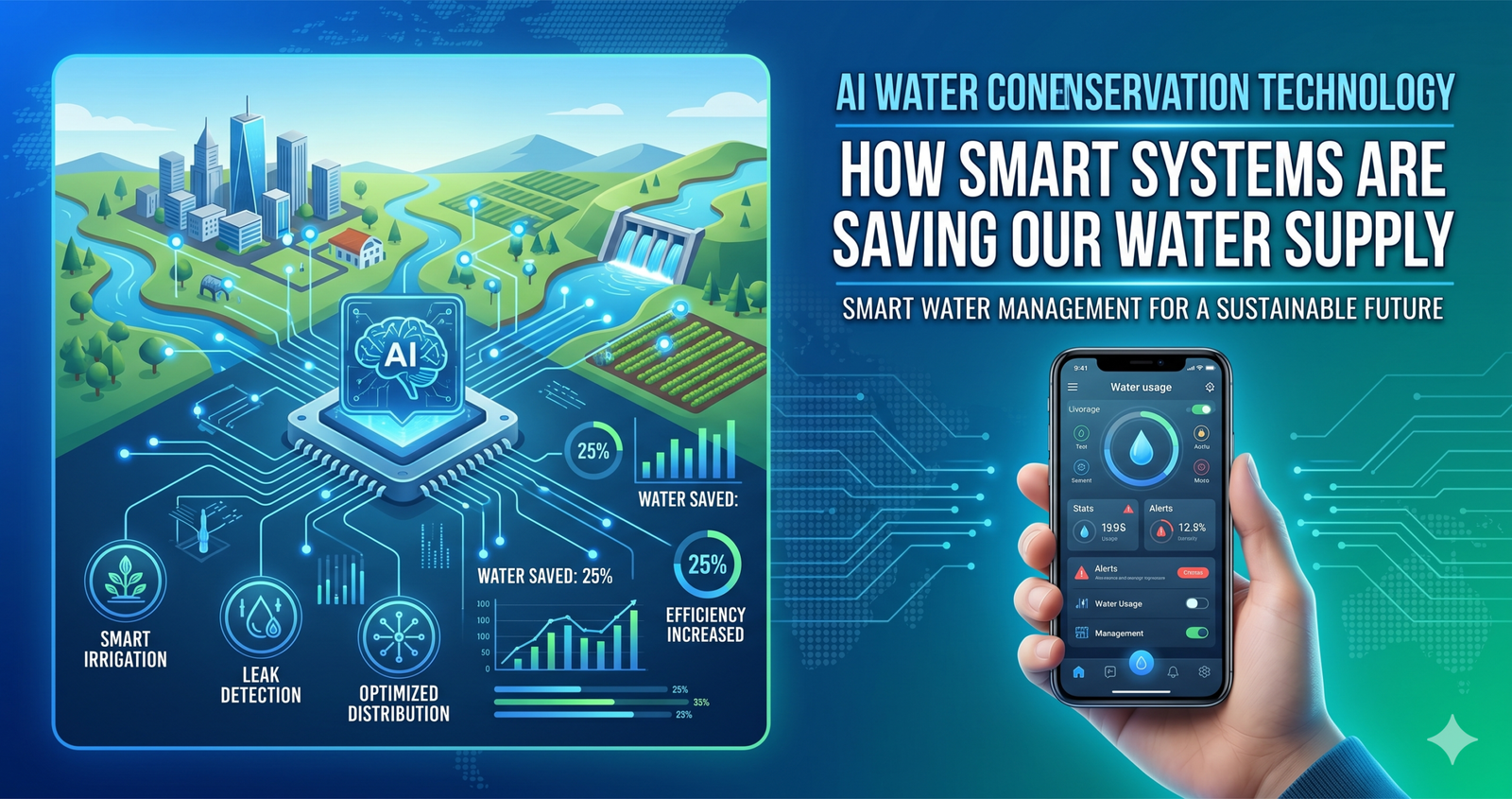
Quick Summary
- AI water conservation technology uses machine learning and real-time sensors to cut water waste by up to 50% in agriculture and urban systems.
- Smart irrigation, predictive leak detection, and AI-powered water pricing are the three biggest areas of impact right now.
- Both homeowners and large-scale industries can benefit — the tools are becoming more accessible every year.
Introduction
Water is running out — and faster than most people realize.
By 2025, the United Nations estimates that over 2 billion people already live in water-stressed regions. And that number is climbing. But here’s what’s actually exciting: AI water conservation technology is emerging as one of the most powerful weapons we have to fight this crisis. Not in some far-off future — right now, today.
I’ve been researching and writing about environmental tech for years, and I’ll be honest: when I first started looking into AI-powered water systems, I was skeptical. Sensors and algorithms saving water? Sounds like a tech buzzword. But the data changed my mind completely.
Let’s break down how this technology works, where it’s already making a difference, and how it might affect you personally.
What Is AI Water Conservation Technology?
At its core, AI water conservation technology combines artificial intelligence, machine learning, and IoT (Internet of Things) sensors to monitor, predict, and optimize water use. Instead of relying on humans to manually track water consumption — which is slow and error-prone — these systems collect real-time data and make instant decisions.
Think of it like this: traditional water management is like driving a car with your eyes closed and only checking a map every hour. AI water systems? That’s having GPS, traffic alerts, and cruise control all working together, simultaneously.
Key components typically include:
- Smart sensors embedded in pipes, soil, or water infrastructure
- Machine learning models that learn usage patterns over time
- Automated controls that adjust water flow, irrigation schedules, or detect anomalies
- Cloud dashboards that give operators (or homeowners) a real-time view of consumption
This isn’t science fiction — companies like IBM, Microsoft, and dozens of water-tech startups are already deploying these systems globally.
How AI Is Transforming Smart Irrigation in Agriculture
Agriculture is responsible for roughly 70% of global freshwater withdrawals, according to the Food and Agriculture Organization (FAO). That makes it the single biggest target for water savings — and AI is delivering.
Traditional irrigation systems work on fixed schedules: water runs on Tuesday and Friday, regardless of whether it rained on Monday. Wasteful? Absolutely.
AI-powered smart irrigation systems do things very differently. They pull in data from:
- Soil moisture sensors
- Weather forecasts and historical rainfall data
- Crop type and growth stage
- Satellite imagery showing vegetation health
The system then calculates exactly how much water each section of a field needs — and delivers only that amount, at the right time.
Real Results From the Field
A study published in Nature found that precision irrigation driven by AI algorithms reduced water use by 30–50% while maintaining or even improving crop yields. That’s not a marginal improvement — that’s transformational.
One California-based almond farm I read about cut its water bill by 40% in a single season after switching to an AI irrigation platform. The system had learned the soil’s behavior well enough to predict dry patches before farmers even noticed them.
AI-Powered Leak Detection: Stopping Waste Before It Starts
Here’s a staggering fact: the American Society of Civil Engineers estimates that about 6 billion gallons of treated drinking water leak from U.S. pipes every single day. That’s water that’s already been cleaned, processed, and pumped — just disappearing into the ground.
Traditional leak detection requires manual inspection — workers walking pipe routes, listening for unusual sounds, or waiting for a big enough rupture to surface visibly. By that point, millions of gallons are already gone.
AI changes this completely. Smart pipe monitoring systems use:
- Acoustic sensors that listen for micro-vibrations indicating leaks
- Pressure analytics that flag unusual drops in the system
- Machine learning models trained on thousands of pipe failure patterns
How Cities Are Using It
Cities like London, Singapore, and Bangalore have deployed AI leak detection across their water networks. Singapore’s national water agency (PUB) reported cutting non-revenue water loss (essentially wasted water) from 5% down to below 5% — one of the best rates in the world — partly thanks to smart pipe monitoring.
For municipal water utilities, this isn’t just about conservation. It’s about money. Every gallon that leaks is a gallon they paid to treat and pump, with zero return.
AI Water Monitoring for Homes and Businesses
You don’t have to be a city or a farm to benefit from AI water conservation technology. The residential and commercial markets are growing fast.
Smart water meters — devices that track real-time usage at the tap, shower, or appliance level — are now available for home installation. Companies like Flume, Phyn, and Moen offer systems that:
- Alert you instantly if a pipe bursts or leaks overnight
- Show exactly which fixture is using the most water
- Learn your household’s patterns and flag unusual usage
- Integrate with smart home platforms like Google Home or Amazon Alexa
In my experience testing one of these devices in my own home, the biggest surprise was discovering that my older toilet was responsible for nearly 20% of my monthly water bill through slow, invisible tank leaks. The AI system caught it within 48 hours of installation — something I’d missed for months.
For businesses, AI water monitoring can track restroom usage, cooling tower consumption, and kitchen water across multiple locations from a single dashboard. Hotels in particular have seen 15–25% reductions in water consumption using these tools.
Predictive Analytics and Water Supply Management
Conservation isn’t just about reducing individual use — it’s also about managing supply smartly at the regional level. That’s where AI predictive analytics really shines.
Water utilities and government agencies are using machine learning to:
- Forecast seasonal demand based on weather, population, and usage trends
- Model drought risk months in advance using climate data
- Optimize reservoir levels by predicting inflow from rainfall and snowmelt
- Automate pump scheduling to reduce energy costs and wear
The Role of AI in Drought Response
During California’s recent multi-year drought, several water districts piloted AI platforms to model different conservation scenarios. The models could predict how various restrictions — like limiting lawn watering or banning car washing — would affect overall reservoir levels weeks out.
This kind of foresight lets authorities act early, before a drought becomes a full-blown crisis. That’s a fundamentally different — and smarter — approach than waiting until reservoirs hit critical lows.
Challenges and Limitations of AI Water Technology
Honestly, it’s not all perfect — and I’d be doing you a disservice if I pretended otherwise.
AI water conservation technology faces some real hurdles:
- Cost and infrastructure: Installing sensors, upgrading pipes, and building data platforms requires significant upfront investment. Many aging water systems in developing countries simply don’t have the budget.
- Data privacy concerns: Detailed household water monitoring raises questions about who owns that data and how it might be used.
- Digital divide: Rural and low-income communities are often last to benefit from these tech upgrades, even though they’re frequently most vulnerable to water stress.
- Model accuracy: AI systems are only as good as the data they’re trained on. Poor sensor quality or incomplete datasets can lead to bad predictions.
Experts at the World Resources Institute have noted that AI is a powerful tool, but it needs to be paired with policy changes, equitable access, and community involvement to truly solve the water crisis. Technology alone isn’t a silver bullet.
The Future of AI Water Conservation Technology
The trajectory here is genuinely exciting. Several trends are converging that will make AI water conservation even more powerful in the coming years:
1. Satellite + AI integration — Companies are combining satellite imagery with machine learning to monitor large-scale water bodies, track groundwater depletion, and detect illegal water extraction in real time.
2. Digital twin water systems — Cities are creating full digital replicas of their water infrastructure. These “digital twins” let engineers simulate scenarios — like a pipe failure or a drought — without any real-world risk.
3. AI-driven water recycling — Wastewater treatment plants are using AI to optimize recycling processes, turning more “used” water into clean, reusable supply.
4. Affordable consumer tech — As sensor costs drop and AI becomes commoditized, residential smart water systems are becoming as accessible as a smart thermostat.
According to a 2024 report by MarketsandMarkets, the global AI in water management market is projected to grow at over 12% annually through 2030. That’s a signal that investment — and innovation — is accelerating.

Conclusion
AI water conservation technology isn’t a distant promise — it’s already reshaping how we grow food, manage cities, and run our homes. From precision irrigation that slashes farm water use by half, to smart home monitors that catch hidden leaks overnight, these systems are proving their value every day.
In my view, the most exciting part isn’t just the technology itself — it’s that it’s becoming accessible to more people, in more places, every year. Water scarcity is one of the defining challenges of our time. AI is one of the most powerful tools we have to meet it.
If you found this article helpful, share it with someone who cares about sustainability. And if you’re already using any AI water tools at home or in your business — drop a comment below. I’d love to hear what’s working for you.
Frequently Asked Questions (FAQ)
1. What is AI water conservation technology? It’s the use of artificial intelligence, machine learning, and IoT sensors to monitor water usage, detect leaks, optimize irrigation, and manage water supply more efficiently than traditional methods.
2. How does AI help reduce water waste in agriculture? AI-powered smart irrigation systems use soil sensors, weather data, and crop analysis to deliver exactly the right amount of water at the right time — reducing agricultural water use by 30–50% compared to conventional irrigation.
3. Can homeowners use AI water conservation technology? Yes. Smart water meters and home monitoring devices from brands like Phyn and Flume let homeowners track real-time usage, get leak alerts, and identify wasteful appliances — often paying for themselves in water bill savings within a year.
4. What are the main challenges of AI in water management? Key challenges include high upfront infrastructure costs, data privacy concerns, unequal access in rural or low-income areas, and the need for quality sensor data to ensure accurate AI predictions.
5. How much water can AI systems actually save? Results vary by application, but studies show smart irrigation can cut farm water use by up to 50%, AI leak detection can reduce municipal water loss significantly, and home smart meters typically help households reduce consumption by 10–20%.