
Table of Contents
AI in Agriculture India Use Cases: How Tech is Transforming Smallholder Farming
When we look at the most impactful AI in agriculture India use cases today, we see a digital revolution unfolding on the ground. Imagine stepping onto a half-hectare plot of land in the heart of Telangana.
Imagine stepping onto a half-hectare plot of land in the heart of Telangana. The sun is blazing, the soil is dry, and for generations, your family has relied on the whim of the monsoon to decide when to sow your crops. For millions of Indian farmers, this high-stakes guessing game is a daily reality.
However, things are shifting rapidly. Today, that same farmer can pull out a basic smartphone, receive a hyper-local text message powered by artificial intelligence, and discover the exact day to plant their seeds for a 30% higher yield.
From predictive weather forecasting to AI-guided soil diagnostics, the landscape of Indian farming is experiencing a massive digital upgrade. In this post, we will explore the most impactful AI in agriculture India use cases that are changing the game for smallholder farmers, boosting incomes, and building a more resilient food supply chain.
Key Takeaways
- Predictive Power: AI-driven tools like the Microsoft-ICRISAT Sowing App are helping farmers time their planting perfectly, leading to yield increases of up to 30%.
- Resource Efficiency: Smart irrigation systems are saving millions of liters of water and cutting down electricity usage by automating watering cycles based on real-time soil moisture.
- Empowering Smallholders: Through public-private partnerships like Telangana’s “Saagu Baagu” initiative, even farmers with tiny landholdings are doubling their incomes using AI diagnostics.
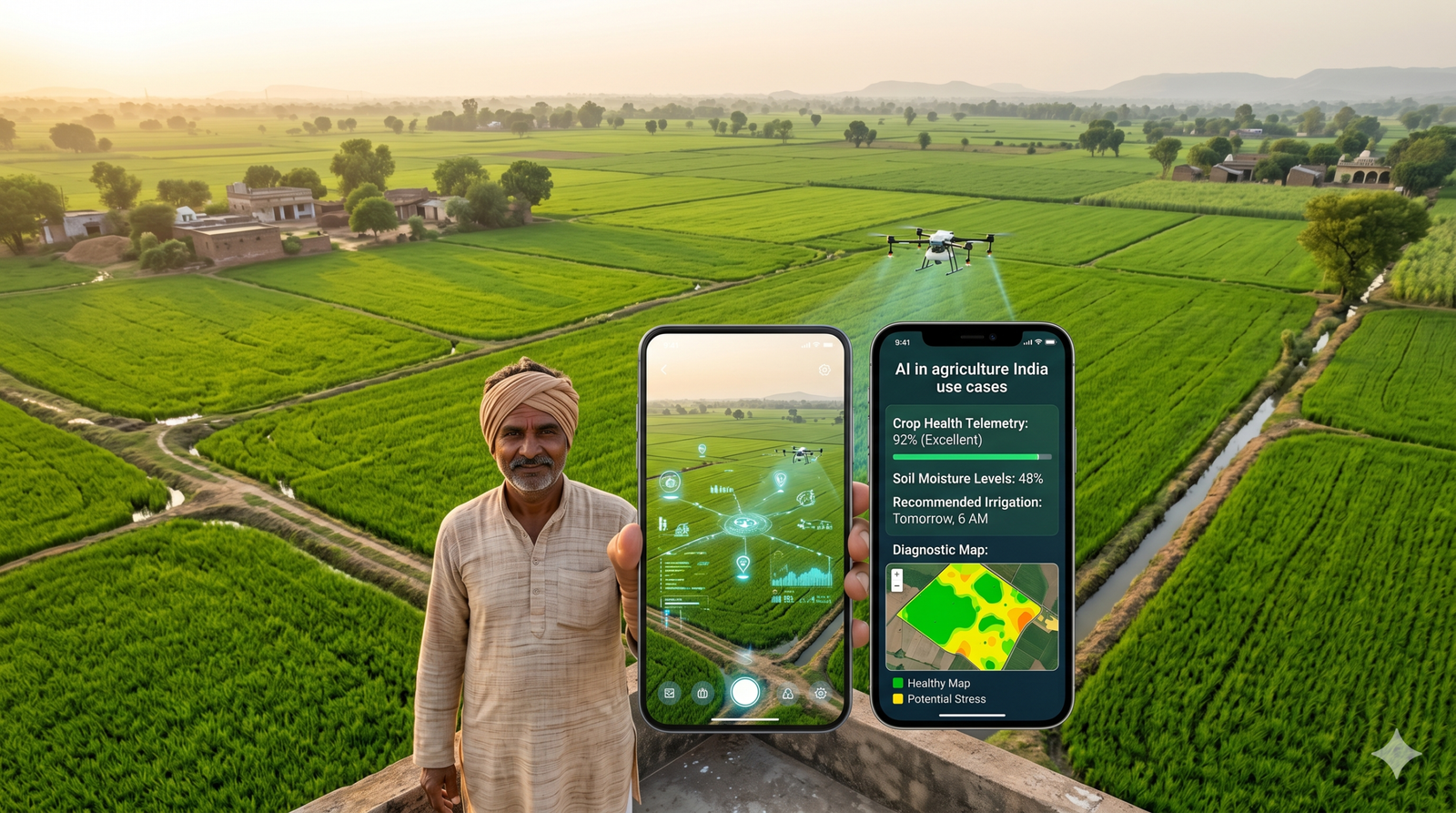
[IMAGE SUGGESTION: A close-up of an Indian farmer holding a smartphone displaying agricultural data, with green fields blurring out in the background.]
The New Dawn of Indian Farming: Why AI Matters
For decades, agriculture has been the backbone of the Indian economy, employing over 40% of the nation’s workforce. Yet, our farmers constantly battle fragmented landholdings, unpredictable monsoons, and devastating pest outbreaks.
Honestly, in my experience writing about agricultural technology, traditional farming methods are no longer enough to withstand the severe climate volatility we see today. We need high-tech intervention.
By turning massive amounts of satellite imagery, weather data, and soil metrics into simple, actionable steps, artificial intelligence acts as a digital advisor. This shift is not just about fancy robots; it is about keeping families profitable and ensuring national food security.
1. AI-Driven Sowing Advisories: Timing the Perfect Harvest
In my view, one of the most brilliant AI in agriculture India use cases is the optimization of sowing dates. Sowing too early or too late can ruin an entire season’s hard work.
The Microsoft & ICRISAT Pilot
To solve this, Microsoft partnered with the International Crops Research Institute for the Semi-Arid Tropics (ICRISAT) to develop an AI-powered Sowing App. Using over 30 years of historical climate data and real-time moisture monitoring, the app calculates the ideal sowing week.
- How it works: The AI measures the Moisture Adequacy Index (MAI) using daily rainfall and global weather forecasts.
- The Result: In Andhra Pradesh and Karnataka, farmers who followed the app’s SMS recommendations saw an impressive 10% to 30% increase in crop yields without adding expensive machinery.
Instead of guessing, farmers receive direct, localized text messages telling them exactly when the soil is ready. It is a perfect example of high-tech machinery working quietly in the background to serve simple, life-changing advice.
2. Precision Soil Health & Nutrient Management
A healthy crop starts from the ground up, but traditional laboratory soil testing in India can take weeks. This delay often leads farmers to over-apply chemical fertilizers, which damages the soil biology over time and increases input costs.
AI is changing this dynamic entirely. Startups like Gramophone and Intello Labs are leveraging computer vision and deep learning to analyze soil health. By matching real-time imagery from smartphone cameras or low-cost sensors against massive databases, these platforms diagnose nutrient deficiencies instantly.
Expert Insight: According to the Press Information Bureau (PIB) of India, localized AI-enabled precision farming has helped cut down chemical usage and excessive fertilizer application, saving costs while preserving fragile ecosystems.
3. Early Pest and Disease Detection with Computer Vision
There is nothing more heartbreaking for a farmer than watching a healthy crop get wiped out by pests. Historically, by the time a pest infestation was visible to the naked eye, the damage was already done.
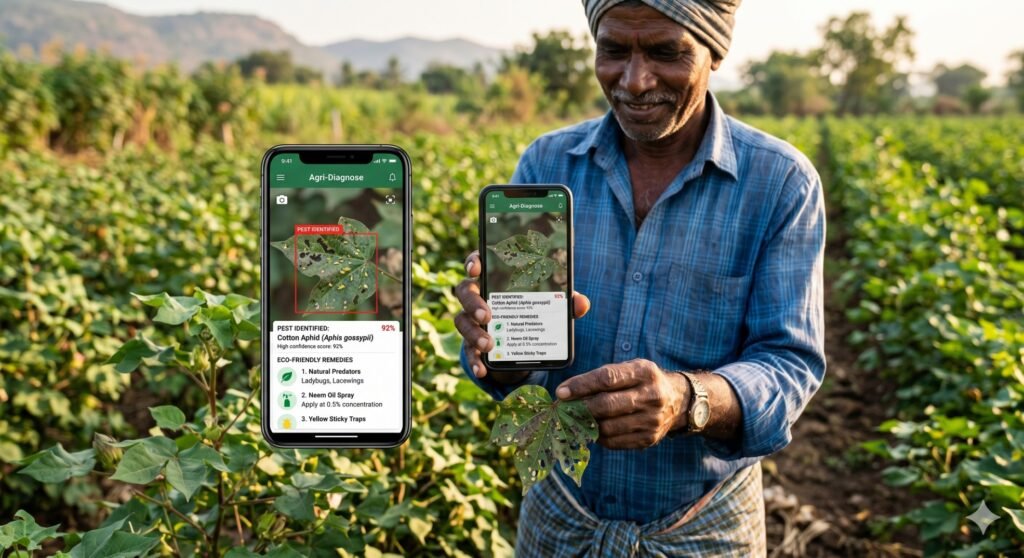
Smart Diagnostic Apps
Today, farmers can simply click a picture of a diseased leaf using their phone. AI algorithms analyze the image, identify the exact pest or fungus, and recommend the precise treatment required.
- Targeted Spraying: Instead of spraying an entire field with pesticides, farmers apply treatments only to affected spots.
- Pest Risk Prediction: Companies like UPL, in collaboration with Microsoft, have created Pest Risk Prediction Apps. These tools warn entire villages via automated voice calls if local weather patterns indicate a high risk of incoming pest attacks.
4. Smart Irrigation: Combatting India’s Water Crisis
India is home to nearly 18% of the world’s population but has only 4% of its water resources. Over-irrigation is a massive issue that depletes groundwater and drowns crop roots.
Through AI-powered Internet of Things (IoT) platforms, smart irrigation has become a reality. A great example of this in action is the Indian agritech startup Fasal.
Case Study: Saving Litres on the Ground
- The Tech: Fasal places solar-powered sensors in fields to measure hourly soil moisture, micro-climate temperatures, and humidity.
- The Impact: In Maharashtra, grape and chili growers utilizing this AI software reduced their irrigation frequency by 30% to 50%. This intervention saved over 8.5 lakh liters of water per farm in a single season while preventing root-borne diseases.
5. Drone-Based Aerial Monitoring and Smart Spraying
Drones equipped with multispectral cameras are taking over the skies of rural India. When integrated with AI, these drones do far more than just capture beautiful videos.
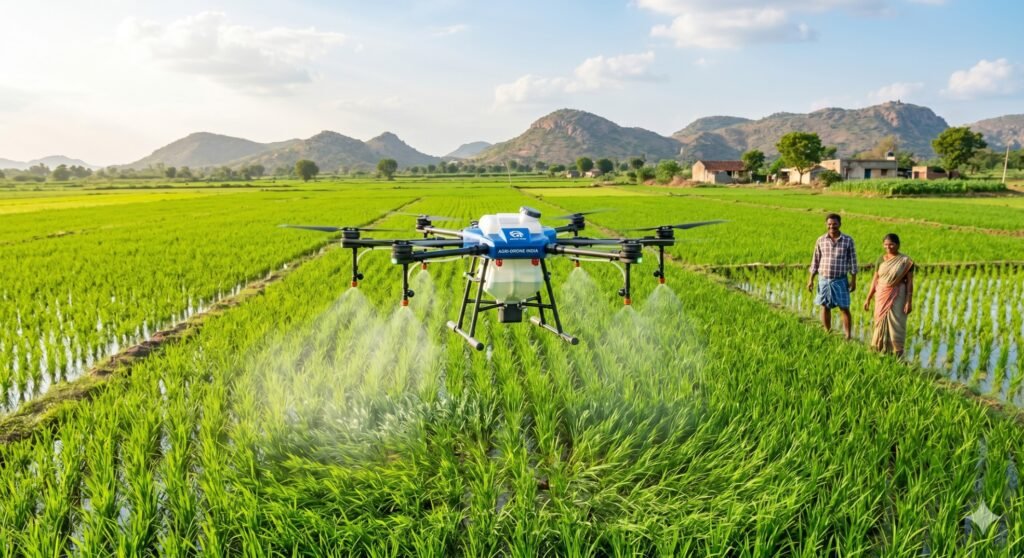
These “Kisan Drones” fly autonomously over fields to map crop stress, detect patchiness, and identify weed infestations that are invisible from the ground. Furthermore, AI-enabled drones can perform ultra-precise spraying of nutrients and pesticides. This keeps human workers safe from chemical exposure and reduces pesticide waste by up to 80%.
6. Resolving Supply Chain Inefficiencies and Market Pricing
One of the greatest challenges in Indian agriculture isn’t growing the food—it’s selling it at a fair price. Middlemen often exploit the lack of market information, leaving farmers with low profits.
AI is stepping in to bridge this gap. Platforms like StarAgri and Agri10x use machine learning to analyze market demand, predict future commodity price trends, and help farmers decide exactly when to sell their produce.
AI-Based Quality Grading
In addition, AI-powered image analysis tools allow local collection centers to instantly grade fruits, vegetables, and grains based on size, color, and shape. This eliminates subjective pricing, ensuring that farmers get paid exactly what their high-quality crop is worth.
To learn more about how digital tools are reshaping Indian trade networks, check out the official Digital Agriculture Mission updates or read the World Economic Forum’s playbook on Scaling AI in Indian Agriculture.
The Roadblocks: What’s Stopping Nationwide Adoption?
While these AI in agriculture India use cases paint an exciting picture, we must remain realistic about the hurdles.
- High Initial Costs: While indigenous tech is getting cheaper, setting up IoT sensors and buying drones is still out of reach for marginal farmers earning modest monthly incomes.
- Digital Divide: Many older farmers are hesitant to trust algorithms over decades of personal experience.
- Fragmented Data: AI needs massive, clean datasets to make accurate predictions. Regional languages, varying soil types, and inconsistent data logging make scaling difficult.
Fortunately, public-private initiatives like Telangana’s Saagu Baagu (which helped chili farmers double their incomes via AI bot advisories) are proving that collaborative frameworks can make technology affordable and accessible.
FAQs about AI in Agriculture India Use Cases
How is AI currently used in Indian agriculture?
AI is primarily used for predicting optimal sowing dates, diagnosing soil health, detecting crop pests through smartphone photos, automating smart irrigation systems, and forecasting market prices for harvested crops.
Can smallholder farmers with basic phones benefit from AI?
Yes! Many AI platforms send critical advisories—like pest alerts and sowing dates—via simple SMS text messages or automated voice calls in local regional languages, meaning a smartphone isn’t always required.
What are some major agritech startups in India using AI?
Startups like Fasal (smart irrigation), Intello Labs (image-based crop grading), Gramophone (soil science and pest advisory), and CropIn (satellite-based crop monitoring) are leading the revolution.
How does AI help in reducing water waste?
By using IoT sensors that track actual soil moisture levels and matching that data with local weather forecasts, AI tells farmers exactly when and how much to water, preventing over-irrigation.
Is the Indian government supporting AI in farming?
Absolutely. Through initiatives like the Digital Agriculture Mission and the newly introduced “Bharat-VISTAAR” framework, the government is actively funding digital infrastructure to scale AI-driven advisory services.
Conclusion
The transformation of Indian farming from a game of chance into a precise, data-driven science is well underway. As we have seen across these incredible AI in agriculture India use cases, integrating artificial intelligence isn’t about replacing the farmer; it’s about empowering them. By giving farmers the tools to predict weather anomalies, conserve water, and spot pests early, we are building a more sustainable and prosperous rural India.
The future of farming is smart, collaborative, and incredibly promising.
What are your thoughts on using AI to solve farming challenges? Do you think digital tools can fully bridge the gap for our rural communities? Let us know in the comments below, and don’t forget to share this article with your fellow tech and agri-enthusiasts!