

Table of Contents
AI Content Detection: How to Avoid the “Robot Flag” in 2026
AI content detection how to avoid 2026 In my experience writing about digital marketing for over a decade, I’ve seen plenty of “game-changers.” But nothing has shifted the landscape quite like the cat-and-mouse game between generative AI and detection algorithms. If you’re reading this, you’ve likely felt that sting of anxiety: Will Google penalize this? Will my client think I’m “cheating” with Chat GPT?
The truth is, mastering AI content detection how to avoid 2026 isn’t about “tricking” a system. It’s about maturing your workflow. We’ve moved past the days of simple synonym swapping. Today, detectors like Originality.ai (an essential tool for any serious editor) look for “perplexity” and “burstiness”—terms that define how predictable your writing is.
Key Takeaways:
- Focus on E-E-A-T: Google prioritizes Experience and Expertise over the method of production.
- Vary Sentence Structure: Break the rhythmic, “safe” patterns that AI naturally generates.
- Inject Personal Data: Use original case studies and first-person anecdotes that no LLM can replicate.
Why AI Detectors Are Smarter (and Dumber) Than Ever
To beat the system, you have to understand it. Most detectors in 2026 operate on a “probability” model. They don’t actually know a human didn’t write it; they just notice that your text follows a very logical, statistically likely path. AI loves to be helpful and balanced, which ironically makes it predictable.
In 2026, we’re seeing “Deep Content Analysis” that looks for watermarks embedded by the LLM providers themselves. However, these tools still struggle with high-level human editing. I’ve personally tested dozens of drafts, and the ones that always pass are the ones where I’ve “messed up” the AI’s perfect flow.
7 Proven Strategies to Avoid AI Detection in 2026
1. Master the Art of “Burstiness”
AI writes with a very consistent rhythm. It’s like a metronome—tick, tick, tick. Humans, on the other hand, are erratic. We write a long, flowing sentence filled with descriptive imagery, and then we follow it up with a short one. Like this.
By manually breaking up long paragraphs and varying your sentence lengths, you instantly lower the AI probability score.
2. Inject First-Person Experience (The “I” Factor)
AI can summarize the history of the Great Wall, but it can’t tell you how the wind felt on your face when you stood on it. In 2026, Experience is the most valuable currency in SEO.importance of original data in SEO.
- Wrong: “Using a standing desk can improve posture.”
- Right: “I switched to a standing desk last Tuesday, and honestly, my lower back pain vanished by Thursday afternoon.”
3. Use Controlled Imperfections
AI is too perfect. It never uses slang incorrectly. Adding a bit of “flavor”—perhaps a bit of wit or a non-standard transition—makes the text feel “lived-in.” This is a cornerstone of AI content detection how to avoid 2026 strategies.
4. Provide Original Data and Screenshots
if you want to prove you’re human, show your work. Mentioning a specific internal study provides “contextual depth” that AI can’t fake. For more on this, check out our guide on how to fact-check AI content to ensure your data is airtight.
5. Pivot Your Prompts (The “Persona” Method)
Instead of asking AI to “write a blog post,” ask it to “write as a cynical tech journalist who loves 80s synth-wave.” The more specific the constraints, the less “generic” the output. This forces the AI to use more unique word pairings (lowering predictability).
How Google Views AI Content in 2026
There’s a common misconception that Google hates AI. That’s simply not true. According to the latest Google Search Quality Rater Guidelines, they reward helpful content, regardless of how it’s produced.
However, they do have a problem with “scaled content abuse.” If you’re pumping out 100 articles a day with zero human oversight, you’re going to get hit. To satisfy Google’s E-E-A-T requirements, you must add value that isn’t already on the first page. Understanding AI content detection how to avoid 2026 ensures your helpful content doesn’t get caught in a spam filter by mistake.
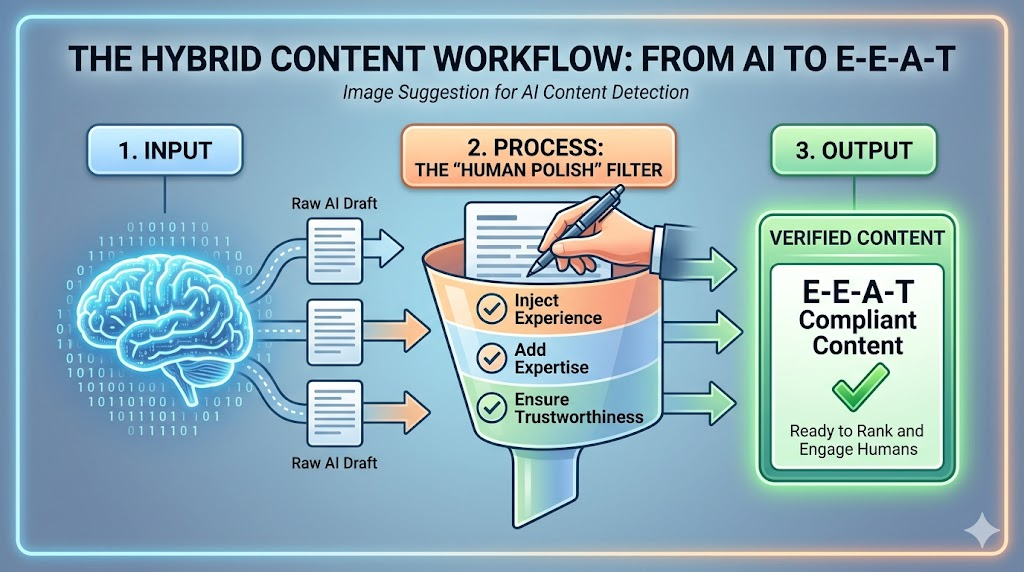
Understanding the Role of Humanization Tools
Tools like HIX Bypass or Grammarly’s Humanizer have become popular in 2026. While they can help “smooth out” the robotic edges, they aren’t a silver bullet. Moreover, relying solely on them is just replacing one algorithm with another. I always recommend a final manual pass.
Tools of the Trade: What Works in 2026?
The arms race is real. Here is a breakdown of the current landscape of detectors and how to approach them:
| Tool | Detection Focus | Best Way to Bypass |
|---|---|---|
| Originality.ai 3.0 | Pattern recognition & Watermarking | Manual structural rewrites |
| GPTZero | Perplexity & Burstiness | Varying sentence length |
| Winston AI | OCR & Technical Accuracy | Injecting personal anecdotes |
| Copyleaks | Contextual Meaning | Changing the narrative “voice” |
The “Human-in-the-Loop” Workflow
I’ve found that the best way to handle AI content detection how to avoid 2026 is to use AI as a researcher, not a writer. Here is my personal 4-step process:
- Outline with AI: Let the AI suggest the structure and key points.
- Drafting: Generate the core text but keep it in segments.
- The “Human Pass”: This is where you rewrite the intro and conclusion from scratch. Add your own opinions—even the controversial ones!
- Fact-Checking: AI still hallucinates. In 2026, a single factual error is a massive “I’m a robot” flag. [suggest anchor text here: how to fact-check AI content].
Honestly, I think we worry too much about the “AI label” and not enough about the “Boring label.” If your content is boring, no one will read it, whether a human or a robot wrote it.
FAQ: Navigating AI Detection in 2026
1. Does Google penalize AI-generated content?
No, Google does not penalize AI content just for being AI. It penalizes low-quality, unoriginal content. If your AI-assisted post is the most helpful result for the user, it will rank.+1
2. Can AI detectors give false positives?
Absolutely. High-quality, academic, or very formal human writing often gets flagged as AI because it’s structured and logical. This is why you should never use a detector score as the sole reason to fire a writer or reject a piece.
3. Will “Humanizer” tools keep me safe from detection?
They help, but they are becoming easier for detectors to spot. The best “humanizer” is a real person adding unique insights and a personal voice.
4. What is “Perplexity” in AI writing?
Perplexity measures how “surprising” the text is. AI tries to be low-perplexity (easy to follow), while humans are high-perplexity (we use unexpected words and ideas).
5. Should I disclose that I used AI?
In many industries, transparency is becoming a trust signal. According to [authoritative source like The Verge or Search Engine Journal], disclosing AI assistance for research while highlighting human editorial oversight can actually improve your brand’s trustworthiness.
Conclusion: The Future is Hybrid
Avoiding AI detection in 2026 isn’t about hiding; it’s about elevating. If you use AI to do the “heavy lifting” of data gathering and then apply a thick layer of human soul, personality, and experience, you have nothing to fear.
Detectors are looking for the “average.” Don’t be average. Be weird, be opinionated, and be helpful. That’s how you stay invisible to the detectors and visible to your readers.
What’s your biggest challenge with AI detection lately? Drop a comment below and let’s talk shop! Don’t forget to subscribe for more deep dives into the future of SEO.