

Table of Contents
Imagine walking into your home after a exhausting day. You do not reach for a light switch, tap your smartphone, or speak to a smart speaker. Yet, the entryway lights softly glow to your preferred warmth, the thermostat adjusts to a comfortable temperature, and your favorite acoustic playlist begins to play at just the right volume.
This is not science fiction. This is ambient computing, and it is quietly staging a massive revolution in how we interact with the digital world.
For decades, we have been completely tethered to glowing glass rectangles. We swipe, click, and scroll our way through life, constantly offering up our active attention to digital demands. But a massive paradigm shift is underway. By blending artificial intelligence, sensory hardware, and the Internet of Things (IoT), technology is fading directly into our physical environments.
In my experience writing about cutting-edge consumer technology, I have watched the definition of a “user interface” shift from pixels on a screen to invisible, background-driven interactions. Below, we will dive deep into what this looks like in the real world by exploring concrete ambient computing interface examples that you can experience today.
Quick Summary: Key Takeaways
- The Death of the Screen: Ambient computing moves technology into the background, replacing traditional screens with voice, physical gestures, and predictive automation.
- Context is King: True ambient interfaces use sensor networks to understand your location, habits, and physical state to proactively serve you.
- Real-World Impact: From smart homes and smart retail to wearable health monitors, ambient interfaces are already eliminating daily friction.
What is an Ambient Computing Interface?
To understand how this technology works, we first need to rethink what an “interface” actually is. Traditionally, a user interface (UI) is a digital bridge—like a keyboard, a mouse, or a touchscreen—that requires your active, undivided attention.
An ambient computing interface, however, is designed to be invisible. It acts as “calm technology.” Instead of demanding that you look at it, it uses natural human behaviors—such as your physical presence, speech, or routine habits—to trigger digital actions.
According to pioneering research from Google Research on hidden interfaces the goal is to embed expressive display technology and smart sensors directly under everyday materials like wood, textiles, and mirrors. Consequently, the technology completely disappears when you do not need it, only coming alive when you do. When researching the best ambient computing interface examples, this seamless integration is always the common thread.
7 Groundbreaking Ambient Computing Interface Examples
Let’s take a look at how this futuristic concept is actively manifesting in our homes, workplaces, and public spaces today through practical ambient computing interface examples.
1. Smart Thermostats and Adaptive Climate Control
Perhaps the most recognizable consumer example of ambient computing is the smart thermostat, pioneered by devices like the Google Nest.
Traditional thermostats require manual programming or constant on-the-fly adjustments. In contrast, a smart thermostat operates on predictive automation. It uses motion sensors to detect when you are home, observes your daily routines, and notes what temperature you prefer at different times of day.
Over time, it builds a personalized climate profile. Therefore, you stop thinking about the temperature altogether. The interface is no longer a dial on the wall; it is your very pattern of living.
2. “Just Walk Out” Shopping Environments
If you have ever stepped into an Amazon Go or similar checkout-free convenience store, you have experienced a highly sophisticated, multi-sensor ambient interface. These retail spaces are premier ambient computing interface examples because they completely eliminate the checkout line.
- The Entryway: You simply scan a QR code on your phone to enter.
- The Interaction: You pick up items, put them in your bag, or put them back on the shelves.
- The Exit: You simply walk out of the store.
Behind the scenes, a complex network of overhead cameras, weight sensors on shelves, and deep-learning algorithms track your movements. There are no registers, barcodes to scan, or physical payment terminals. The physical store itself becomes the computer interface, completing your transaction automatically in the background.
[Store Entry (App Scan)] ➔ [Select Items (Sensor Tracking)] ➔ [Exit Store (Auto-Billing)]
3. Invisible Displays Hidden in Home Materials
We are beginning to see beautiful, artistic interpretations of ambient interfaces that reject the cold, black glass of modern screens. Designers are starting to build dynamic displays directly into household materials, providing stellar ambient computing interface examples for home decor.
For instance, consider smart mirrors that display your calendar and local weather forecast using water-resistant LED arrays underneath the glass surface. When the mirror is turned off, it is a completely normal, reflective bathroom mirror.
Additionally, researchers have successfully demonstrated smart wood veneers and interactive textiles. Imagine sweeping your hand across a wooden coffee table to reveal a glowing volume slider, which swiftly vanishes back into the wood grain once you remove your hand. These are the kinds of ambient computing interface examples that make technology feel like actual magic.
4. Continuous Health and Biometric Wearables
Wearable technology has evolved far beyond simple step-counting. Modern smartwatches and smart rings serve as highly personal, continuous health monitors and represent excellent everyday ambient computing interface examples.
In my own life, I wear an Oura Ring. Honestly, I think the best thing about it is that I completely forget I am wearing it. It does not have a screen, and it does not buzz with constant notifications. Yet, it continuously tracks my heart rate variability, body temperature, and sleep cycles.
If my body temperature spikes overnight, indicating I might be getting sick, the companion app gently nudges me to take it easy. This is a classic example of an ambient interface—effortless data collection that translates into proactive, helpful advice without disrupting my day.
5. Context-Aware Smart Lighting Systems
Smart lightbulbs like Philips Hue have been around for years, but the ambient magic happens when you pair them with motion, time, and location sensors. These setups are highly practical ambient computing interface examples for improving daily focus and sleep hygiene.
Instead of opening an app on your phone to turn on your lights, a truly ambient home uses motion sensors and geofencing. As you walk into a room, the system detects your presence. If it is 2:00 PM, it might cast a bright, cool light to help you focus. However, if it is 10:00 PM, it will automatically cast a dim, amber glow to prepare your body for sleep. The lights naturally adapt to the rhythm of your day without you ever touching a switch.
6. Hands-Free Voice Assistants and Natural Language Processing
While voice assistants like Amazon Alexa or Apple’s Siri are early steps toward true ambient computing, they are incredibly powerful and widespread ambient computing interface examples.
User Voice Input ➔ Smart Speaker Hub ➔ Cloud NLP Engine ➔ Local IoT Device Action
Instead of using a dedicated screen-based device to search for a recipe, check the weather, or set a kitchen timer, you simply speak your requests directly into the air. Voice-activated interfaces take the physical screen entirely out of the equation. As natural language processing continues to improve rapidly, these systems are shifting from reactive helpers (waiting for a command) to proactive companions that fit perfectly into our list of ambient computing interface examples.
7. Connected, Intuitive Automotive Cockpits
Modern vehicles are essentially rolling ambient computers. Think about how a modern car handles your arrival. These vehicles provide some of the most complex, safety-focused ambient computing interface examples in production today.
As you approach with your key fob or smartphone in your pocket, the doors automatically unlock. Once you sit down, the seat and mirrors adjust to your custom driver profile. The vehicle analyzes real-time traffic and instantly maps out your most likely destination, like your office or home. If the cameras detect that your eyes are drooping, the system sounds a gentle alert to suggest a coffee break. The car’s interface adapts around your physical and cognitive state to keep you safe and comfortable.
The Key Technologies Powering the Screen-Free Future
Designing an invisible interface is incredibly complex. For these systems to work smoothly, several layers of modern technology must work in perfect harmony. When we analyze these ambient computing interface examples, we find a common stack of technologies.
| Technology | Core Function in Ambient Systems |
| Internet of Things (IoT) | Creates a massive web of interconnected physical sensors and smart devices. |
| Edge Computing | Processes data locally on devices for near-instant response times without cloud lag. |
| Sensor Networks | Monitors light, sound, motion, temperature, and biometric signals. |
| Generative AI & LLMs | Evaluates user data to predict needs, handle complex requests, and speak naturally. |
Why the Shift to Ambient Computing Interfaces Matters
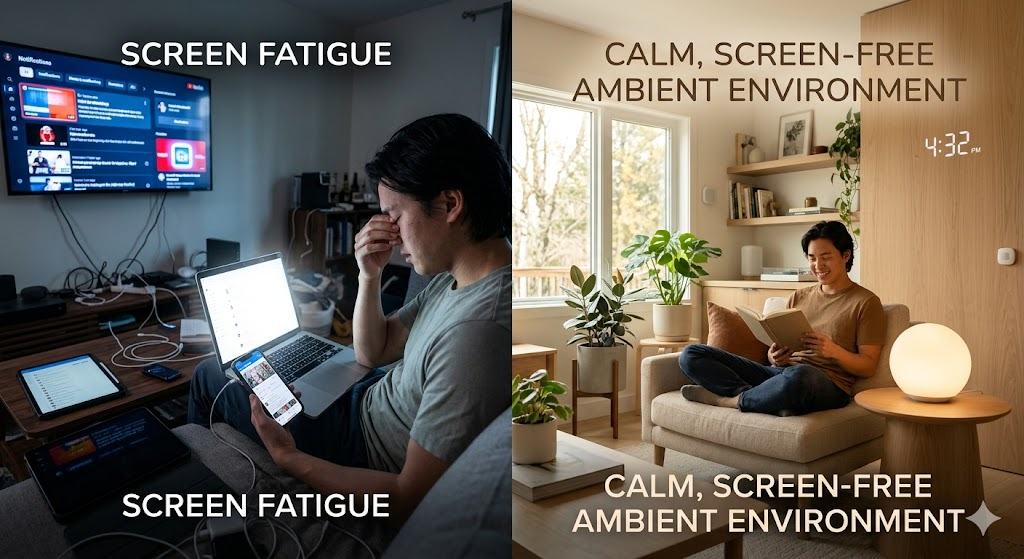
You might be wondering: Is this really better than just using a smartphone app? In my view, the answer is a resounding yes. Our relationship with screens has become incredibly fragmented and exhausting. We are constantly interrupted by red notification badges, pinging alerts, and addictive feed designs.
Ambient computing aims to return our attention to the physical world. It allows us to benefit from the power of the internet and digital automation without being constantly distracted by a screen. By moving technology to the periphery of our attention, we can focus on what actually matters: our lives, our families, and our immediate surroundings.
Challenges and Privacy Concerns: The Invisible Trade-off
Despite all the wonderful benefits, we must be honest about the limitations and risks of this emerging technology.
Because ambient computing operates silently in the background, it relies heavily on constant monitoring. Smart microphones must always listen for wake words; cameras must watch rooms to detect occupancy; smartwatches must continuously log biometric data.
Important Privacy Disclaimer: While ambient technology offers unparalleled convenience, it raises significant concerns regarding data privacy, user consent, and security. It is crucial to source devices from reputable manufacturers that prioritize local edge processing and robust data encryption.
Furthermore, device fragmentation remains a massive roadblock. If your smart lights do not talk to your smart thermostat because they are made by competing companies, the ambient experience breaks down. Thankfully, industry standards like Matter are slowly bridging these gaps, allowing different ecosystems to communicate more easily.
Frequently Asked Questions (FAQs)
What is the difference between IoT and ambient computing?
The Internet of Things (IoT) refers to the physical network of connected devices (like smart bulbs, sensors, and appliances). Ambient computing is the broader software and experiential layer that uses those connected IoT devices to create a seamless, invisible, and smart environment that responds to human needs without manual control.
How does ambient computing help with accessibility?
Ambient computing is a massive win for accessibility. By eliminating the need for complex physical menus, keyboards, or touchscreens, users with physical or visual impairments can control their environments entirely through voice, simple hand gestures, or presence-based automation.
Are there any ambient computing interface examples in healthcare?
Yes! Hospitals use ambient sensors to monitor patient movement, automatically alerting nurses if an elderly patient tries to get out of bed and is at risk of falling. Additionally, wearable sensors continuously monitor vital signs, sending real-time data directly to healthcare providers without requiring active patient input.
Will ambient computing completely replace smartphones?
It is highly unlikely that smartphones will disappear entirely, as we still need high-fidelity screens for tasks like reading, watching videos, or editing documents. However, ambient computing will dramatically reduce our daily smartphone screen time by handling minor, routine tasks automatically.
Is ambient computing safe from hackers?
Because ambient systems rely on a web of connected devices, they can represent security vulnerabilities if not set up correctly. To protect your home, always secure your home Wi-Fi network, update your device firmware regularly, and opt for devices that process data locally on the “edge” rather than sending everything to the cloud.
Conclusion: Embracing a Frictionless, Calm Future
Ultimately, the future of technology isn’t about more screens—it is about fewer of them. These ambient computing interface examples demonstrate that technology is at its absolute best when it serves us quietly, intuitively, and without demanding our active attention.
As we look ahead, we will continue to see computers blend into the physical fabric of our homes, offices, and cities. The result? A digital experience that feels less like a tool we operate and more like a helpful, natural extension of our physical world.
What do you think? Are you excited about a screen-free future, or does the idea of “always-on” sensors make you nervous? Drop your thoughts in the comments below, share this post with your tech-loving friends, and don’t forget to subscribe to our newsletter for more deep dives into the future of technology!