Table of Contents
Quick Summary: The 2026 Coding Outlook
- The AI King: Python remains the undisputed leader for AI, data, and general automation.
- The Safety Specialist: Rust is no longer a niche “cool” language; it is the industry standard for high-performance, secure systems.
- The Web Standard: TypeScript has effectively replaced standard JavaScript for professional, large-scale enterprise applications.
- The Salary Leaders: Languages like Rust, Go, and Mojo are currently commanding the highest senior-level salaries.
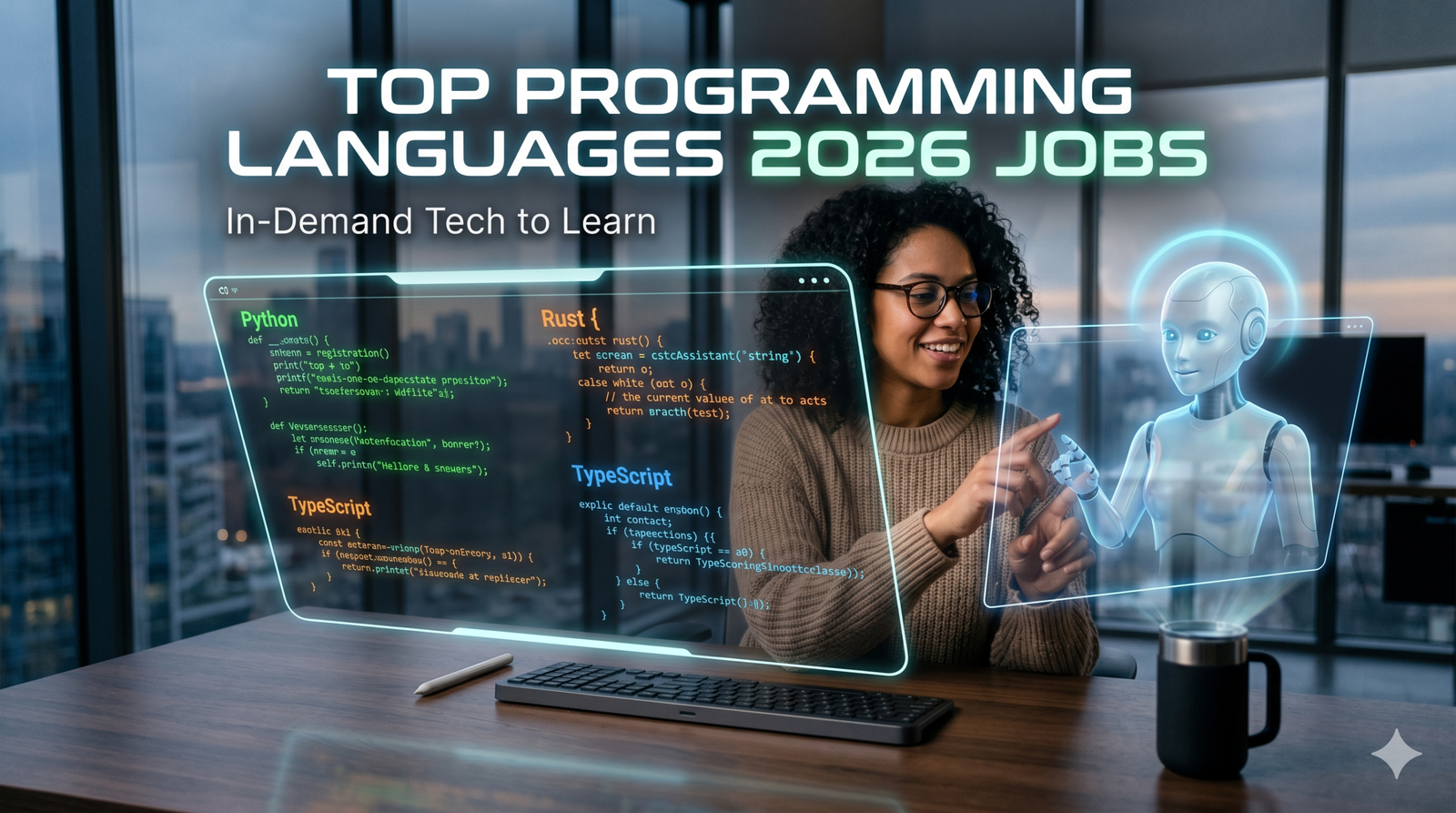
Top Programming Languages 2026 Jobs: Your Guide to Staying Employable
The tech landscape isn’t just “changing” anymore—it’s undergoing a total transformation. In my experience writing about developer career paths for over a decade, I’ve never seen a shift quite as dramatic as the one we are living through right now in 2026.
If you’re looking for the top programming languages 2026 jobs demand, you’ve likely noticed that the old rules don’t always apply. We aren’t just writing code anymore; we are “orchestrating” it alongside AI agents. To land a high-paying role today, you need to know which languages have the most “staying power” and which ones are feeding the AI and cloud-native hunger of modern enterprises.
Finding the right top programming languages 2026 jobs prioritize is the difference between a stagnant career and a six-figure salary.
Why the Market for Top Programming Languages 2026 Jobs is Shifting
Before we dive into the list, let’s get real. In early 2024, everyone was worried AI would replace programmers. Fast forward to 2026, and the reality is much more nuanced. Companies are hiring fewer “syntax-only” coders and more “architectural thinkers.”
I remember talking to a hiring manager last month who told me, “I don’t need someone who can write a for-loop. ChatGPT does that in two seconds. I need someone who knows why that loop belongs there.” This shift toward system-level efficiency is exactly what’s driving the demand for the top programming languages 2026 jobs require.
Moreover, the search for top programming languages 2026 jobs often leads to “safe” older languages, but the real growth is in the “efficiency” sector. Therefore, you must balance legacy knowledge with modern performance tools.
1. Python: Still Leading the Top Programming Languages 2026 Jobs
You probably aren’t surprised to see Python here. It has moved from being a “useful tool” to the literal backbone of the global economy. According to the TIOBE Index for April 2026, Python remains the #1 most popular language in the world, holding a massive lead over its competitors.
1.Why it’s in demand for 2026 jobs
Python is the native tongue of Artificial Intelligence. Whether it’s building LLM wrappers, working with PyTorch for custom model training, or automating complex business workflows, Python is the gateway.
Moreover, its ecosystem has matured. We are seeing a massive surge in Python-based AI agents that handle everything from customer service to predictive maintenance in manufacturing. If you want a job that is “future-proof,” you simply cannot skip Python.
Salary & Roles
- Common Roles: AI Engineer, Data Scientist, Backend Developer.
- Average Salary (US): $135,000 – $175,000.
- Key Libraries: LangChain, TensorFlow, FastAPI.
2. Rust: The New Gold Standard for Performance
Honestly, if you asked me three years ago, I would have said Rust is for “hardcore” systems nerds. But in 2026, Rust is mainstream. Major players like Microsoft, Google, and Amazon have transitioned significant portions of their core infrastructure to Rust because it prevents memory bugs that lead to security vulnerabilities.
The “Memory Safety” Revolution
In my own projects, I’ve found that while the Rust “borrow checker” is a bit of a headache to learn at first, it saves you weeks of debugging later. Employers in 2026 are obsessed with this. They want code that doesn’t crash and can’t be easily hacked. As a result, Rust developers are currently among the highest-paid in the industry, with senior roles often reaching $200,000+.
3. TypeScript: Essential for Scalable Web Apps
If you’re still writing “vanilla” JavaScript for large projects, you’re likely making your life harder than it needs to be. In the world of top programming languages 2026 jobs, TypeScript has become the mandatory standard for front-end and full-stack roles.
Why TypeScript wins
- Fewer Bugs: It catches errors during development rather than at runtime.
- Better Collaboration: In a world of remote, AI-assisted teams, “types” act as documentation that both humans and AI can understand perfectly.
- Framework Dominance: Whether you use React, Vue, or the latest 2026 frameworks, TypeScript is the preferred language.
4. Go (Golang): The King of Cloud Infrastructure
Created by Google, Go was built for one thing: scale. As more companies move to microservices and cloud-native architectures, Go’s simplicity and lightning-fast execution make it a favorite for backend engineering.
The Role of Go in 2026
We’ve seen a huge rise in “DevOps-as-Code.” Go is the language behind Docker and Kubernetes, and as companies try to optimize their cloud spend in 2026, they are hiring Go experts to build more efficient, “green” infrastructure. It’s a “no-nonsense” language—it’s easy to read, easy to deploy, and very hard to mess up.
5. Mojo: The “Hot New” Challenger for AI
I have to mention Mojo. It’s the newest kid on the block, but it’s making huge waves. Think of Mojo as “Python with the speed of C.” It was designed specifically for AI hardware, and while it’s still growing, many forward-thinking startups are hiring Mojo developers to optimize their AI inference costs.
If you already know Python, learning Mojo is a fantastic way to differentiate yourself in a crowded job market. It shows you’re on the cutting edge of high-performance AI computing.
Honorable Mentions: SQL, Kotlin, and Swift
While they might not be the “trendiest,” these languages remain pillars of the 2026 job market:
- SQL: Still the most important language for anyone touching data. You can’t escape it.
- Kotlin: The undisputed leader for Android development.
- Swift: If you want to build for the Apple ecosystem (especially with the latest AR/VR headsets), Swift is your only path.
Comparison of Top Languages for 2026
| Language | Primary Use Case | Learning Curve | 2026 Job Demand |
| Python | AI, Data Science, Scripting | Easy | Extremely High |
| Rust | Systems, Security, Blockchain | Hard | High (Niche/High Pay) |
| TypeScript | Web Development, SaaS | Moderate | Extremely High |
| Go | Cloud, Microservices | Easy/Moderate | High |
| Java | Enterprise, Backend | Moderate | Stable |
How to Choose Which Language to Learn First
Choosing a language is like choosing a tool—you need to know what you’re building.
- Want to build AI? Start with Python.
- Want to build websites? Go with TypeScript.
- Want to work on deep-tech or security? Rust is your best bet.
In my view, the most successful developers in 2026 aren’t “single-language” experts. They are T-shaped developers: they have a deep understanding of one language (like Rust) but a broad understanding of several others (like Python and SQL).
FAQs: Frequently Asked Questions
1. Is Python still worth learning in 2026?
Absolutely. Python is the primary language for AI and machine learning. Its dominance has only grown as AI becomes integrated into every industry, from healthcare to finance.
2. Which language pays the highest salary in 2026?
Currently, Rust and Go tend to command the highest salaries for senior roles, often ranging between $160k and $230k in the US, due to the specialized nature of systems and cloud engineering.
3. Has AI made learning to code obsolete?
Not at all. While AI can write snippets of code, it cannot design complex systems, ensure security, or understand specific business needs. The demand for “AI-literate” developers who can guide these tools is higher than ever.
4. Is Java still relevant for jobs in 2026?
Yes. While it isn’t “trendy,” Java still powers the backends of most Fortune 500 companies. It remains a very safe and stable career choice for enterprise-level development.
5. Should I learn TypeScript or JavaScript?
Go straight for TypeScript. Most professional job postings in 2026 list TypeScript as a requirement. Since it’s a superset of JavaScript, you’ll be learning both simultaneously anyway.
Conclusion: Taking Action for Your 2026 Career
Navigating the top programming languages 2026 jobs require can feel overwhelming, but remember that the fundamentals of logic and problem-solving never go out of style. Whether you choose the AI-heavy path of Python or the performance-driven world of Rust, the key is to stay curious and keep building.
In addition to learning syntax, focus on how these languages interact with AI tools. The “Senior Developer” of today is someone who knows how to leverage an LLM to write the boilerplate while they focus on the high-level architecture.
What language are you planning to master this year? Let me know in the comments below, or share this guide with a friend who’s looking to break into tech!