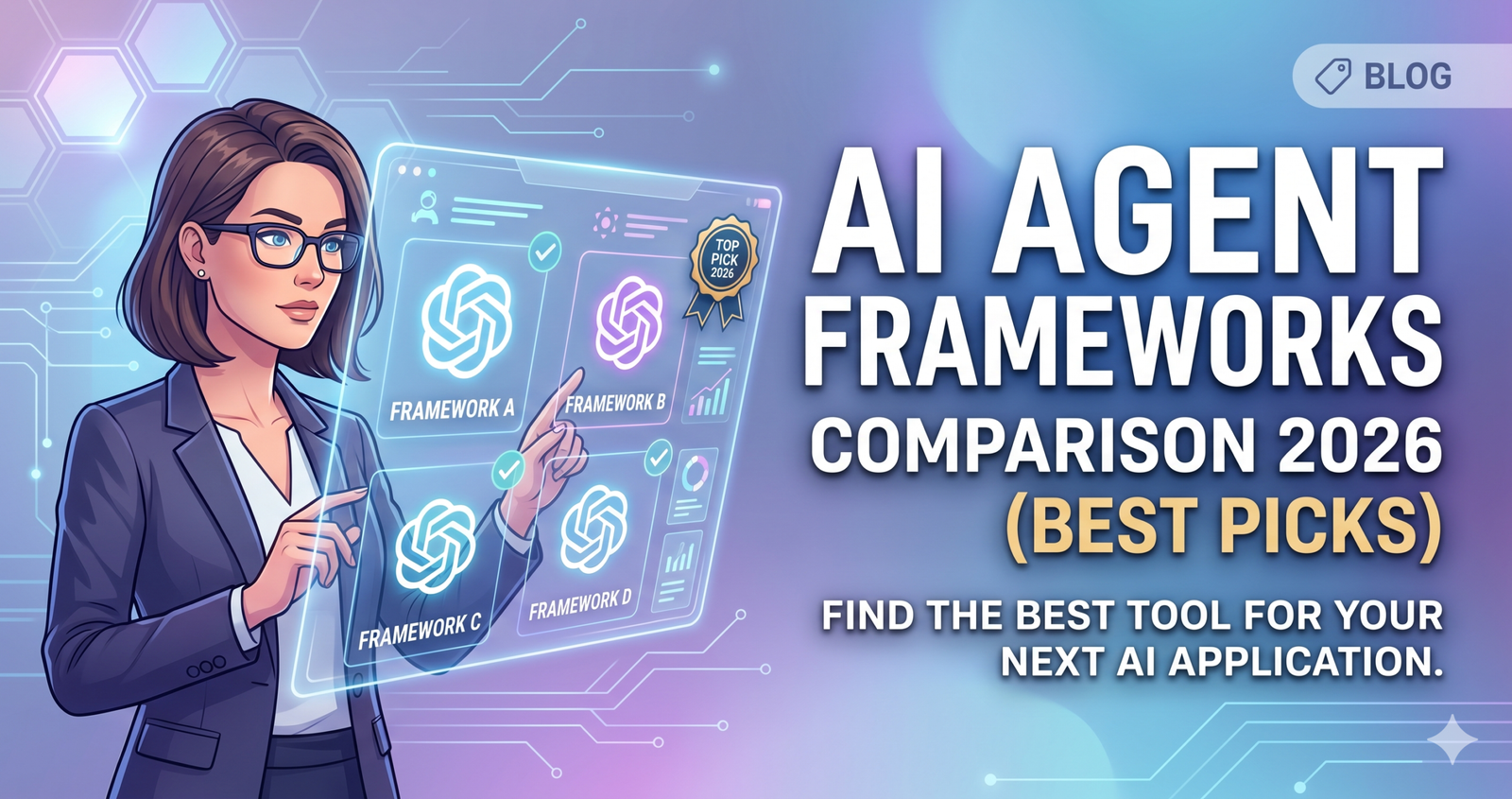
AI Agent Frameworks Comparison 2026 (Best Picks)
If you’re trying to build an AI agent in 2026, you’ve got options… almost too many options. One week you’re happily shipping a simple tool-calling bot, and the next week you’re debating LangGraph vs AutoGen vs CrewAI vs OpenAI Agents SDK like it’s a fantasy football draft.
So, let’s make it simple.
In this AI agent frameworks comparison 2026, we’ll break down the major frameworks, what they’re actually good at, where they bite you later, and how to choose without wasting a month rewriting your “agent loop” for the third time.
In my experience writing about AI agent frameworks comparison 2026 topics (and helping teams pick stacks), the biggest mistake is choosing based on hype instead of your real workflow: state, tools, reliability, and debugging.
Quick Summary (Key Takeaways)
- Pick LangGraph if you need stateful, multi-step workflows with checkpoints and clearer control flow. 1
- Pick OpenAI Agents SDK if you’re OpenAI-first and want built-in tracing + sandboxed long-running work. 2
- Pick CrewAI or AutoGen when multi-agent “team” behavior is the product, not just a fun demo. 3
AI Agent Frameworks Comparison 2026 (Best Picks)-What people really mean by “AI agent frameworks” in 2026
AI Agent Frameworks Comparison 2026 (Best Picks)-An “AI agent framework” is usually a toolkit that helps you do four annoying things consistently:
- Run the agent loop (prompt → tool call → tool result → next step)
- Orchestrate multiple steps (and sometimes multiple agents)
- Manage state (memory, plans, intermediate outputs, checkpoints)
- Debug + observe what happened after it inevitably fails at 2:13 AM
The catch: many “agent” apps don’t need all that.
A lot of production systems are basically: message → retrieve context → call model → maybe call a tool → respond. For those, a heavy framework can slow you down (and add failure modes) without adding real value.
Honestly, I think the best default move is: start minimal, then add a framework only when you can name the pain it solves (state, retries, handoffs, observability, etc.). 4
AI agent frameworks comparison 2026: the short list that matters
AI Agent Frameworks Comparison 2026 (Best Picks)-Below are the frameworks I see most often in real builds in 2026, plus what they’re best at.
The “big 6” frameworks most teams compare
- LangGraph (LangChain ecosystem) — structured, stateful workflows with graphs; strong for complex orchestration. 1
- OpenAI Agents SDK — OpenAI-native harness, tracing, handoffs, plus sandboxing/checkpointing for longer tasks. 2
- AutoGen (Microsoft Research) — conversation-first multi-agent patterns; strong for research and complex agent-to-agent interactions. 5
- CrewAI — role-based “agent teams” that are quick to set up and easy to reason about. 3
- LlamaIndex — often the best fit for agents over your data (RAG-heavy workflows). 6
- Semantic Kernel — Microsoft ecosystem orchestration with plugins + function calling loops; strong in .NET/Azure shops. 7
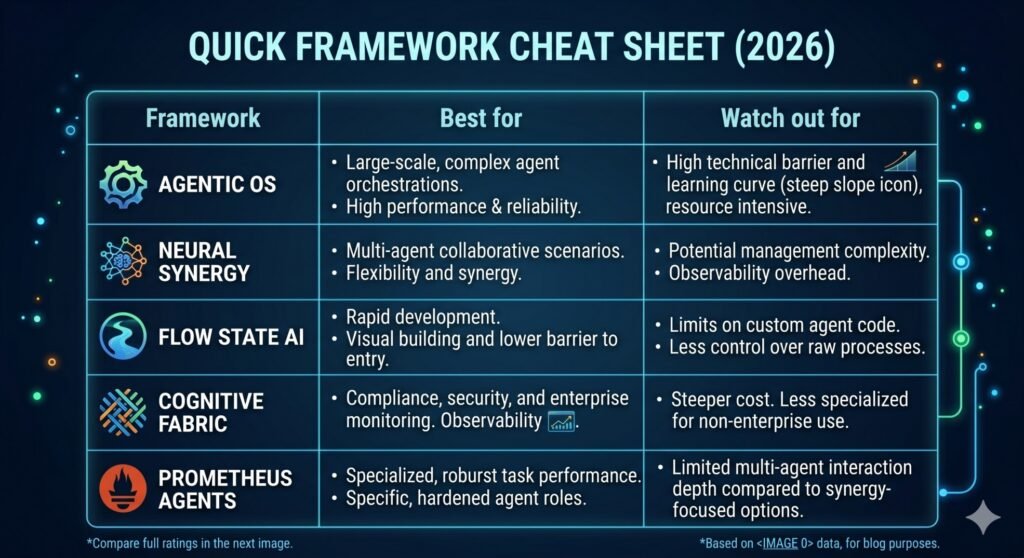
Feature-by-feature comparison (what actually affects outcomes)
AI Agent Frameworks Comparison 2026 (Best Picks)-Here’s the practical comparison I use when advising teams.
1) Workflow control: graphs vs chats vs roles
AI Agent Frameworks Comparison 2026 (Best Picks)–LangGraph models workflows as a graph: nodes are steps, edges control transitions. That’s great when you need loops, branching, and predictable control flow. 1
AutoGen leans into “agents chatting” to solve tasks, which can be very flexible—but also harder to bound. It’s excellent when multi-agent debate or refinement is core to the system. 5
CrewAI makes multi-agent feel like a small company org chart (writer, researcher, reviewer). It’s approachable, and for many teams, that readability is the whole point. 3
OpenAI Agents SDK pushes a more “model-native” harness with first-class concepts like handoffs and guardrails, and it’s designed to fit OpenAI model behavior closely. 2
2) State + reliability: can you resume work, or do you restart?
AI Agent Frameworks Comparison 2026 (Best Picks)-This is where the difference between a cool demo and a real product shows up.
LangGraph durable execution: LangGraph supports durable execution via persistence/checkpointing so you can resume a workflow from the last recorded step after interruptions (timeouts, crashes, human-in-the-loop pauses). 1
OpenAI Agents SDK checkpointing/snapshotting: OpenAI describes snapshotting + rehydration so an agent can restore state in a fresh container and continue from a checkpoint if an environment fails or expires. 2
Reality check: not all “checkpointing” is equal. Some platforms argue that naive checkpoints still fall short of true durable execution patterns in production. So treat “durable” as something to validate with chaos testing, not a marketing checkbox. 8
3) Observability: can you debug the weird stuff?
AI Agent Frameworks Comparison 2026 (Best Picks)-If you’ve ever asked, “Why did it call that tool six times?” you already care about observability.
OpenAI Agents SDK tracing records events during agent runs (LLM generations, tool calls, handoffs, guardrails, custom events) and supports a Traces dashboard for debugging and monitoring. 9
LangGraph commonly pairs with the LangChain ecosystem’s observability tooling, and the general pattern is: strong debugging matters more as your workflows become multi-step and multi-agent. 10
My blunt opinion: if you’re building anything beyond a toy, budget time for tracing/evals early. Otherwise, you’ll “debug” by re-running prompts and squinting at logs like it’s 1999.
Best framework by use case (my 2026 recommendations)
AI Agent Frameworks Comparison 2026 (Best Picks)-This is the section most people actually want when they search AI agent frameworks comparison 2026.
Best for complex, stateful business workflows: LangGraph
AI Agent Frameworks Comparison 2026 (Best Picks)-Pick LangGraph when your agent needs:
- branching logic (if/then)
- loops (retry, refine, escalate)
- human approvals mid-flow
- resumability after failures
LangGraph’s durable execution concept is explicitly designed for long-running and interrupted workflows, which is exactly what business automation becomes after week two. 1
Watch out for: ecosystem/security hygiene. There have been recent reports of high-severity vulnerabilities affecting LangChain/LangGraph components, so keep dependencies patched and treat tool permissions seriously. 11
Best for OpenAI-first production agents: OpenAI Agents SDK
AI Agent Frameworks Comparison 2026 (Best Picks)-Pick OpenAI Agents SDK if your team wants:
- built-in tracing and structured runs 9
- first-class handoffs between agents (triage → specialist) 12
- sandboxed long-running tasks with snapshotting/rehydration 2
This is especially attractive if your agent needs to touch files, run commands, or perform multi-step “computer-ish” work in a controlled environment (without you building that harness from scratch). 2
Trust note: OpenAI also notes that tracing may not be available for organizations using Zero Data Retention policies, so check constraints if you’re in regulated environments. 9
Best for role-based “agent teams”: CrewAI
AI Agent Frameworks Comparison 2026 (Best Picks)-Pick CrewAI when your system is naturally a set of roles:
- Researcher gathers sources
- Analyst extracts insights
- Writer drafts
- Editor checks tone/format
CrewAI’s documentation and role-driven mental model tends to help non-research engineers ship multi-agent pipelines faster. 3
Heads up: multi-agent systems introduce coordination failure modes (timeouts, deadlocks, cascading errors). If you go multi-agent, make sure you have timeouts, retries, and a “single-agent fallback mode.” Real users don’t care that your “crew” got stuck in a meeting.
Best for researchy multi-agent conversation patterns: AutoGen
AI Agent Frameworks Comparison 2026 (Best Picks)-Pick AutoGen if you’re exploring:
- multi-agent debates and self-critique
- tool-using assistants that coordinate via conversation
- research prototypes that may evolve quickly
Microsoft Research frames AutoGen as a framework to accelerate development and research on agentic AI. 5
Best use: when experimentation speed matters more than strict workflow control.
Best for agents over your data (RAG-heavy): LlamaIndex
AI Agent Frameworks Comparison 2026 (Best Picks)-Pick LlamaIndex when your agent’s “superpower” is working over documents, knowledge bases, and structured sources.
LlamaIndex positions itself as a framework for building LLM-powered agents over your data, and it offers agent abstractions alongside data ingestion/retrieval tooling. 13
A practical example: document parsing quality has become its own battleground in 2026, and there are benchmarks emerging that focus on parsing failures that matter to agents (not just text similarity). 14
My take: if your agent is “chat with policies/contracts/manuals,” LlamaIndex is often the fastest path to a strong baseline.
Best for Microsoft/.NET enterprise orchestration: Semantic Kernel
AI Agent Frameworks Comparison 2026 (Best Picks)-If you’re living in Azure, .NET, and “plugins everywhere,” Semantic Kernel is often a comfortable choice.
Microsoft’s Semantic Kernel guidance emphasizes function calling as the primary way to plan and execute tasks, and it even breaks down the function-calling loop the framework automates for you. 7
Also worth noting: Microsoft’s ecosystem has overlap between Semantic Kernel and agent orchestration approaches, especially in Microsoft 365 agent tooling. 15
The decision checklist I use (steal this)
AI Agent Frameworks Comparison 2026 (Best Picks)-When choosing from an AI agent frameworks comparison 2026 list, don’t ask “which is best?” Ask these:
- How long does the work run?
- Seconds/minutes → simple runner is fine
- 30+ minutes / human approvals → you’ll want durable execution + resuming 1
- How many tools?
- 1–3 tools → keep it simple
- 10+ tools → you’ll need guardrails, schemas, permissions, and tracing 9
- Do you need multi-agent for real?
Multi-agent can improve quality, but it adds coordination overhead. Many production apps do better with one strong agent + structured steps. 4 - Who will maintain it?
If future-you (or your teammate) can’t read it at 9 AM, it’s not “production-ready.”
Common pitfalls (and how to avoid facepalms)
Over-frameworking (the #1 silent killer)
It’s tempting to stack everything: framework + RAG + memory + agent router + tool registry + eval harness + “agent OS.”
Then it breaks, and nobody knows which layer did it.
A boring but effective approach:
- Start with raw tool calling
- Add retrieval only if needed
- Add multi-step orchestration only when you can’t express the workflow cleanly
- Add multi-agent only when one agent can’t do the job reliably
You’ll ship faster. And you’ll sleep more.
Treating “agents” as magic (they’re not)
Reliability usually comes from:
- timeouts + retries
- strict tool permissions
- state persistence
- fallbacks (including “ask a human”)
Frameworks help, but they don’t replace engineering.
Mini “best stack” recipes (practical combos)
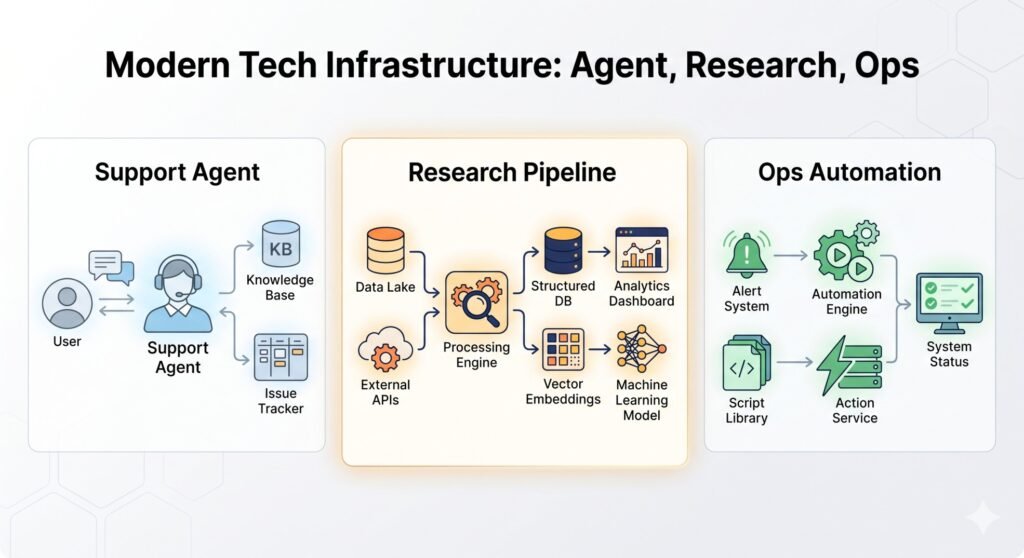
- Customer support agent (most common)
- Minimal orchestrator
- Retrieval (optional)
- Tool: ticket creation / CRM update
- Add tracing early (you’ll need it)
- Research + writing pipeline
- CrewAI for role clarity or LangGraph for control
- One agent gathers sources, one synthesizes, one edits
- Add strong citations rules and “source required” checks
- Long-running automation (ops/back office)
- LangGraph durable execution or OpenAI Agents SDK sandbox/checkpointing
- Human approval nodes
- Strict tool access and audit logs 1
FAQ: AI Agent Frameworks Comparison 2026
1) What is the best AI agent framework in 2026?
There isn’t one best overall. LangGraph is a strong pick for stateful workflows, while OpenAI Agents SDK is compelling for OpenAI-first production with tracing and sandboxed long-running tasks. 1
2) Do I need a framework to build an AI agent?
No. Many “agents” are just a tool-calling loop with retrieval. Frameworks help once you need orchestration, resumability, or serious debugging. 4
3) LangGraph vs CrewAI: which should I choose?
Choose LangGraph for precise workflow control (branching, loops, checkpoints). Choose CrewAI when role-based multi-agent collaboration is the clearest way to build and maintain your pipeline. 1
4) Is OpenAI Agents SDK production-ready for long tasks?
OpenAI describes snapshotting/rehydration and sandboxed execution aimed at long-horizon tasks, plus built-in tracing for monitoring. You should still validate behavior under restarts and partial tool failures in your environment. 2
5) What’s the best framework for “chat with my documents” agents?
Often LlamaIndex, because it’s designed around agents over data and has strong retrieval/document tooling. That said, if your workflow is complex, pairing retrieval with an orchestrator can make sense. 13
Conclusion: picking the right tool in this AI agent frameworks comparison 2026
If you take one thing from this AI agent frameworks comparison 2026, let it be this: your framework should match your failure modes.
- If your agent needs structured steps and resumability, LangGraph is a great fit. 1
- If you’re OpenAI-first and want tracing plus sandboxed long-running work, OpenAI Agents SDK is hard to ignore in 2026. 2
- If your product is truly multi-agent collaboration, CrewAI and AutoGen are worth serious consideration. 3
- If your agent lives and dies by documents and retrieval, LlamaIndex is often the fastest path to value. 13
Now I’d love to hear from you: which framework are you leaning toward, and what are you building?
If this post helped, share it with a teammate, and subscribe so you don’t miss the next deep-dive (I’m planning one on evals + tracing setups that actually catch multi-turn failures).