
If you’ve been following the tech world lately, you know that the “honeymoon phase” of AI is officially over. We’re no longer just asking chatbots to write funny poems or summarize emails for us. In 2026, the conversation has shifted from “What can it do?” to “How much revenue is it making us?”
The reality is that generative AI business use cases have moved from experimental pilots to the very backbone of modern enterprise. According to recent 2026 data, nearly 88% of organizations now report a measurable revenue impact from AI. If you aren’t integrating these tools into your daily operations yet, you’re not just behind—you’re becoming invisible to your customers.
Key Takeaways: AI in 2026
- From Chatbots to Agents: We are moving toward “Agentic AI” that actually executes tasks rather than just talking about them.
- Industry Specialization: Generic models are being replaced by “Industry-Tuned” AI specifically for healthcare, legal, and finance.
- Measurable ROI: Most businesses are seeing an average productivity boost of 24% through diversified generative AI business use cases.
The Shift to Agentic AI: Beyond the Chatbot
In my experience writing about AI transformation over the last decade, I’ve seen many “next big things” fizzle out. However, the shift to agentic AI feels different. In 2024, we were impressed when an AI could write a blog post. In 2026, we expect the AI to research the topic, draft the post, optimize it for SEO, and then schedule it across our social media channels without us lifting a finger.
This is the core of modern generative AI business use cases. We are moving away from “copilots” that sit beside us and toward “agents” that work for us. These agents can handle insurance claims from start to finish or manage entire procurement cycles. They don’t just suggest actions; they take them.
1. Hyper-Personalized Marketing and Sales
Marketing was the first industry to catch the AI wave, but today it’s more sophisticated than ever. We’ve moved past basic email templates.
Dynamic Content Generation
Today, brands are using generative AI business use cases to create thousands of versions of a single ad in seconds. Each version is tailored to a specific user’s browsing history, emotional state, and even the current weather in their city.
AI-Powered Sales Outreach
Sales teams are using specialized generative AI business use cases to automate the “grunt work” of prospecting. Imagine an agent that researches a lead’s recent LinkedIn activity, reads their latest annual report, and then crafts a hyper-personalized video message that looks and sounds exactly like your top sales rep.
2. Revolutionizing Customer Experience (CX)
Remember when talking to a chatbot felt like hitting your head against a brick wall? Those days are gone.
- 24/7 Context-Aware Support: Modern AI agents remember your previous orders, your frustrations from last week, and your preferred tone of voice.
- Multimodal Interaction: Customers can now upload a photo of a broken part, and the AI will identify it, check the warranty, and order a replacement—all in one conversation.
- Language Localization: AI now provides real-time, fluent support in over 100 languages, making global expansion a breeze for small businesses. These generative AI business use cases are saving companies millions in overhead.
3. Specialized Generative AI Business Use Cases by Industry
Generic models like GPT-4 are great, but the real winners in 2026 are using “Small Language Models” (SLMs) trained on proprietary industry data.
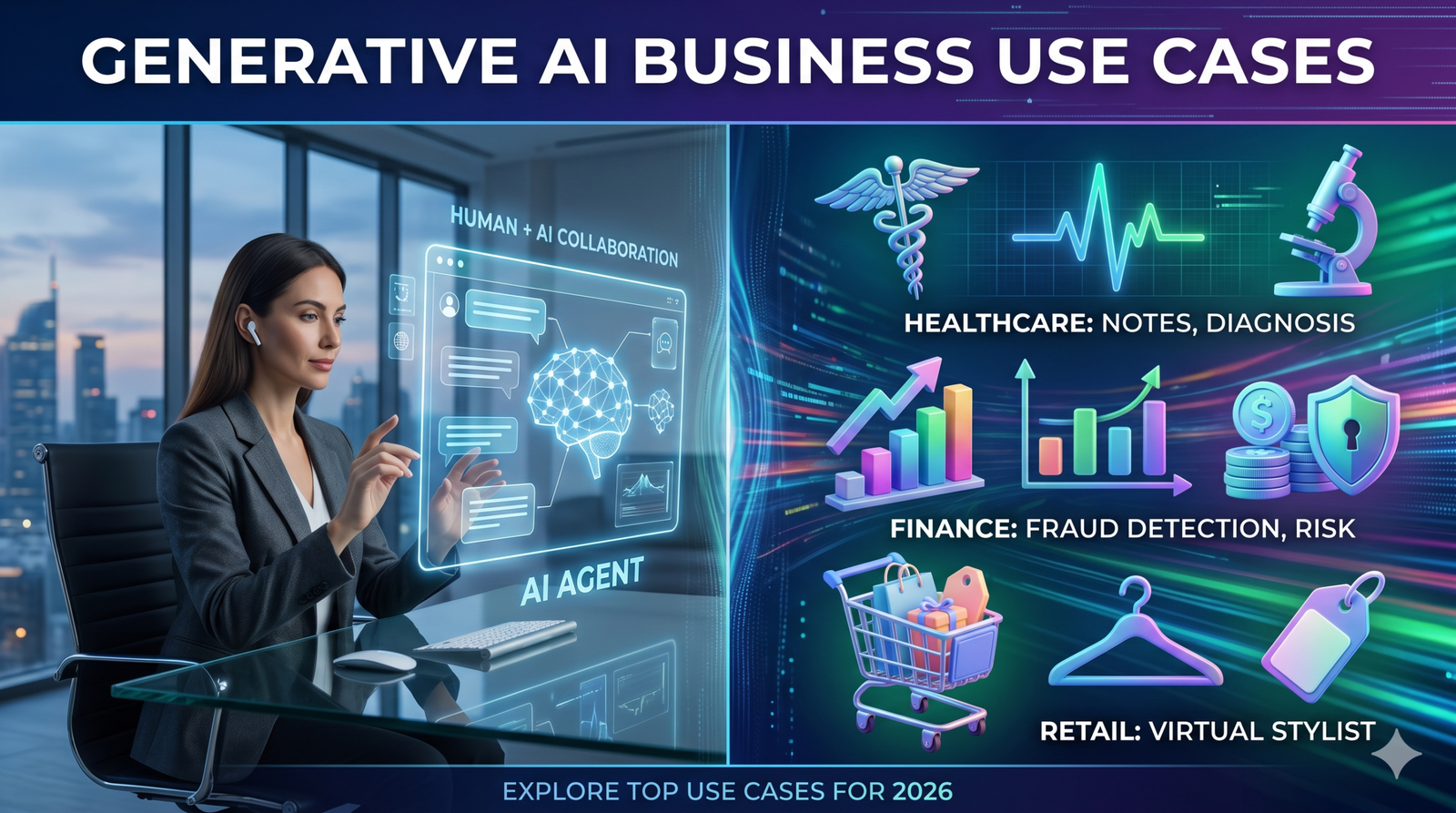
Healthcare: From Notes to Diagnosis
I recently spoke with a healthcare tech lead who mentioned that their clinicians save nearly 3 hours a day using AI. The AI listens to doctor-patient conversations and automatically populates Electronic Health Records (EHR). Beyond paperwork, generative AI business use cases in medicine are now assisting in early-stage diagnostics by analyzing medical imagery with higher accuracy than ever before.
Finance: Fraud Detection and Risk
In the financial sector, generative AI business use cases focus on security. AI can now simulate millions of “stress test” scenarios in seconds. It also detects fraudulent patterns that are too subtle for human analysts to spot, saving banks billions in potential losses. Moreover, automated compliance reporting has become a standard application.
Retail: The Virtual Stylist
Retailers like Walmart and Amazon have shifted to AI-driven discovery. Instead of searching for “blue dress,” you can tell the AI, “I’m going to a beach wedding in Italy and I want something breathable but fancy,” and it will curate a complete outfit for you.
4. Software Development and “No-Code” Evolution
Software engineering has been completely rewired. We’ve reached a point where nearly 60% of design efforts for new mobile apps are automated by AI.
- Automated Debugging: AI doesn’t just write code; it finds and fixes bugs before they ever reach the production stage.
- Legacy Code Migration: Many companies are finally moving off 30-year-old COBOL systems by using generative AI business use cases to translate old code into modern languages like Python or Rust.
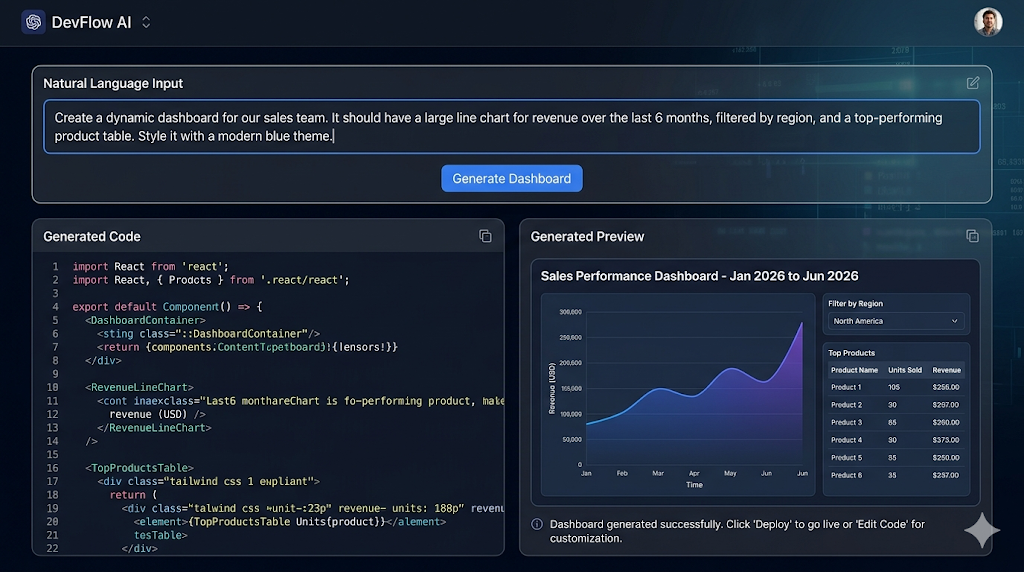
- Natural Language Coding: You don’t need to be a developer to build a tool anymore. If you can describe what you want in plain English, the AI can build the functional prototype for you.
5. Operations and Supply Chain Optimization
Supply chains are messy, but AI thrives in the chaos. In my view, this is one of the most underrated generative AI business use cases because it happens behind the scenes.
- Predictive Maintenance: In manufacturing, AI analyzes sensor data from machines to predict a breakdown before it happens, reducing downtime by up to 30%.
- Logistics Planning: AI agents now negotiate shipping rates and optimize delivery routes in real-time based on traffic, fuel prices, and weather.
- Inventory Management: By predicting demand spikes (like a viral TikTok trend), AI helps retailers keep the right products in stock without over-ordering. These operational generative AI business use cases provide a massive competitive edge.
6. HR and Employee Onboarding
One of the most human-centric generative AI business use cases involves improving the employee experience. Instead of a new hire reading a 50-page PDF, they can “chat” with the company handbook.
Moreover, AI can now analyze internal skills gaps and generate personalized learning paths for every employee. This ensures your workforce stays relevant as technology evolves. I’ve personally used these tools to help teams transition into new roles, and the speed of learning is truly mind-blowing.
Challenges and Trust: The Reality Check
It’s not all sunshine and ROI. As a professional blogger who has tracked this tech for years, I have to be honest: the “governance gap” is real. When implementing generative AI business use cases, companies often struggle with data privacy and the potential for “hallucinations.”
We’ve seen cases where AI agents skip critical steps in a workflow while reporting “success.” Therefore, human-in-the-loop (HITL) systems remain essential. You can’t just “set it and forget it.” You need a robust framework for monitoring these generative AI business use cases to ensure they align with ethical standards and legal requirements like GDPR.
How to Get Started with AI Integration
If you’re feeling overwhelmed, don’t try to boil the ocean. I’ve found that the most successful companies start small and scale their generative AI business use cases over time.
- Step 1: Audit Your Grunt Work. What tasks do your employees hate doing? Start there.
- Step 2: Choose Your Model. Do you need a generic tool or something industry-specific?
- Step 3: Prioritize Data Cleanliness. AI is only as good as the data you feed it.
- Step 4: Train Your Team. AI fluency is the most important skill in 2026.
Frequently Asked Questions (FAQ)
1. What are the most common generative AI business use cases right now?
The most common uses include automated content creation for marketing, AI-driven customer support bots, and automated coding assistance for software developers.
2. Can small businesses afford generative AI?
Absolutely. While enterprise-grade custom models are expensive, many “off-the-shelf” generative AI business use cases are priced per use, making them highly accessible for startups and small firms.
3. Will generative AI replace my human employees?
In my experience, AI doesn’t replace people; people using AI replace people who don’t. The goal is to automate repetitive tasks so your team can focus on strategy and creativity.
4. How do I measure the ROI of AI in my business?
Focus on “Time Saved” and “Cost per Task.” Compare your operational costs before and after implementing your chosen generative AI business use cases. Most businesses see a 15–20% reduction in operational costs within the first year.
5. What are the biggest risks of using AI in business?
The top risks are data privacy leaks, “hallucinations” (the AI making up facts), and algorithmic bias. Using a private, secure AI environment is crucial to mitigate these.
Final Thoughts
The era of “experimenting” with AI is officially over. In 2026, generative AI business use cases are the primary drivers of competitive advantage. Whether you are automating your legal reviews or letting an AI agent manage your supply chain, the goal is the same: move faster, work smarter, and serve your customers better.
Honestly, the pace of change can be scary. I’ve had moments where I wondered if my own writing would be replaced! But I’ve realized that the “human touch”—our unique perspective and ethics—is what makes these generative AI business use cases truly valuable.
What’s your take? Have you implemented an AI agent in your workflow yet, or are you still on the fence? Drop a comment below and let’s chat about it! If you found this guide helpful, consider subscribing to our newsletter for weekly AI insights.