
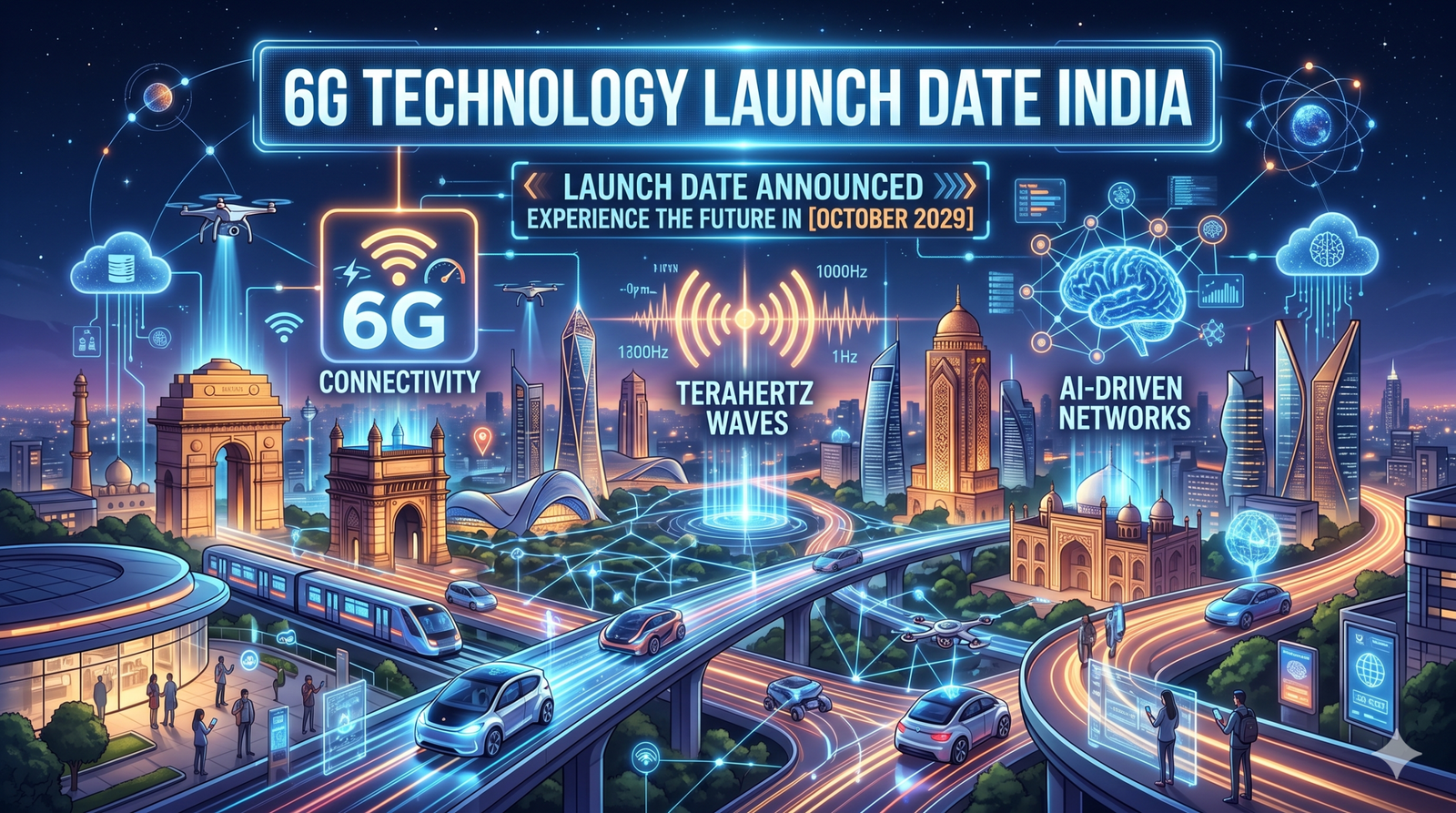
6G Technology Launch Date India: The Full Roadmap to 100x Faster Internet
If you thought 5G was fast, buckle up. While many of us are still getting used to the lightning speeds of 5G on our smartphones, the tech world is already buzzing about what comes next. The 6G technology launch date India is a topic that has moved from “science fiction” to a concrete government roadmap.
In my experience writing about telecommunications, I’ve seen India transform from a follower in 4G to a global leader in the 5G rollout. Now, the stakes are even higher. We aren’t just waiting for a new “G”—we are building it ourselves.
Quick Summary & Key Takeaways:
- Official Launch Window: Commercial 6G is expected in India by 2030, with pilot projects starting as early as 2027-2028.
- Speed: 6G will be up to 100 times faster than 5G, potentially reaching speeds of 1 Terabit per second (Tbps).
- The Bharat 6G Mission: India has already secured over 100+ patents and is actively participating in setting global 6G standards.
When is the 6G Technology Launch Date in India?
The question everyone is asking is: “When can I actually buy a 6G SIM card?” According to the official Bharat 6G Vision document released by the Department of Telecommunications (DoT), the 6G technology launch date India is set for 2030.
However, the journey starts much sooner. The government has divided the mission into two phases:
- Phase 1 (2023–2025): Focus on ideation, exploratory research, and proof-of-concept testing.
- Phase 2 (2025–2030): Creation of Intellectual Property (IP), commercialization, and the establishment of testbeds.
As of early 2026, we are officially in Phase 2. This means the transition from “lab research” to “real-world testing” is currently underway. While you won’t see 6G on your phone tomorrow, the infrastructure is being laid right now.
Why India is Racing Toward 6G
You might wonder why we are talking about 6G when 5G is still fresh. Honestly, I think it’s because the world realized how quickly India can adapt. We had the fastest 5G rollout in history, covering nearly every district in record time.
Moreover, the Indian government wants to ensure we aren’t just consumers this time. By aiming for a 6G technology launch date India around 2030, the country is positioning itself as a “supplier” of tech to the rest of the world.
The Bharat 6G Alliance
To make this happen, the Bharat 6G Alliance was formed. It’s a powerful group of startups, tech companies, and universities working together. I recently followed a report where the Union Minister of Communications reviewed their progress, noting that India has already greenlit over 100 research initiatives specifically for 6G.
6G vs 5G: What’s the Real Difference?
If 5G was about connecting people and “things” (IoT), 6G is about connecting the physical world with the digital and biological worlds.
1. Speed That Defies Logic
While 5G peaks at around 20 Gbps, 6G is targeting 1 Tbps. To put that in perspective, you could download 100 high-definition movies in a single second. It’s almost hard to wrap your head around!
2. Near-Zero Latency
Latency is that annoying lag you feel during a video call or online game. 5G brought it down to about 1-5 milliseconds. 6G aims to bring it down to under 1 millisecond. This is crucial for things like remote robotic surgery, where a surgeon in Delhi could operate on a patient in a rural village with zero delay.
3. Terahertz (THz) Frequencies
6G will use much higher frequencies than 5G. These “terahertz waves” allow for massive amounts of data to travel at once. However, they have a short range, which is why we’ll need new types of antennas and intelligent reflective surfaces to bounce signals around buildings.
Key Technologies Powering India’s 6G Future
It isn’t just about faster YouTube buffering. 6G involves some seriously cool “sci-fi” tech that will change our daily lives.
AI-Native Networks
In 6G, Artificial Intelligence isn’t just an add-on; it’s the brain of the network. The network will fix itself if it breaks and predict where it needs more signal before you even realize it.
Space-Terrestrial Integration
We’ve all been in “dead zones” where there’s no signal. 6G plans to fix this by integrating satellites with ground towers. This means you’ll have high-speed internet even in the middle of the Himalayas or the Indian Ocean.
Holographic Communication
Forget 2D Zoom calls. We are talking about 3D holograms that make it feel like the person you’re talking to is standing in the room with you. This sounds like a dream, but experts say it will be a primary use case for 6G.
Challenges on the Road to 2030
It’s not all sunshine and 1Tbps speeds. In my view, the biggest hurdle will be the cost of infrastructure. 6G requires a much denser network of “small cells” compared to 5G.
Furthermore, we need to solve the “tower fiberization” problem. For 6G to work, almost every tower in India needs to be connected by fiber optic cables. Currently, India is catching up, but there’s still a long way to go.
Another limitation is device compatibility. You’ll eventually need to buy a 6G-ready phone, which likely won’t hit the market until 2028 or 2029. So, don’t worry about your current 5G phone becoming obsolete just yet!
How 6G Will Transform Indian Industries
The 6G technology launch date India matters because it will change how we work and live.
- Agriculture: Farmers could use 6G-connected drones and sensors to monitor soil health in real-time, leading to much higher crop yields.
- Education: Students in remote villages could attend “holographic classrooms” led by the best teachers in the world.
- Healthcare: We are looking at a future with “Internet of Bio-Nano-Things,” where tiny sensors inside the body could alert doctors to health issues before symptoms even appear.
FAQ: Your Questions About 6G in India Answered
1. Is 6G available in India now?
No, 6G is not yet available. It is currently in the research and development phase. The expected commercial launch is 2030.
2. How much faster will 6G be than 5G?
6G is expected to be about 100 times faster than 5G, with theoretical peak speeds of 1 Terabit per second (Tbps).
3. Will I need a new SIM card for 6G?
Yes, 6G will require new hardware, including new SIM cards and 6G-compatible smartphones, similar to the transition from 4G to 5G.
4. Which Indian companies are working on 6G?
Major players like Reliance Jio and Bharti Airtel, along with the Bharat 6G Alliance and various IITs, are leading the R&D efforts.
5. Will 6G be expensive?
While initial rollout costs are high, the government’s goal through the Bharat 6G Mission is to keep services “affordable and accessible” for the general public.
Final Thoughts: A New Era of Connectivity
The 6G technology launch date India might feel far away, but the foundation is being built as you read this. From the Bharat 6G Alliance to the 100+ research projects currently underway, India is determined to lead the world into the next decade of connectivity.
Personally, I’m most excited about the “holographic” future. Imagine a world where distance truly doesn’t matter anymore! For now, keep enjoying your 5G, but keep an eye on the horizon—the 6G revolution is coming.
What do you think? Are you excited about 6G, or do you think 5G is enough for now? Let me know your thoughts in the comments below! Don’t forget to share this post with your tech-savvy friends.
This short video provides a quick visual overview of India’s journey from 5G to its ambitious 6G vision and the government’s strategic roadmap.