

Is Cyber Security Hard? A Brutally Honest Guide for 2026
If you’re staring at a screen full of scrolling green text and wondering if you need to be a math genius to enter this field, take a deep breath. You’re not alone. The most common question I get from aspiring techies is: is cyber security hard?
The short answer? It’s challenging, but it’s probably not “hard” for the reasons you think.
In my experience writing about digital defense for over a decade, I’ve seen people from all walks of life—from baristas to English teachers—successfully transition into this world. While the technical side looks intimidating, the real “difficulty” usually lies in the sheer volume of information rather than the complexity of a single task.
Key Takeaways:is cyber security hard
- It’s a marathon, not a sprint: You don’t need to know everything on day one.
- Soft skills matter: Problem-solving and curiosity are just as vital as coding.
- High Demand: With over 4.8 million unfilled roles globally in 2026, the industry is more welcoming to newcomers than ever.
Why People Think Cyber Security is Hard
The “hardness” of cyber security is often a matter of perception. If you walk into a room where everyone is talking about Zero Trust architecture or API data exfiltration, you’re going to feel lost.
However, much of the intimidation comes from Hollywood. Movies portray hackers as hooded figures who type at 200 words per minute to “bypass the mainframe.” In reality, a lot of the work is about following processes, analyzing patterns, and staying organized.
According to recent data from Research.com, cyber security is often ranked as a demanding major, but it typically falls below intense STEM fields like Physics or Electrical Engineering. It’s more about logical thinking than advanced calculus.
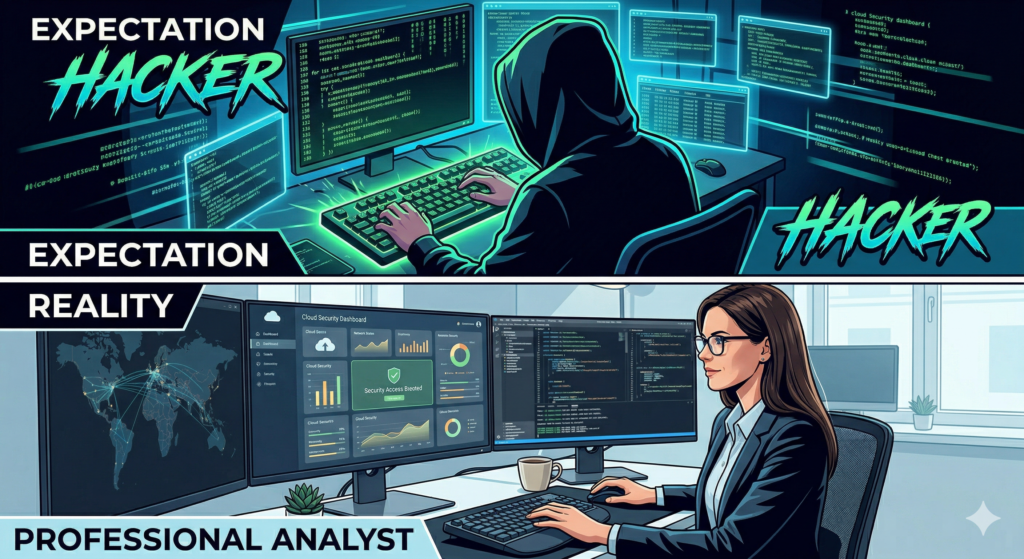
Is Cyber Security Hard to Learn for Beginners?
If you are starting from zero, the learning curve can feel steep. You aren’t just learning a tool; you’re learning how the entire internet works.
The Technical Foundation
To understand how to protect a system, you first have to understand how it functions. This means you’ll need to grasp:
- Networking Basics: How do computers talk to each other? (TCP/IP, DNS, and IP addressing).
- Operating Systems: You’ll likely need to get comfortable with the Linux command line.
- Cloud Infrastructure: In 2026, almost everything is in the cloud. Learning AWS or Azure isn’t optional anymore.
The “Mindset” Hurdle
Honestly, the hardest part for most of my students isn’t the code—it’s the adversarial mindset. You have to learn to look at a perfectly good piece of software and ask, “How could I break this?” That shift in perspective takes time to develop.
5 Factors That Make Cyber Security Challenging (And How to Beat Them)
While it’s accessible, I won’t lie to you: there are parts of this job that will test your patience. Therefore, knowing these challenges ahead of time is your best defense.
1. The Constant Evolution of Threats
In 2026, AI-powered attacks are the new norm. Hackers are using machine learning to find vulnerabilities faster than ever. As a result, you can never “finish” learning. The moment you master a tool, a new version or a new threat appears.
2. The Responsibility Weight
Knowing that you are the barrier between a company’s data and a ransomware gang can be stressful. About 44% of cyber pros report severe work-related stress. However, this is also what makes the job incredibly rewarding. You’re the digital bodyguard.
3. The “Information Overload”
There are hundreds of certifications (CompTIA Security+, CISSP, CEH). Beginners often get “analysis paralysis” trying to pick the right one.
Pro Tip: Start with the basics. Don’t worry about being a “Penetration Tester” until you understand how a basic network works.
4. Technical Breadth
You need to know a little bit about a lot of things. Scripting in Python, understanding SQL databases, and knowing how firewalls work—it’s a lot to juggle.
5. Breaking into the Industry
While there is a massive talent gap, 9 out of 10 hiring managers still prefer candidates with some IT experience. This means your first job might be in IT support or as a junior analyst. It’s a ladder, not an elevator.
How Long Does It Take to Become Job-Ready?
This is where the good news comes in. You don’t need a four-year degree to get started.
In the current 2026 landscape, many professionals are finding success through scenario-based learning. Instead of just reading books, they use virtual labs to practice real-world attacks. Experts at the U.S. Cybersecurity Institute suggest that with a focused plan, you can become job-ready for entry-level roles (like a SOC Analyst) in about 4 to 6 months.
Is Cyber Security Harder Than Coding?
This is a classic debate. Software engineering is about building things. Cyber security is about protecting (and sometimes breaking) those things.
- Coding requires deep knowledge of syntax and logic.
- Cyber Security requires a broad knowledge of systems and human behavior.
If you enjoy puzzles and investigating “why” something happened, security will feel easier for you. If you prefer building a product from scratch, coding might be your forte. Personally, I find security more exciting because no two days are the same. One day you’re dealing with a phishing scam; the next, you’re auditing a cloud configuration.
Common Myths About Cyber Security
Let’s clear the air on a few things that scare people away:
- “You need to be a math whiz.” False. Unless you’re going into high-level cryptography, basic logic is much more important than complex math.
- “You need a Computer Science degree.” Not anymore. Certifications and hands-on experience (like participating in “Capture the Flag” competitions) carry huge weight in 2026.
- “It’s only for introverts.” Actually, communication is a top skill. You have to explain risks to people who aren’t technical. If you can’t explain it, you can’t secure it.
Frequently Asked Questions (FAQ)
1. Can I learn cyber security with no experience?
Yes! Everyone starts at zero. Many entry-level roles prioritize your ability to learn and solve problems over your current technical stack. Start with the CompTIA Security+ curriculum to see if you enjoy the topics.
2. Does cyber security require coding?
You don’t need to be a “developer,” but you should understand basic scripting. Python and PowerShell are incredibly helpful for automating boring tasks.
3. Is cyber security a stressful job?
It can be, especially during a live incident. However, many roles (like Governance, Risk, and Compliance) are much more stable and follow a standard 9-to-5 schedule.
4. What is the hardest part of cyber security?
The hardest part is often staying updated. The field moves so fast that you have to be a lifelong learner. If you hate studying, this might not be the right path for you.
5. Is it too late to start a career in cyber security in 2026?
Absolutely not. With a global shortage of nearly 5 million workers, the industry is desperate for fresh talent and diverse perspectives.
Conclusion: So, Is Cyber Security Hard?
At the end of the day, is cyber security hard? It’s exactly as hard as any other high-value skill. It’s harder than a retail job, but it’s not as “impossible” as the media makes it out to be.
If you have a curious mind, a bit of grit, and a love for problem-solving, you’ll find that the “difficulty” is just a series of puzzles waiting to be solved. Moreover, the career stability and high salaries (often starting over $80,000 to $100,000) make the effort well worth it.
What do you think? Does the technical side of security scare you, or does the challenge excite you? Drop a comment below and let’s chat about your career goals!