Table of Contents
If you’ve stepped outside in a major city lately, you’ve probably seen them: cars with no one in the driver’s seat, or Teslas navigating complex turns while the “driver” just watches. It feels like we’re finally living in the future. But if you’re looking to ride in one or buy a car that drives itself, you might be wondering who actually wins the Tesla FSD vs Waymo comparison 2026.
In my experience writing about autonomous vehicle (AV) tech, the “winner” usually depends on what you need. Are you looking for a robotaxi to pick you up from a bar, or do you want your personal car to handle the commute?
Honestly, I remember the first time I sat in a Waymo in Phoenix. It was eerie how “human” the braking felt. Then, a week later, I tried Tesla’s FSD v13 on a rain-slicked road in Austin. Both are incredible, but they are built for completely different worlds.
Key Takeaways: Quick Summary
- Waymo is a true Level 4 autonomous service (no driver needed) but only works in specific cities like SF, Phoenix, LA, and Austin.
- Tesla FSD (Supervised) is a Level 2 system that works almost anywhere in North America but requires you to stay alert and take over if things get hairy.
- Safety Data: Waymo currently boasts a much lower accident rate per mile compared to human drivers, while Tesla is still scaling its “unsupervised” fleet.
1. The Technology: Cameras vs. The “Kitchen Sink”
One of the biggest parts of any Tesla FSD vs Waymo comparison 2026 is how these cars “see” the world.
Waymo uses what I call the “kitchen sink” approach. Their cars are bristling with sensors to ensure redundancy. They rely on high-performance LiDAR technology and radar to “see” in the dark and through fog.
- LiDAR: Lasers that create a 3D map of the surroundings.
- Radar: Great for seeing through fog or heavy rain.
- Cameras: High-res visuals for traffic lights and signs.
On the other side, we have Tesla. Elon Musk famously ditched radar and LiDAR years ago. Tesla uses Vision Only, relying on eight cameras and a massive AI “brain” trained on billions of miles of real-world driving data.
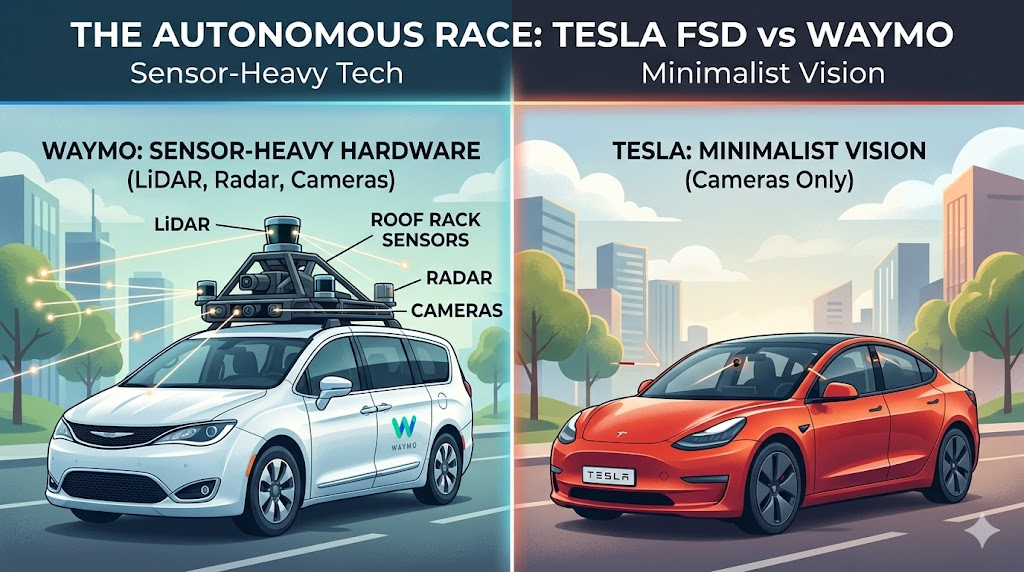
In my view, Tesla’s approach is more “human-like.” We don’t have lasers coming out of our eyes, right? However, Waymo’s extra sensors provide a safety net that cameras alone sometimes struggle with—especially in weird lighting or blinding glare.
2. Availability: Where Can You Actually Use Them?
This is where the two companies diverge the most.
Waymo’s Geo-Fenced Success
Waymo operates as a ride-hailing service (like Uber). As of early 2026, they’ve expanded to over 10 metro areas, including:
- San Francisco
- Phoenix
- Los Angeles
- Austin
- Atlanta
- Miami
Moreover, Waymo plans to hit 20 cities globally by the end of the year. The catch? You can’t buy a Waymo. You can only rent a ride in one.
Tesla’s “Drive Anywhere” Ambition
Tesla’s FSD (Supervised) works on almost any paved road in the U.S. and Canada. Whether you’re in a rural town in Ohio or downtown Manhattan, the software will try to navigate.
As a result, Tesla has a massive data advantage. They have over 4 million cars on the road sending data back to their supercomputers. Waymo’s fleet is much smaller (around 3,000 vehicles), but every mile they drive is “high quality” because the car is doing 100% of the work.
3. Safety and Liability: Who is Responsible?
This is the “million-dollar question”—literally.
- Waymo (Level 4): When you’re in a Waymo, the company is the driver. If the car crashes, Waymo is legally responsible. Their 2025-2026 data shows they have 92% fewer serious-injury crashes than humans. That’s a staggering stat.
- Tesla FSD Supervised (Level 2): You are still the driver. Even if the car is steering, you are legally responsible. Tesla has faced some heat for this, including a deceptive marketing ruling in California in late 2025.
However, Tesla is currently rolling out “Unsupervised FSD” for their new Cybercab fleet. In January 2026, Musk announced that driverless rides had finally begun in Austin. Early reports showed a few hiccups (about one incident every 55,000 miles), but the software is improving faster than ever thanks to the new v13.3 “end-to-end” neural networks.
4. The User Experience: What It’s Like to Ride
I’ve spent plenty of time in both, and the “vibe” is totally different.
Riding in a Waymo feels like riding in a very polite, slightly robotic chauffeur. It’s smooth, predictable, and—dare I say—a bit boring. But boring is good when you’re being driven by a computer! You can hop in the back, watch a movie, and totally forget there’s no one in the front seat.
Driving with Tesla FSD is more of a “co-pilot” experience. It’s exciting to see the car handle a complex roundabout or a narrow construction zone. But you still have to keep your hands near the wheel. It’s great for long road trips where you want to reduce fatigue, but it’s not yet a “take a nap” kind of system for most owners.
5. Cost: Subscription vs. Pay-per-Ride
How much does this future tech cost you?
| Feature | Tesla FSD (Supervised) | Waymo |
| Model | Ownership / Subscription | Ride-hailing (App-based) |
| Upfront Cost | ~$8,000 – $12,000 | $0 |
| Monthly/Per Use | ~$99/month subscription | Similar to Uber/Lyft prices |
| Availability | Available for purchase now | Limited to specific cities |
For many, the $99/month for Tesla FSD is a steal if you commute 40+ miles a day. But if you live in a dense city like San Francisco, paying $15 for a Waymo ride is often cheaper than owning a car at all.
6. The 2026 Verdict: Which is Better?
In this Tesla FSD vs Waymo comparison 2026, there isn’t one “better” system—there are just two different goals.
Choose Waymo if:
- You live in a supported city.
- You want to get from A to B without touching a steering wheel.
- You value the safety data provided by the official SAE Level 4 standards.
Choose Tesla FSD if:
- You want a car that can assist you anywhere in the country.
- You enjoy being part of a massive AI experiment.
- You want the convenience of autonomy in your own personal vehicle.
In my view, Waymo has won the “Robotaxi” battle for now, but Tesla is winning the “Scale” war. If Tesla can prove that their camera-only system is as safe as Waymo’s sensors, they could flip the script overnight.
3. Comparison Table
Tables are magnets for featured snippets. Add a table with the title: Tesla FSD vs Waymo Comparison 2026: Key Specs.
| Feature | Tesla FSD (Supervised) | Waymo Driver |
| Autonomy Level | SAE Level 2 | SAE Level 4 |
| Sensor Suite | Vision-Only (8 Cameras) | Sensor Fusion (LiDAR, Radar) |
| 2026 Tech Stack | Cortex Supercomputer / v13.3 | Google DeepMind Genie 3 |
| Operational Area | Everywhere (Unmapped) | Geofenced (HD Maps) |
FAQ: Common Questions About Tesla vs. Waymo
Is Tesla FSD fully autonomous yet?
As of early 2026, it is mostly “Supervised,” meaning a human must watch the road. However, “Unsupervised” versions are rolling out in limited areas like Austin for the Cybercab program.
Can I buy a Waymo car for my garage?
No. Waymo does not sell vehicles to the public. They only operate a ride-hailing fleet.
“Is the Tesla FSD vs Waymo comparison 2026 still relevant for city driving?”
Yes, Waymo’s sensor suite (specifically radar and LiDAR) allows it to operate in various weather conditions, though it may slow down during extreme storms for safety.
Which is safer: Tesla or Waymo?
Currently, Waymo has more published, third-party validated data showing they are safer than human drivers. Tesla’s safety is improving, but since humans often intervene, it’s harder to compare “apples to apples.”
Do I need an internet connection for these cars to work?
Both systems use onboard computers to make driving decisions, so they don’t need a constant connection to steer. However, they do need data for maps and software updates.
“Final Verdict: Tesla FSD vs Waymo Comparison 2026.”
The Tesla FSD vs Waymo comparison 2026 shows us that the road to full autonomy has two lanes. Waymo is taking the slow, steady, and ultra-safe route. Tesla is taking the fast, aggressive, and global route.
Both are changing the way we think about travel. In addition to saving lives, these technologies will eventually give us back hours of our time every week. Moreover, the competition between these two giants is only making the tech better for all of us.
What do you think? Would you trust a camera-only Tesla, or do you prefer the laser-guided Waymo? Let me know in the comments below! Don’t forget to subscribe for more deep dives into the world of AI and future tech.