
Digital Twin Technology Examples 2026: Top 10 Real Uses Transforming Industries
Quick Summary:
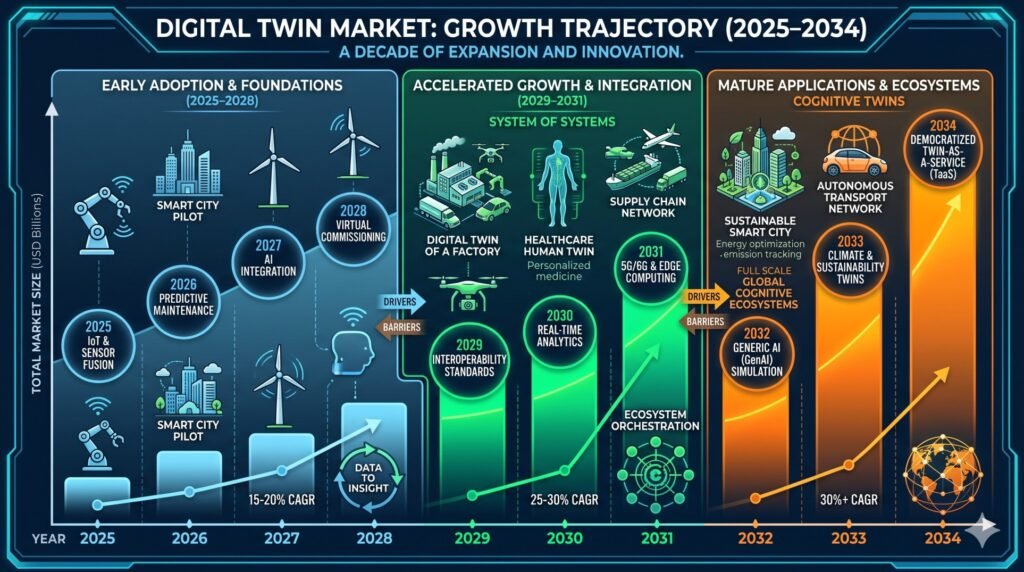
- The global digital twin market size is projected to grow from USD 33.97 billion in 2026 to USD 384.79 billion by 20341
- Major industries adopting digital twins include manufacturing, healthcare, automotive, smart cities, and telecommunications
- Companies using digital twins report measurable reductions in unplanned downtime (65%), improvements in asset utilization (62%), and faster decision-making cycles (90%)
Ever wondered what it would be like to test a heart surgery without touchiing the actual patient? Or simulate an entire city’s traffic flow before building a single road?
That’s exactly what digital twin technology makes possible in 2026. And honestly, I’ve been tracking this space for years—watching it evolve from a nerdy aerospace concept into something that’s genuinely changing how businesses operate across virtually every industry.
Digital twin technology examples are everywhere now. They’re helping doctors predict patient outcomes, enabling automakers to validate software before building cars, and even allowing telecom companies to design 6G networks in virtual environments.
Let’s dive into the most exciting applications transforming our world right now.
What Exactly Is a Digital Twin? (A Quick Refresher)
Digital Twin Technology Examples 2026: Top 10 Real Uses-Before we explore real-world examples, let’s make sure we’re on the same page.
A digital twin is a detailed, virtual replica of a real-world object, system or process. It can represent almost anything: a car, a factory, a city’s traffic network and even a human heart.
Think of it like this: imagine having a video game version of your car that knows everything about your actual vehicle—its mileage, tire pressure, engine performance, and maintenance history. When something’s about to break down, the digital version predicts it first.
Over the past few decades, digital twin technology has evolved into a highly versatile tool. Initially used in the aerospace industry, digital twins can now form the dynamic backbone of systems in manufacturing, healthcare, smart cities, and planetary-scale climate models.4
What makes 2026 different? By 2026, digital twin technology has reached a level of maturity, cost-effectiveness, and ubiquity that marks a qualitative shift in its role in industrial operations. The global market exceeds $73 billion.
Digital Twin Technology Examples in Manufacturing
Digital Twin Technology Examples 2026: Top 10 Real Uses-Manufacturing remains the powerhouse sector for digital twin adoption. And for good reason—the ROI is undeniable.
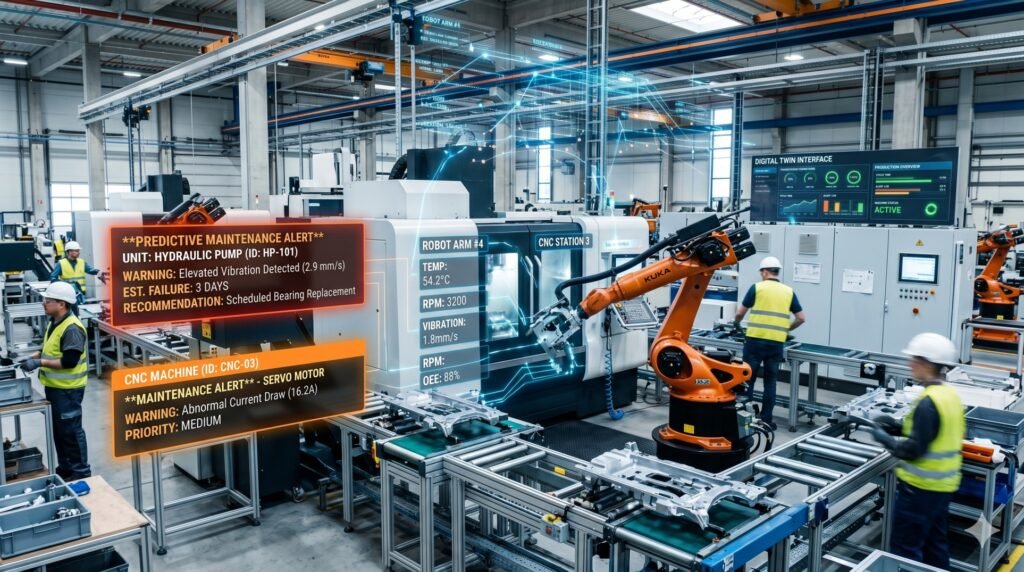
Digital twins are most widely used in the manufacturing industry. Manufacturing relies on high-cost equipment that generates a high volume of data which facilitates creating digital twins. This is why digital twins technology has become one of the essential production planning tools.
How Factories Are Using Digital Twins Today
In my experience writing about industrial technology, I’ve seen manufacturers achieve results that seemed impossible just five years ago:
- Predictive maintenance: By application, the predictive maintenance segment is expected to lead the market during the forecast period.1
- Process optimization: Real-time monitoring of production lines catches inefficiencies before they become costly problems
- Quality control: Virtual testing of products before physical manufacturing begins
The case for digital twin technology in manufacturing is not theoretical. It is built on thousands of documented deployments, billions of dollars in measured savings, and a competitive landscape that is increasingly divided between organizations that have made the transition to data-driven intelligence and those that have not.
Healthcare Digital Twins: Patient Care Revolution
Digital Twin Technology Examples 2026: Top 10 Real Uses-This is where things get really exciting—and honestly, a little mind-blowing.
Digital twin technology is revolutionizing healthcare systems by leveraging real-time data integration, advanced analytics, and virtual simulations to enhance patient care, enable predictive analytics, optimize clinical operations, and facilitate training and simulation. With the ability to gather and analyze a wealth of patient data from various sources, digital twins can offer personalized treatment plans based on individual characteristics, medical history, and real-time physiological data.
The FDA-Approved Virtual Heart
Digital Twin Technology Examples 2026: Top 10 Real Uses-Here’s a perfect example of digital twin technology in action:
Johns Hopkins University were pioneers when they created a digital twin technology with the first virtual heart model approved by the FDA. This specific digital twins healthcare model lets doctors run precise simulations of how a patient’s heart acts. It means doctors can customize treatments and predict patient outcomes with much better accuracy.
Orthopedic Surgery Planning
Although digital twin (DT) technology was introduced less than 25 years ago, it’s already opened the door to a wide range of healthcare applications, and that now includes orthopedic surgery. In November 2025, Hospital for Special Surgery (HSS) in New York City received a $10 million gift from Lauren and Robert Steers to develop the HSS Digital Twin Platform. This 4-year project is designed to advance orthopedic surgical care, focusing on a range of joints and diverse procedures.
A DT platform is, essentially, a virtual replica of a patient’s anatomy, created by software. DT helps to eliminate trial-and-error because physicians can monitor a patient’s “twin” in real time, then experiment with treatment strategies without traditional safety risks.
Clinical Trial Transformation
Here are a few high-impact use cases in 2026 that show real operational value: Streamlining Clinical Trials and Improving Inclusion: Pharma companies and academic medical centers are exploring “virtual clinical trials” using digital patient twins to speed up research and make trials more inclusive. With digital twins, researchers can simulate aspects of a trial in silico. For example, AI-driven disease models can generate a “virtual control group” of patient twins, allowing real patients to all receive the experimental treatment (fewer on placebo) and still have solid comparative data.10
Smart Cities: Singapore’s Virtual Singapore Platform
Digital Twin Technology Examples 2026: Top 10 Real Uses-If you want to see digital twin technology at its absolute peak, look at Singapore.
Singapore’s Virtual Singapore platform — a continuously updated 3D model of the entire city-state integrating real-time data from over 100,000 sensors — is the world’s most advanced example of a city twin. It is used for urban planning, emergency management, infrastructure maintenance optimization, environmental monitoring, and dozens of other applications that collectively save the city hundreds of millions of dollars annually.
What City Planners Can Do With Digital Twins
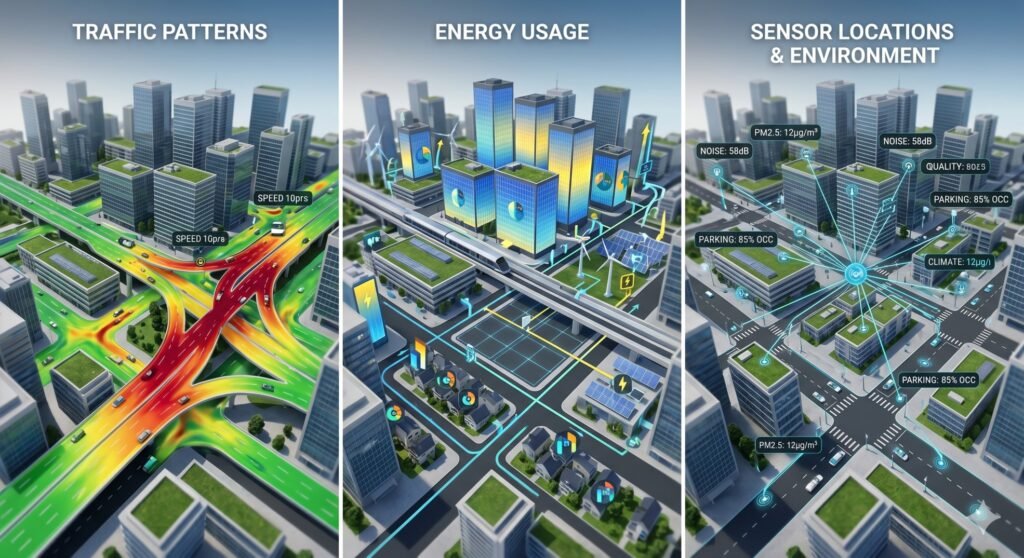
- Test traffic flow changes before implementing them
- Simulate emergency evacuations
- Optimize energy distribution across neighborhoods
- Plan new construction with real environmental impact data
Digital twins have the potential to improve everyday life and urban systems. NSF-supported researchers are developing “hybrid twins” that combine traffic simulations with real-time observations to optimize traffic flow, support city planners and coordinate traffic signals across multiple intersections to reduce congestion.3
I’ve personally seen demos of these systems, and they’re genuinely impressive. Imagine being able to predict how a new stadium will affect rush hour traffic—before you even break ground.
Automotive Industry: Transforming Vehicle Development
Digital Twin Technology Examples 2026: Top 10 Real Uses-The automotive sector is leveraging digital twins in ways that are fundamentally changing how cars are designed, tested, and manufactured.
AI, digital twins, and SDV architectures are becoming central to automotive resilience. As OEMs face growing regulatory, geopolitical, and margin pressures, tighter control over software, cybersecurity, and the supply chain is becoming essential.
Synopsys Electronics Digital Twin Platform
Synopsys launched an open platform to create, deploy, manage, and use electronics digital twins, establishing a new integrated and collaborative engineering paradigm across electronics, software, and systems. Initially focused on high-value automotive use cases, the platform enables OEMs to achieve up to 90% of software validation prior to hardware availability — significantly shrinking vehicle development cycles.
Think about that for a second. Car manufacturers can now validate nearly all their software before physical prototypes even exist. That’s a massive time and cost savings.
Developing new cars mostly takes place in a virtual setting. Digital Twins are used in the automobile industry to create the virtual model of a connected vehicle. Automotive companies use the technology to design the ideal automotive product even before production starts. They simulate and analyze the production phase and the problems that might occur once the vehicle hits the roads.
Telecommunications: Building 6G Networks Virtually
Digital Twin Technology Examples 2026: Top 10 Real Uses-Here’s something most people don’t realize: the telecom industry is using digital twins to build 6G networks that don’t physically exist yet.
The telecommunications sector is currently utilizing digital twins to accelerate the transition to 6G networks. Nokia has recently launched its “Nokia RAN Digital Twin,” built upon the NVIDIA Aerial Omniverse Digital Twin platform. This technology allows engineers to create physically accurate radio propagation environments, moving beyond traditional statistical approximations.
NVIDIA’s AODT Platform
Digital Twin Technology Examples 2026: Top 10 Real Uses-NVIDIA Aerial Omniverse Digital Twin (AODT) provides a modular, physics-accurate simulation environment for designing, training, and validating AI-native 6G networks before real-world deployment. Key industry partners including Nokia, Keysight Technologies, VIAVI Solutions, Ansys, and Amazon Web Services have integrated AODT into their solutions, enabling advanced RAN digital twins, deterministic channel modeling, scalable RAN testing, network-scale electromagnetic simulation, and cloud-based network experimentation. The AODT platform accelerates the development of autonomous, self-optimizing networks.
Earth-Scale Digital Twins: Climate Modeling
Digital Twin Technology Examples 2026: Top 10 Real Uses-This one still blows my mind. Scientists are literally creating digital twins of our entire planet.
One of the most ambitious applications of digital twin technology is taking shape on a planetary scale. Climate scientists and computational experts are collaborating on digital twin earth projects, creating replicas of Earth’s environmental systems and aiming to capture everything from the atmosphere and oceans to the biosphere. The vision is to create interactive Earth simulators that can run „what-if” scenarios for climate change and extreme events, providing policymakers with a powerful decision-support tool.
For example, a digital twin of the Earth could be used to simulate the impact of specific emissions reduction policies on future climate, or to virtually rehearse responses to a hypothetical hurricane before it strikes. Companies such as NVIDIA are developing an “Earth-2” simulation platform with the aim of mapping and forecasting the Earth’s complex processes.4
Real Estate and Building Operations
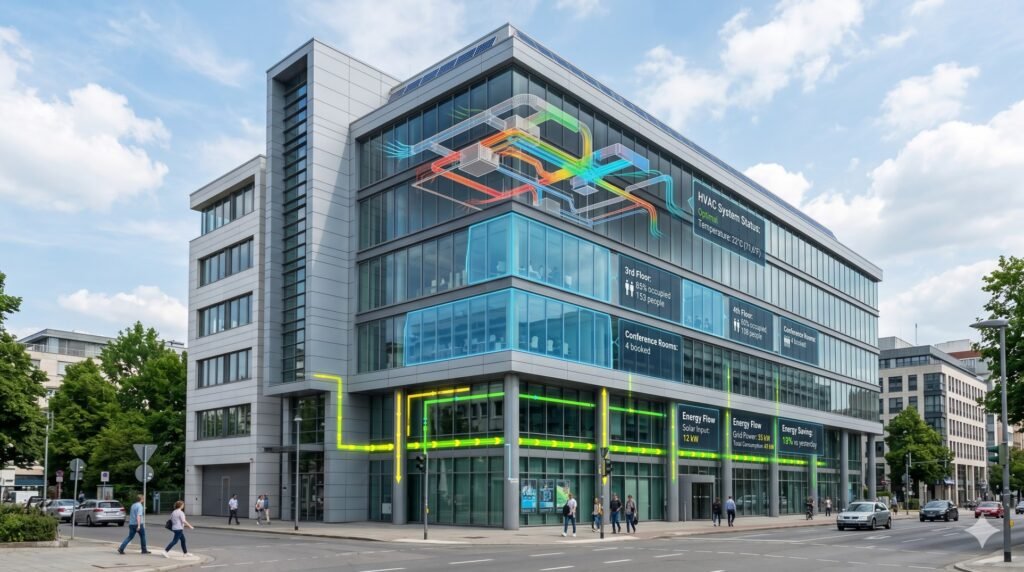
Digital Twin Technology Examples 2026: Top 10 Real Uses-In 2026 we’ll see the strongest operational adoption in sectors where buildings are either mission-critical or operationally complex. Think sectors such as higher education, healthcare, social housing or large CRE portfolios. These environments have all the drivers in play, such as ageing estates, constrained budgets, regulatory pressure, high occupant expectations and a strong need for performance transparency.15
The South African Space Agency Example
Digital Twin Technology Examples 2026: Top 10 Real Uses-The South African National Space Agency (SANSA) is responsible for advancing the nation’s space science and technology initiatives. To support its mission-critical operations in Hermanus, SANSA has implemented the Twinview Digital Twin platform, a unified, real-time solution that consolidates building and infrastructure data into a single intelligent system. By integrating live telemetry, asset data and facilities workflows, Twinview enables SANSA to shift from reactive maintenance to early warning, data-driven decision-making.15
The increased use of digital twins across construction and real estate is enabling property owners to lower energy consumption by up to 50% while reducing operating costs by 35%.2
Energy and Utilities
Digital Twin Technology Examples 2026: Top 10 Real Uses-The energy sector is seeing remarkable results from digital twin implementations.
In energy management, the rapid adoption is driving the electrical digital twin market toward USD 285.46 billion by 2033, reflecting a strong CAGR of 36.3% from 2026 to 2033. The primary driver of the electrical digital twin market is the urgent need to integrate renewable energy sources with the grid and manage the increased complexity caused by decentralized energy resources (DERs).
Siemens and Schneider Electric used digital twins in their energy management operations, which helped them improve AGV simulation accuracy by 10% and reduce 70% of the energy consumed by the ventilation system.
The Sensor Revolution Powering Digital Twins
Digital Twin Technology Examples 2026: Top 10 Real Uses-What’s making all this possible? The explosion of affordable, powerful sensors.
The sensing ecosystem available to digital twin implementers in 2026 is extraordinarily rich. Industrial IoT sensors covering every measurable physical variable — temperature, pressure, vibration, current, voltage, flow rate, torque, position, speed, acoustic emission, chemical composition, optical properties, and hundreds more — are available at costs ranging from a few dollars to a few hundred dollars per unit.
MEMS (Micro-Electro-Mechanical Systems) technology has miniaturized many sensor types to the point where they can be embedded in equipment with minimal installation impact. Energy harvesting technologies allow many sensors to operate indefinitely without battery replacement, harvesting energy from the equipment’s own vibration, heat, or electromagnetic fields.
Challenges and Limitations (Honest Take)
Digital Twin Technology Examples 2026: Top 10 Real Uses-I wouldn’t be doing my job if I didn’t mention the hurdles.
Digital twins involve the collection and processing of vast amounts of sensitive data. Concerns related to data privacy, security breaches, and unauthorized access pose significant challenges, especially in industries such as healthcare, government, and finance dealing with sensitive information. In addition, the absence of universal standards for physical twin technology can lead to interoperability challenges. Moreover, the lack of standardized practices may hinder collaboration between different systems, making it difficult to exchange and use digital replication data seamlessly.
Where I think the hype still exists is around the more extreme promises, like fully autonomous buildings or digital twins that can predict everything without proper data foundations. It’s not that those things won’t happen eventually; it’s just they’re not happening at scale in 2026.
FAQ: Digital Twin Technology Examples 2026
What is the biggest use case for digital twins in 2026?
Predictive maintenance holds the largest market in the digital twin market. Predictive maintenance offered by digital twins increases content productivity, enabling improved ongoing operations, maintenance, and other services. This virtual copy of a product allows for better communication and collaboration among organizations.
How much is the digital twin market worth in 2026?
In the year 2026, the industry size of digital twin is assessed at USD 31.83 billion.17 Different research firms estimate slightly different figures, but most agree the market is between $30-40 billion in 2026.
Which companies are leading digital twin technology?
Major companies operating in the digital twin market are Siemens AG, General Electric (GE Vernova), International Business Machines Corporation (IBM), Microsoft Corp (Azure Digital Twins), PTC Inc., Dassault Systèmes SE, Oracle Corporation, Ansys Inc., SAP SE, Rockwell Automation Inc.
Can digital twins be used for individual patients?
Yes! Digital twins are virtual models that replicate real-world objects or systems. In healthcare, digital twins can be virtual representations of organs, such as the heart or lungs, entire physiological systems, or even a patient’s full body. Unlike static computational models, digital twins dynamically integrate real-time data, such as from wearable sensors, to reflect the unique characteristics of a person.
What industries benefit most from digital twin technology?
This technology is increasingly adopted in various industries, such as manufacturing, healthcare, smart cities, aerospace & defense, and others.1 By end use, the telecommunication segment is expected to grow at the fastest CAGR from 2026 to 2033.
Conclusion: Digital Twin Technology Examples Are Just the Beginning
We’re living through a genuine transformation. Digital twin technology examples in 2026 showcase a market that has moved from experimental to essential.
More than 60 percent of Fortune 500 companies have active digital twin programs. The technology has moved from the exclusive domain of large, well-resourced corporations to become accessible to mid-market manufacturers, regional utilities, and municipal governments.
Whether you’re in healthcare looking to personalize patient care, manufacturing aiming to reduce downtime, or city planning trying to build smarter infrastructure—digital twins offer a path forward.
The growth in the forecast period can be attributed to integration of AI driven simulations, expansion of smart manufacturing, growth of infrastructure digitalization, adoption of 5g connectivity, rising demand for real time decision support.
What’s your experience with digital twin technology? Have you seen it implemented in your industry? Drop a comment below—I’d love to hear real-world stories from readers who are working with this technology.
And if you found this helpful, share it with your network. The more people understand what’s possible with digital twins, the faster we’ll see innovative applications emerge.