
QUICK KEY TAKEAWAYS 📌
- Post quantum cryptography is encryption designed to resist attacks from quantum computers—not just today’s computers
- Quantum computers will eventually break current encryption methods, making this tech critical for future security
- Migration to quantum-safe standards is already happening; governments and tech companies are preparing now
- You likely don’t need to worry personally yet, but understanding it helps you stay informed
INTRODUCTION
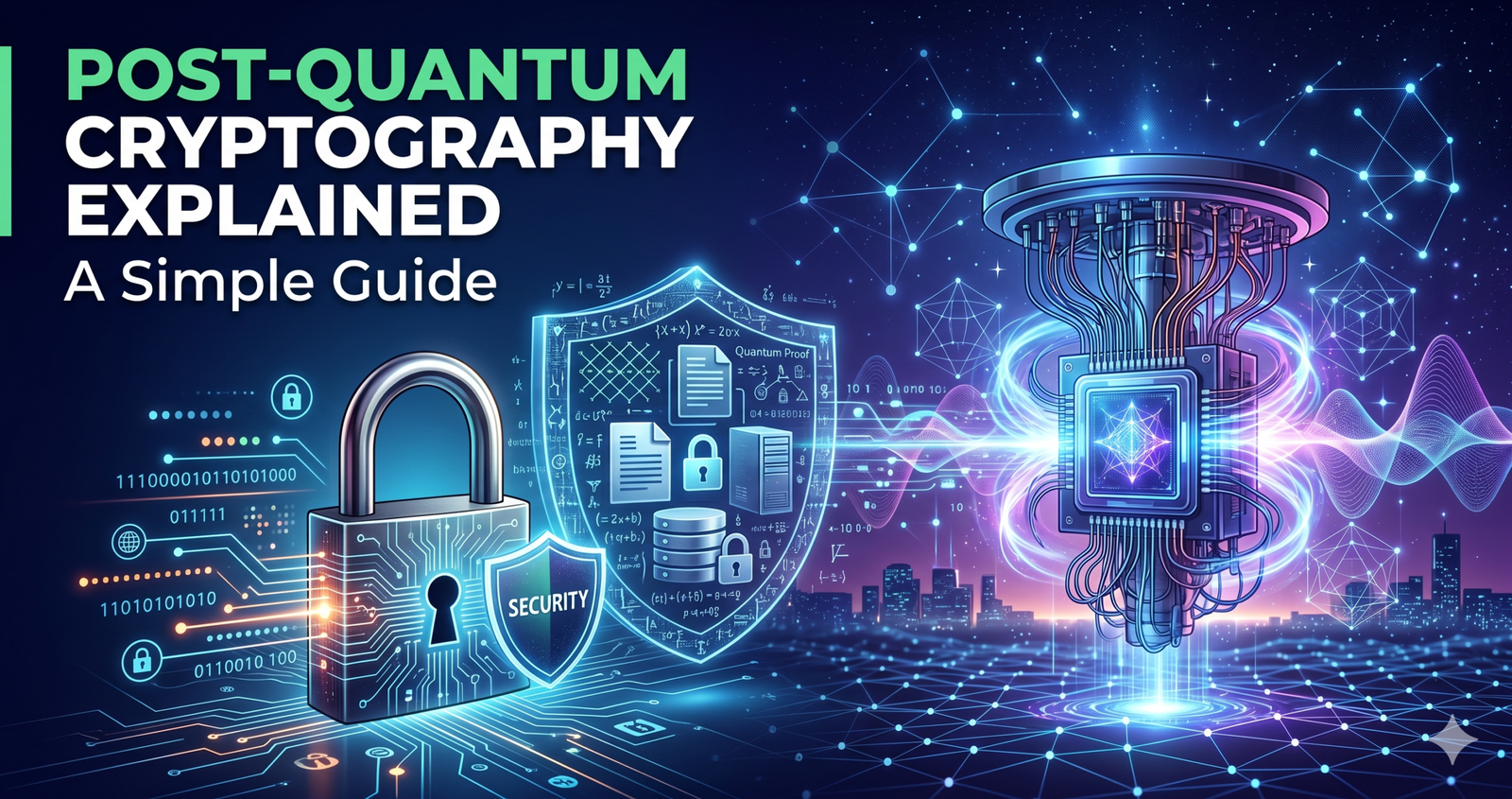
Post Quantum Cryptography Explained: A Simple Guide-Imagine locking your front door with a padlock that works perfectly today—but in 10 years, someone invents a key that opens it instantly. That’s essentially what’s happening with modern encryption and quantum computers. Post quantum cryptography explained is the solution to this looming problem, and honestly, it’s one of the most important conversations in cybersecurity right now.
If you’ve ever wondered why tech companies and governments are suddenly obsessed with “quantum-safe” security, you’re in the right place. I’ve spent considerable time researching this topic, and I’m going to break down what post quantum cryptography is, why it matters, and what you actually need to know about it—without the confusing jargon.
Post Quantum Cryptography Explained-What Is Post Quantum Cryptography?
Post quantum cryptography refers to encryption methods designed to withstand attacks from quantum computers. Think of it as “future-proofing” your digital security.
Today, we use encryption based on mathematical problems that are hard for regular computers to solve. For example, traditional encryption relies on the difficulty of factoring huge numbers or solving discrete logarithm problems. A standard computer would take thousands of years to break these codes through brute force.
However, quantum computers operate differently. They use quantum bits (qubits) instead of regular bits, which allows them to process multiple possibilities simultaneously. According to research from the National Institute of Standards and Technology (NIST), a sufficiently powerful quantum computer could crack most of today’s encryption in hours.
Post quantum cryptography doesn’t wait for that problem to happen. Instead, it usesmathematical problems that remain difficult even for quantum computers to solve. These include lattice-based cryptography, hash-based signatures, and multivariate polynomial equations.Why Should You Care About This?
You might be thinking, “Quantum computers don’t exist yet, so why worry?” Fair point. But here’s the catch: the threat is closer than you think.
Post Quantum Cryptography Explained-The “Harvest Now, Decrypt Later” Problem
Here’s something that keeps security experts up at night: attackers are already collecting encrypted data today, knowing they’ll be able to decrypt it once quantum computers become available. This is called “harvest now, decrypt later.” Your sensitive emails, financial records, and health information encrypted today could be vulnerable tomorrow.
Governments are taking this seriously. In 2022, the U.S. government issued a memorandum requiring federal agencies to transition to post quantum cryptography by 2035Similarly, according to the European Telecommunications Standards Institute (ETSI), Europe is actively developing quantum-resistant standards.
Industries Most at Risk
Healthcare, finance, government, and infrastructure sectors need long-term data protection. For example, patient records need to stay confidential for 50+ years. Military secrets protected today must remain classified for decades. In my experience writing about cybersecurity, these industries are where the urgency is highest.
How Does Post Quantum Cryptography Work?
Post quantum cryptography uses different mathematical approaches compared to traditional encryption. Let me walk you through the main types:
Lattice-Based Cryptography
Lattice-based systems are considered among the most promising. They’re based on the difficulty of finding the shortest vector in a high-dimensional lattice—a problem that remains hard even for quantum computers.
Think of a lattice as a grid in multi-dimensional space. Finding the shortest path through this grid is computationally difficult. This difficulty is what makes lattice-based encryption secure.
Why it matters: Lattice systems are fast, efficient, and can replace current encryption in many applications. NIST has already approved lattice-based algorithms as part of its post quantum cryptography standards.
Hash-Based Signatures
Hash functions create a unique fingerprint for data. Hash-based signatures use these fingerprints to verify identity and authenticity. Unlike other post quantum methods, hash-based cryptography has a proven track record—mathematicians have studied it for decades.
The trade-off? They can be slower and require more storage space than traditional signatures.
Multivariate Polynomial Cryptography
This method relies on solving systems of multivariate polynomial equations—essentially, solving multiple complex math problems simultaneously. Quantum computers struggle with this because the number of variables and equations makes the problem exponentially harder.
Post Quantum Cryptography Explained-The NIST Standards: What’s Being Approved?

In August 2022, the National Institute of Standards and Technology announced the first standardized post quantum cryptography algorithms. This was a watershed moment. Here’s what got approved:
For General Encryption:
- ML-KEM (formerly CRYSTALS-Kyber) — lattice-based key encapsulation mechanism
- ML-DSA (formerly CRYSTALS-Dilithium) — lattice-based digital signature
For Hash-Based Signatures:
- SLH-DSA (formerly SPHINCS+) — stateless hash-based signature
For Specialized Uses:
- Falcon — compact lattice-based signature algorithm
These aren’t theoretical anymore. They’re real, tested, and ready for deploymentTech companies and government agencies are already beginning integration.
Post Quantum Cryptography Explained-Timeline: When Will This Affect You?
Here’s a realistic timeline for post quantum cryptography adoption:
2024–2026: Government agencies and large enterprises begin pilot programs. Tech giants like Google, Microsoft, and Apple quietly integrate quantum-resistant algorithms into systems.
2027–2030: Broader adoption across financial services, healthcare, and critical infrastructure. You’ll likely hear more news about “quantum-safe” products and services.
2030–2035: Enterprise-wide migration accelerates. Legacy systems get updated or retired. This is the federal deadline in the U.S.
2035+: Most critical systems should be quantum-safe. Quantum computers powerful enough to break current encryption might become operational—though estimates vary widely.
For everyday users, don’t panic. Your email provider and banks will handle the technical transition. However, if you work in IT, cybersecurity, or critical infrastructure, now’s the time to start learning and planning.
Post Quantum Cryptography Explained-What Challenges Exist?
Post quantum cryptography isn’t a perfect solution—it comes with real challenges:
Size and Performance Issues
Post quantum algorithms often require larger key sizes and more computational power than traditional encryption. This means larger files, slower processing, and higher storagedemands. For some applications like IoT devices, this is a genuine problem.
Backward Compatibility
Moving to new encryption standards isn’t like flipping a switch. Legacy systems need to work alongside new ones during the transition period. This creates complexity and temporary vulnerabilities.
Standards Still Evolving
While NIST has approved initial standards, the field continues to evolve. New algorithms might be discovered. Better implementations will emerge. Organizations need to build flexibility into their systems.
Lack of Awareness
Honestly? Most people and small organizations don’t yet understand why this matters. Education is a major hurdle. That’s partly why I’m writing this—awareness is step one.What Can Organizations Do Now?
If you’re responsible for IT security or data protection, don’t wait until 2035:
Start with a Cryptographic Inventory
Document all encryption systems you currently use. Identify which ones need quantum-resistant replacements.
Monitor NIST Updates
The standards landscape is still evolving. Subscribe to NIST’s cryptography bulletins and stay informed.
Plan for Hybrid Approaches
Use both traditional and post quantum encryption together during transition periods. This provides security even if one method is compromised.
Test in Non-Critical Systems First
Implement post quantum cryptography in less critical applications to identify issues before rolling out enterprise-wide.
Train Your TeamYour IT team needs to understand post quantum cryptography concepts. Invest in training and certifications.
FAQ: Common Questions About Post Quantum Cryptography
Q1: Will quantum computers break all encryption immediately?
A: No. Only encryption methods based on certain mathematical problems (factoring, discrete logarithm) are vulnerable. Post quantum cryptography uses different math that remains secure.
Q: Do I need to change my password because of quantum computers?
A: Not because of quantum computers specifically. Your passwords are typically protected by hashing algorithms (like bcrypt), which are less vulnerable to quantum attacks than public-key encryption.
Q: Can I use post quantum cryptography today?
A: Yes. NIST-approved algorithms are available now. Some cloud providers and security vendors offer implementations. However, widespread adoption is still in early stages.
Q: Will post quantum cryptography make the internet slower?
A: Potentially, but minimally. Modern computers can handle the increased computational demands. Performance impact is expected to be negligible for most users.
Q: How do I know if my data provider uses post quantum cryptography?
A: Contact your service provider directly. Most major companies publish security transparency reports. Check their security documentation or privacy pages.
Q6: Is post quantum cryptography more expensive?
A: Initial implementation requires investment in new systems and training. However, the cost of a quantum-enabled breach would be far higher, making this a worthwhile investment.
CONCLUSION
Post quantum cryptography explained is essentially insurance against a future threat. Right now, quantum computers capable of breaking encryption don’t exist. But they’re coming, and the time to prepare is now, not when the crisis arrives.
Here’s my honest take: if you work in cybersecurity, government, finance, or healthcare, understanding post quantum cryptography is no longer optional—it’s essential. For everyone else, awareness matters. The sooner organizations migrate to quantum-safe encryption, the safer all of our data becomes.
The good news? Standards are established. Technology exists. The transition is happening. You’re not falling behind if you start learning about this now—you’re staying ahead.
What’s your next step? If you’re in IT, start by auditing your current encryption systems. If you’re just curious, share this with someone in your organization who handles security. And if you have questions about post quantum cryptography, drop them in the comments below—I’d love to discuss this further.