
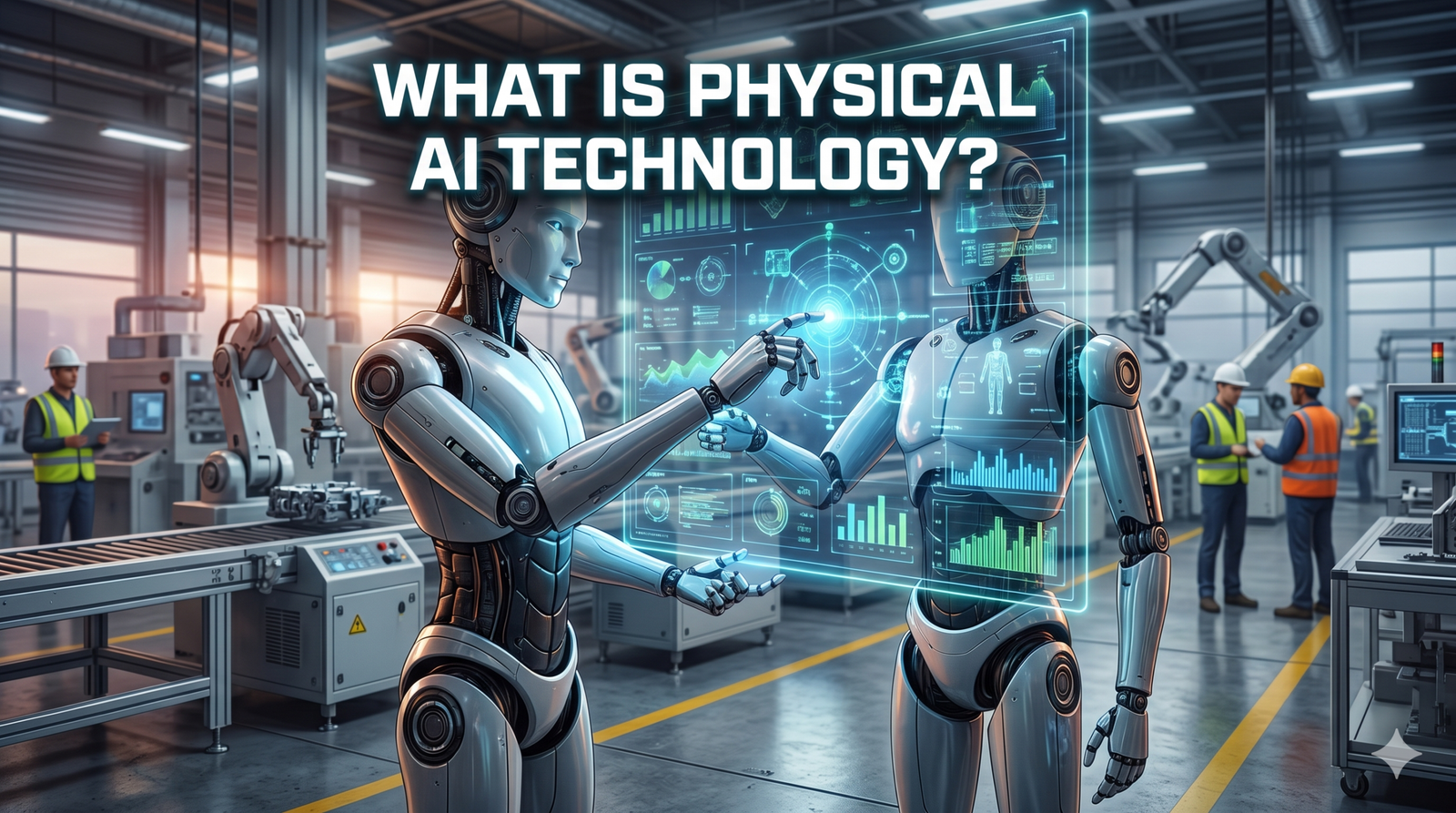
What Is Physical AI Technology? The Ultimate Business Guide for 2026
Be honest: when you hear “artificial intelligence,” you probably picture a chatbot or a content generator. Something that lives inside a screen. But what if AI could step off the screen and into the room with you? What if it could pick up a package, steer a vehicle, or assist a surgeon—all on its own?
That’s the promise of physical AI technology, and it is no longer a distant science-fiction concept. It was the biggest buzzword at CES 2026 for a reason.
In this guide, we’ll break down exactly what physical AI is, why it matters right now, and how businesses of every size can start thinking about it strategically.
Quick Summary: Key Takeaways-what is physical AI technology
- Definition: Physical AI refers to AI systems that don’t just process data but perceive, reason, and act in the real world—through robots, autonomous vehicles, and adaptive machines.
- Market Momentum: NVIDIA CEO Jensen Huang called it “the ChatGPT moment for robotics.” The market is moving fast.
- Business Impact: From manufacturing to healthcare, early adopters are already reporting dramatic efficiency gains.
So, What Is Physical AI Technology, Exactly?
Let’s start with the plain-English definition. Physical AI describes AI systems that move beyond generating text or images and instead interact directly with the physical world. Think robots that can see, think, and act. Think self-driving cars. Think warehouse machines that adapt on the fly.
As analysts at TechInformed put it, the term is essentially shorthand for the convergence of robotics, autonomous systems, simulation software, and edge computing. It describes efforts to extend artificial intelligence beyond screens and servers into machines that perceive, reason, and act in the physical world.
The key distinction from older robotics is profound. Traditional robots follow rigid, hard-coded rules. A physical AI system, by contrast, learns from its environment. Instead of programming a robot step-by-step to pick up an object, physical AI enables it to experiment, adjust, and refine its approach until it masters the task—resulting in far greater adaptability.
Why Physical AI Is Having Its Moment Right Now
what is physical AI technology-You might be wondering: why is everyone talking about physical AI now? The answer isn’t one big breakthrough; it’s the simultaneous convergence of several.
Three core enabling factors have matured at the same time, which analysts at Bank of America Research have labeled the “three Bs”:
- Brains: Cognitive AI, large language models, and vision-language-action (VLA) models that can connect perception, language, and decision-making.
- Brawn: Better, cheaper actuators and mechanical systems. Hardware costs have fallen roughly 30-fold over the past decade, from approximately $3 million per unit to around $100,000.
- Batteries: Energy storage technology that can power mobile robots in the real world.
Add to this the maturation of high-fidelity simulation platforms—where robots can be trained in virtual environments before ever touching the real world—and you have a perfect launchpad. Persistent labor shortages and the push to reshore manufacturing are providing the market demand to match.
5 Key Features That Define Modern Physical AI Systems-what is physical AI technology
If you’re evaluating this technology for your business, here’s what to look for under the hood:
1. Real-Time Perception and Sensing
Physical AI systems use cameras, lidar, and other sensors to understand their surroundings. They don’t just see—they interpret and react, moment to moment.
2. Vision-Language-Action (VLA) Models
This is the “brain” of modern physical AI. VLA models bridge language, vision, and action together, allowing a robot to receive a spoken instruction and execute a physical task in response.
3. Simulation-Based Training
Before being deployed in the real world, physical AI systems are trained inside photorealistic virtual environments. This makes development faster and safer. NVIDIA’s Cosmos world models, for example, generate synthetic training data at scale so robots can generalize across diverse environments.
4. Continuous Learning and Adaptation
Unlike traditional automation, physical AI systems improve through experience. Observability platforms monitor how robots behave in real-world deployment, turning unexpected edge cases into new training data that feeds back into the system.
5. Foundation Models for Robotics
Just as large language models serve as general-purpose AI brains for text, foundation models for robotics serve as deployable “robot brains” that companies can license and adapt, rather than building intelligence from scratch.
Real-World Examples: Who Is Using Physical AI Right Now?
what is physical AI technology-This is not lab-only territory. Physical AI is already producing measurable results across industries.
Manufacturing: In 2025, BMW’s Spartanburg plant deployed humanoid robots on its assembly line for loading sheet-metal parts, helping roll out 30,000 vehicles. Foxconn, the electronics manufacturer, has adopted AI-powered robots that have improved cycle times by 20–30% and lowered error rates by 25%, while cutting operational expenses by 15%.
Logistics: Amazon has deployed over a million robots across its 300 fulfillment centers. Orchestrating these systems has already led to faster delivery times, a 25% boost in efficiency, and a surprising 30% increase in skilled jobs at test sites.
Healthcare: Surgeons performed 2.68 million procedures using da Vinci robotic systems in 2024. At Yale New Haven Health, patients who underwent robotic surgery averaged just 1.5 days in hospital stays, compared with six days for open surgeries.
Agriculture: Physical AI-powered rovers are now helping farmers weed crops more sustainably using regenerative practices that reduce chemical use.
What Physical AI Means for Your Business Strategy
Here is where the rubber meets the road. Whether you run a factory or a healthcare clinic, physical AI is going to affect your competitive landscape. The question is whether you’re proactive or reactive.
For Large Enterprises: Deep integration is your priority. Invest in the intelligence layer first—data pipelines, simulation infrastructure, and AI governance structures—rather than rushing to buy hardware. EY analysts note that the intelligence layer matters more than the hardware itself, and value compounds when organizations integrate technologies across disciplines.
For Small and Mid-Size Businesses: Good news: physical AI is becoming more accessible. Platforms like Vention’s Machine Motion AI are specifically designed to help smaller manufacturers implement automation without the cost and complexity of traditional systems.
For All Leaders: Think of this as a multi-year capability build, not a one-off deployment. Physical AI is a transition, not a flip of a switch.
The Workforce Question: What Happens to Human Jobs?
It’s the question everyone is asking, and it deserves a direct answer. According to the World Economic Forum’s Future of Jobs 2025 report, robotics and autonomous systems will be major sources of job displacement. But displacement is not the same as disappearance—it is a transition.
Machine operators will become robot technicians. Logistics teams will coordinate mobile robot fleets. Maintenance teams will shift to predictive maintenance. Manufacturing engineers will focus on training and optimizing AI systems. The goal of a well-managed physical AI strategy is to free people from repetitive or hazardous tasks so they can perform more meaningful work.
The businesses that handle this transition well—investing in workforce development alongside their technology investment—will be the ones that come out ahead.
Overcoming the Challenges of Adopting Physical AI-what is physical AI technology
It isn’t all smooth sailing. Here are the hurdles to be aware of:
Upfront Cost: While hardware prices are falling rapidly, enterprise-level physical AI deployments still require significant capital investment. Starting with a focused pilot program in one department or facility is the smartest first step.
The Sim-to-Real Gap: Training a robot in a simulation and deploying it in a messy, unpredictable real environment is still one of the biggest technical challenges in the field. The best platforms are actively closing this gap, but it’s something to evaluate carefully.
Culture and Change Management: Your team needs to understand why these systems are being introduced. Transparency about the purpose and benefits is essential for adoption.
Governance and Oversight: Just as digital AI requires governance, physical AI requires safety frameworks. The stakes are higher when the machine is operating in the physical world alongside people.
Frequently Asked Questions (FAQ)
What is physical AI technology in simple terms?
Physical AI is artificial intelligence embedded in machines that can perceive their environment, make decisions, and take physical actions—such as robots, autonomous vehicles, and smart manufacturing equipment. It goes beyond AI that simply generates text or images.
How is physical AI different from regular robotics?
Traditional robots follow fixed, pre-programmed rules. Physical AI systems learn from their environment, adapt to new situations, and improve over time through experience—much like a person learning a new skill.
What industries are being most affected by physical AI?
Manufacturing, logistics, healthcare, agriculture, and transportation are seeing the earliest and most significant impact. However, as costs fall and capabilities improve, virtually every industry that involves physical processes will be affected.
Is physical AI only for large corporations?
Not anymore. While early deployments favored large enterprises, the market is rapidly democratizing. Accessible platforms are now targeting small and mid-size businesses, making entry-level physical AI automation increasingly affordable.
What is the role of simulation in physical AI?
Simulation is critical. It allows robots to be trained in photorealistic virtual environments at scale before deployment, which dramatically reduces development time and safety risks. High-fidelity simulation platforms have been a key enabler of the current wave of physical AI progress.
How does physical AI connect to humanoid robots?
Humanoid robots are one of the most visible applications of physical AI, but not the only one. Physical AI also powers industrial robot arms, autonomous mobile robots, drones, autonomous vehicles, and more. The humanoid form factor is compelling because it can operate in environments designed for humans.
Final Thoughts: The Physical World Is AI’s Next Frontier
So, what is physical AI technology, in the end? It is the answer to a simple but powerful question: what happens when AI stops being a tool you use and starts being a presence that acts?
We are living through the early chapters of this shift. The companies that take it seriously today—building the intelligence infrastructure, training their workforce, and adopting a responsible governance mindset—are the ones that will be best positioned for what comes next.
Don’t wait for a competitor to automate what you haven’t. Start small, run a pilot, keep humans in the loop, and scale thoughtfully.
What part of physical AI feels most relevant to your business right now? Drop a comment below—we’d love to hear where you’re starting from. And if you found this useful, share it with your operations lead. They’ll have questions.
Author Bio
I am a legal professional and tech enthusiast with over a decade of experience navigating the intersection of law and digital innovation. I’ve spent years helping businesses implement SEO-friendly content strategies while maintaining high standards for AI ethics and data integrity. My goal is to make complex technology feel simple and accessible for everyone.